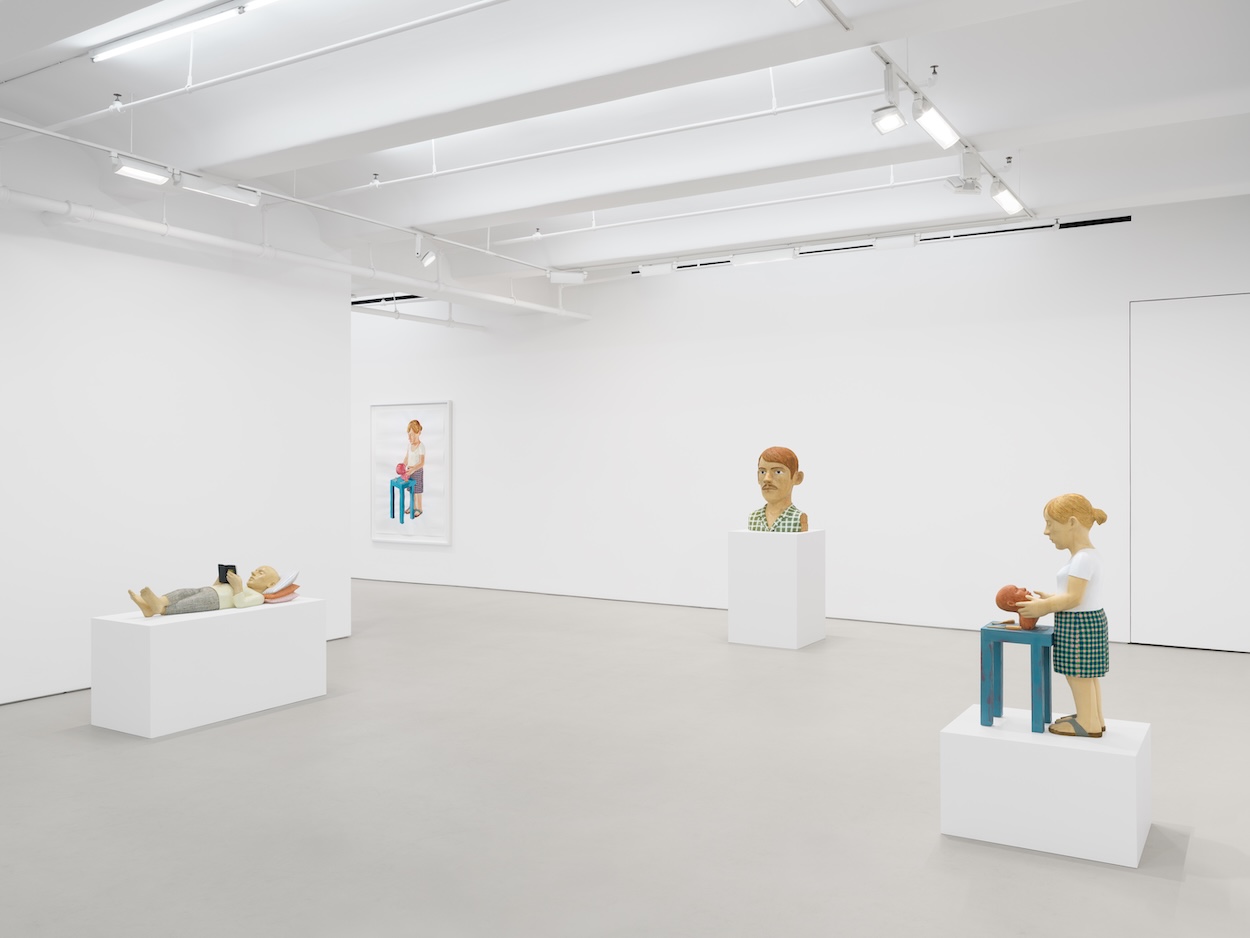
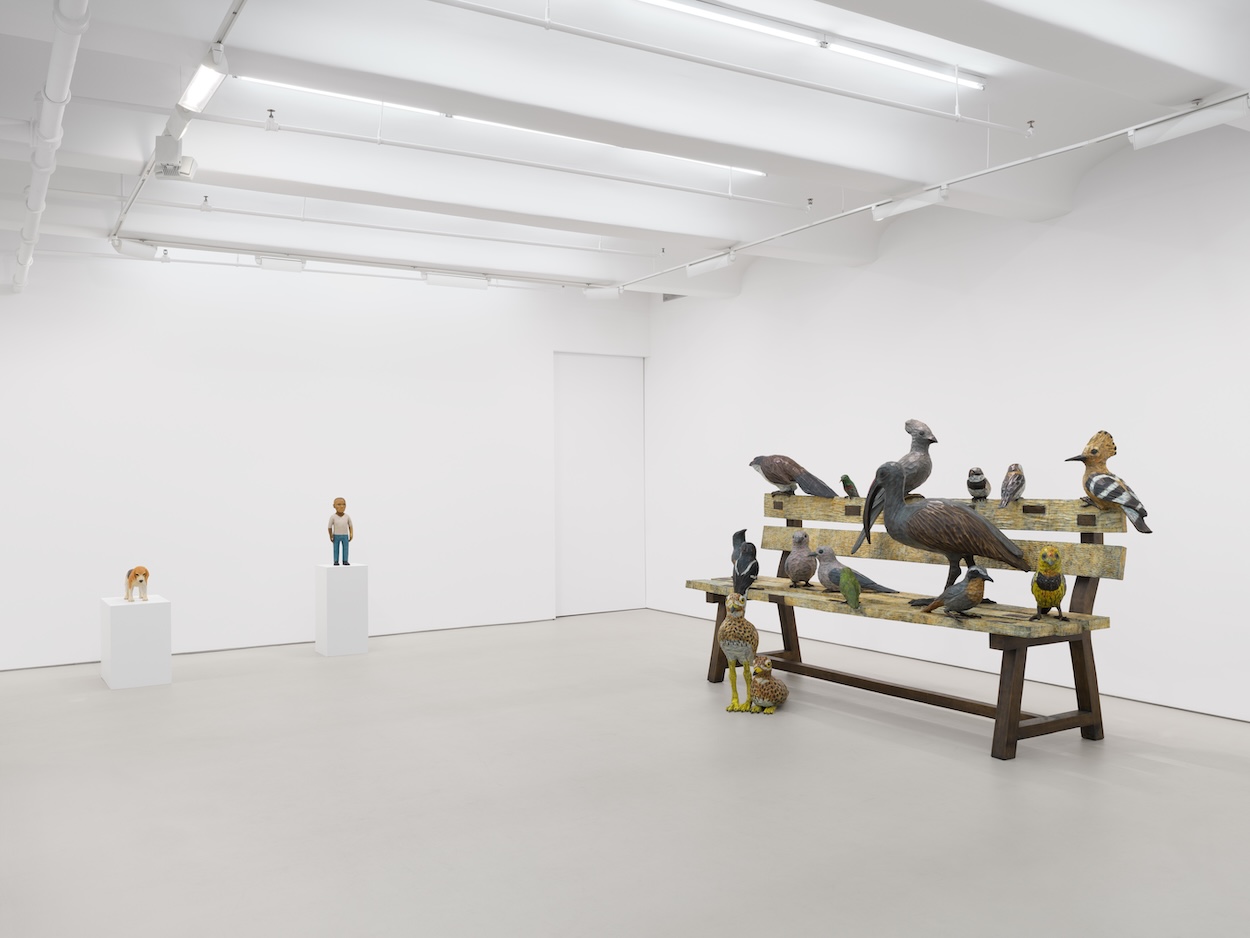
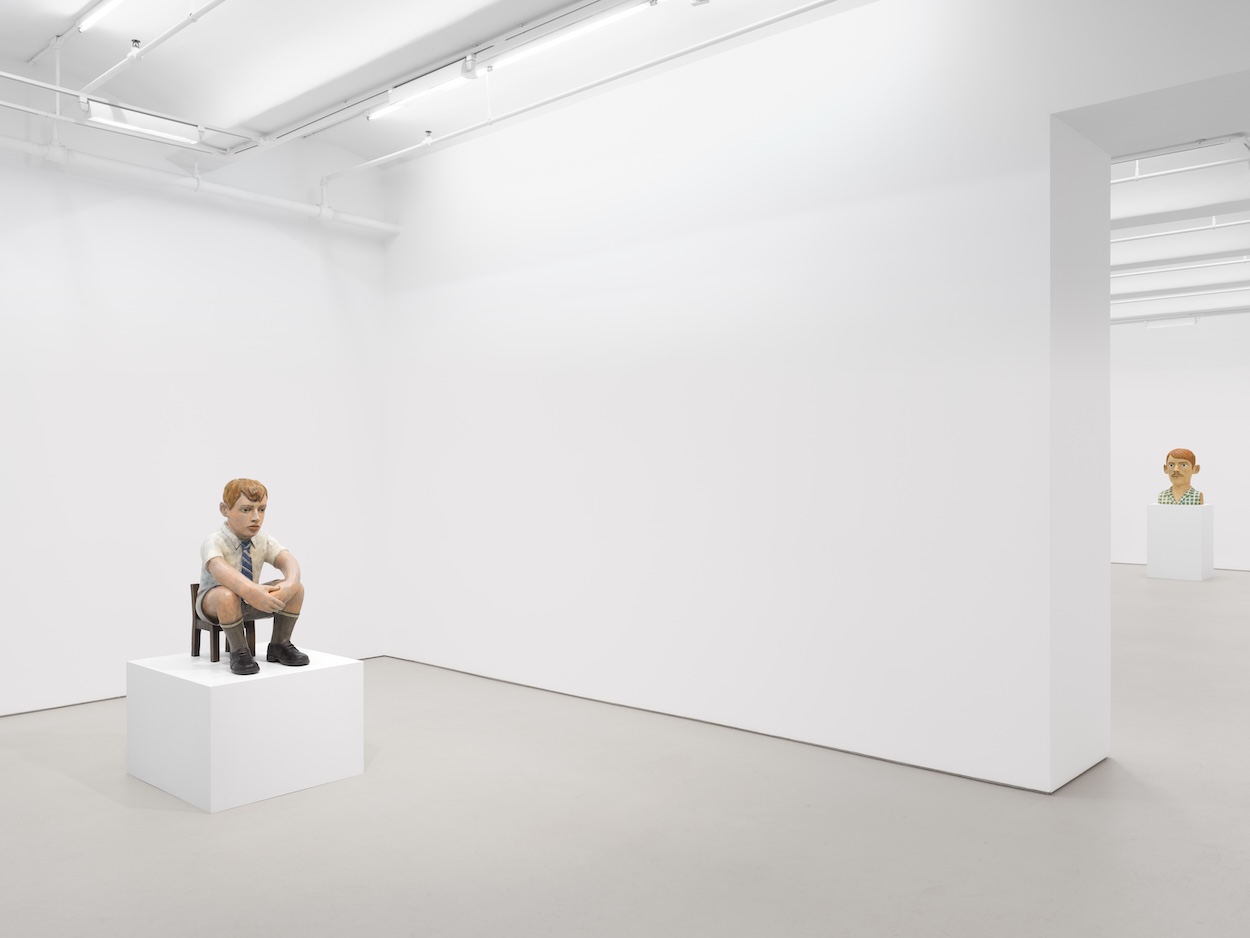
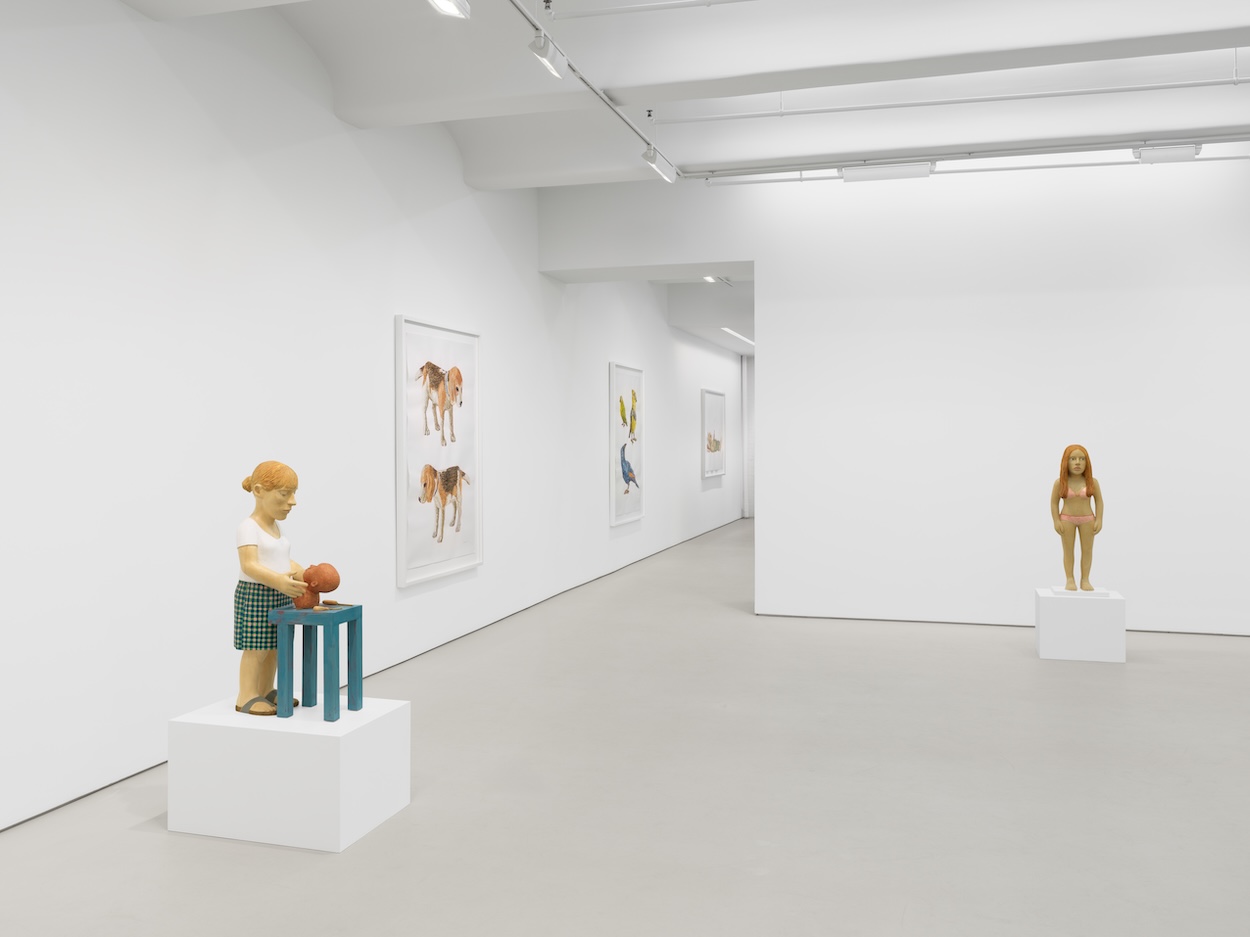
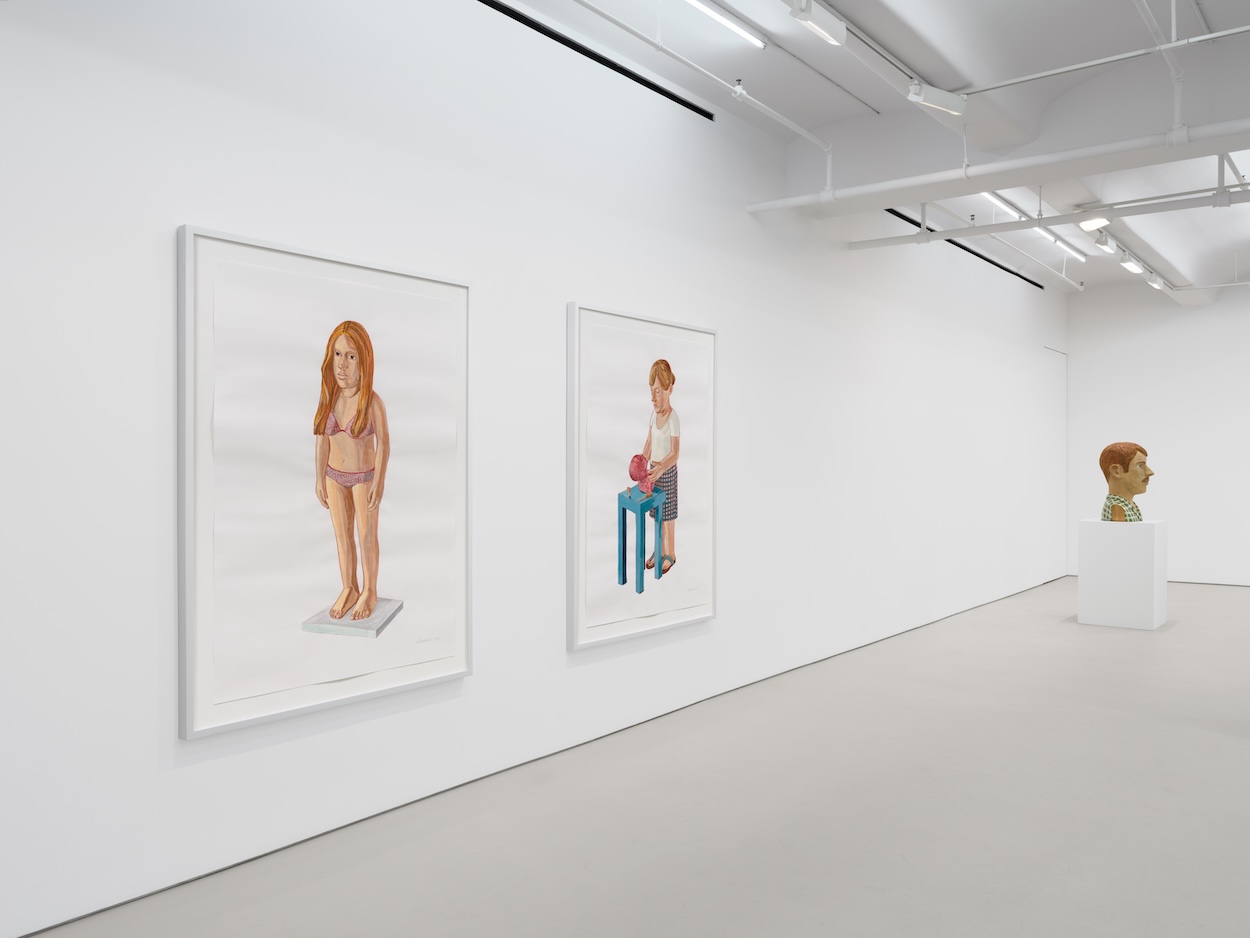
Within “Genesis,” South African artist Claudette Schreuders’ current exhibition at Jack Shainman Gallery in Chelsea, a tribute to the idyllic spirit of the suburbs comes to life in the form of figurative sculptures (and fluid acrylic and colored pencil works on Fabriano paper of the same subjects). The titular work, Genesis, depicts her partner, with his head upon three pillows and ankles crossed, reading Robert Crumb’s The Book of Genesis. From the recumbent position to the muted palette, the piece outlines the values of the show, as well as Schreuders’ nuanced, yet approachable style.
Over the last thirty years producing figurative sculptures, Schreuders’ understanding of the human form has deepened, allowing her to utilize certain attributes as means of expression. Her observations inform these new pieces, and the way she’s approached the portrayal of her subjects. “I tend to see the body of the sculpture as less important than the head, hands, and feet, which are the more expressive parts of the body,” the artist tells Surface.
As such, she addresses the body, primarily, as “the carrier of the head.” This influenced a change in her process. She now carves small maquettes and enlarges them. “Whereas in the past I would just start directly in the big block or log after making sketches,” she says. “The proportions of the figure changed slightly in the process.” This impacts viewer perception and invites interpretation, as well.
This is Schreuders’ eighth solo exhibition at Jack Shainman Gallery. “I enjoyed being back in the gallery where I first exhibited at 27 years old. It’s precious to have had such a long-standing working relationship with them,” she says. Schreuders notes that this body of work stands out as being uniquely enjoyable to her and underpinned by autonomy. “I decided not to care about how the work would be received, because there’s just no way to control an audience’s response. These are the sculptures I wanted to make. I really enjoyed the sense of freedom that this approach offered me.”
For her sculptures, Schreuders shifts between Camphor and Jelutong wood, as well as bronze. Each provides its own creative constraints and possibilities. “I like the limits that working in wood brings to my process,” she says. “The two bronze sculptures were also first realized as wood maquettes. The maquettes were enlarged in plastic that was covered in clay that I then carved into again. The complex shapes of School and Crucible dictated that they should be in bronze, also the fact that they should be able to be permanently installed outside.”
“Jelutong is softer and can be worked in once it is completely kiln dried,” she continues. “I build the shapes I want to carve in from thick Jelutong planks that I laminate together. The Camphor wood sculpture is carved from a log that came from a dead tree on the slopes of Table Mountain. I tried to keep the shape of the sculpture as close to the shape of the log it came from—that’s why I decided I would make the head, Pa, a solid and simple shape from the log.”
There is such subtlety to Schreuders’ work—beneath an illusion of simplicity that acts as an invitation to viewers. “I have stacks of drawings that my daughter made when she first started drawing, highlighting the people that surrounded her daily. This theme seems to come most naturally to children. With ‘Genesis’ I tried to be as free and unmediated in my decision as children are,” she explains. This can be felt through each piece.