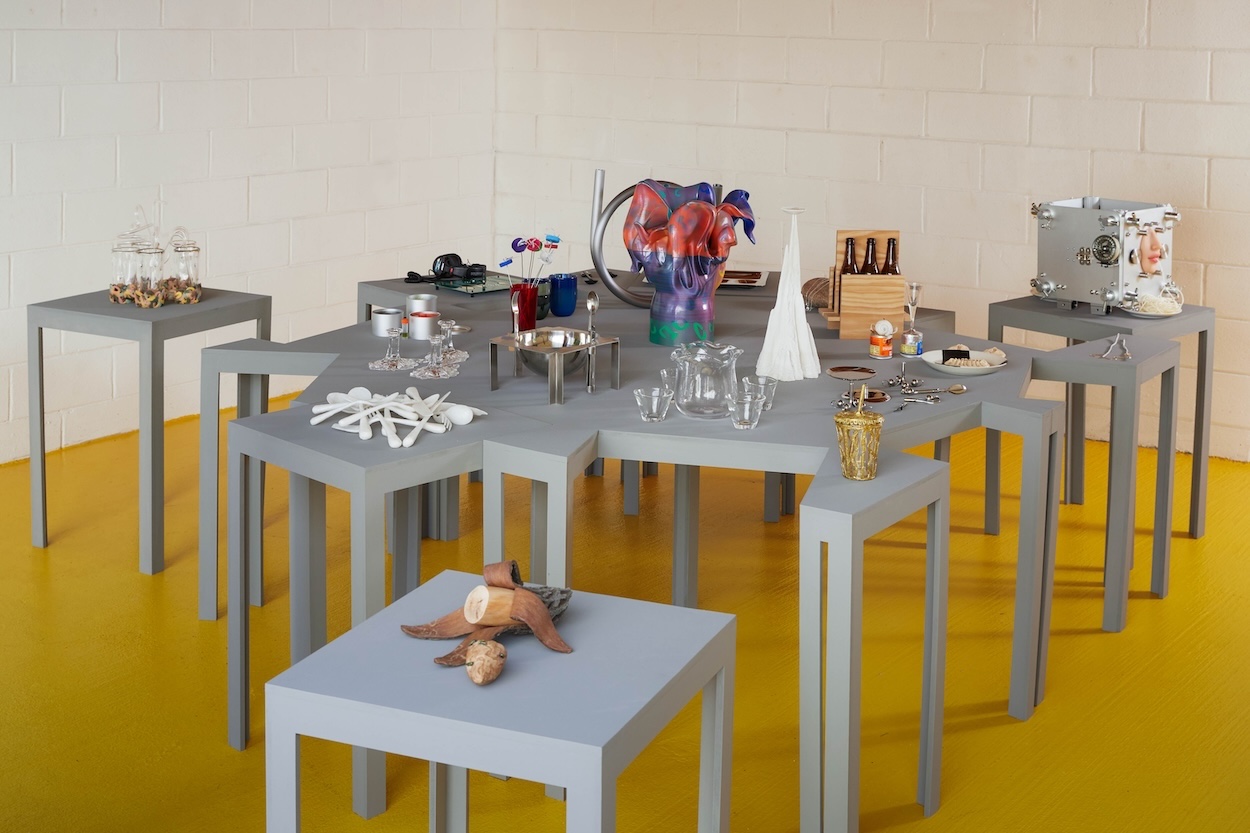
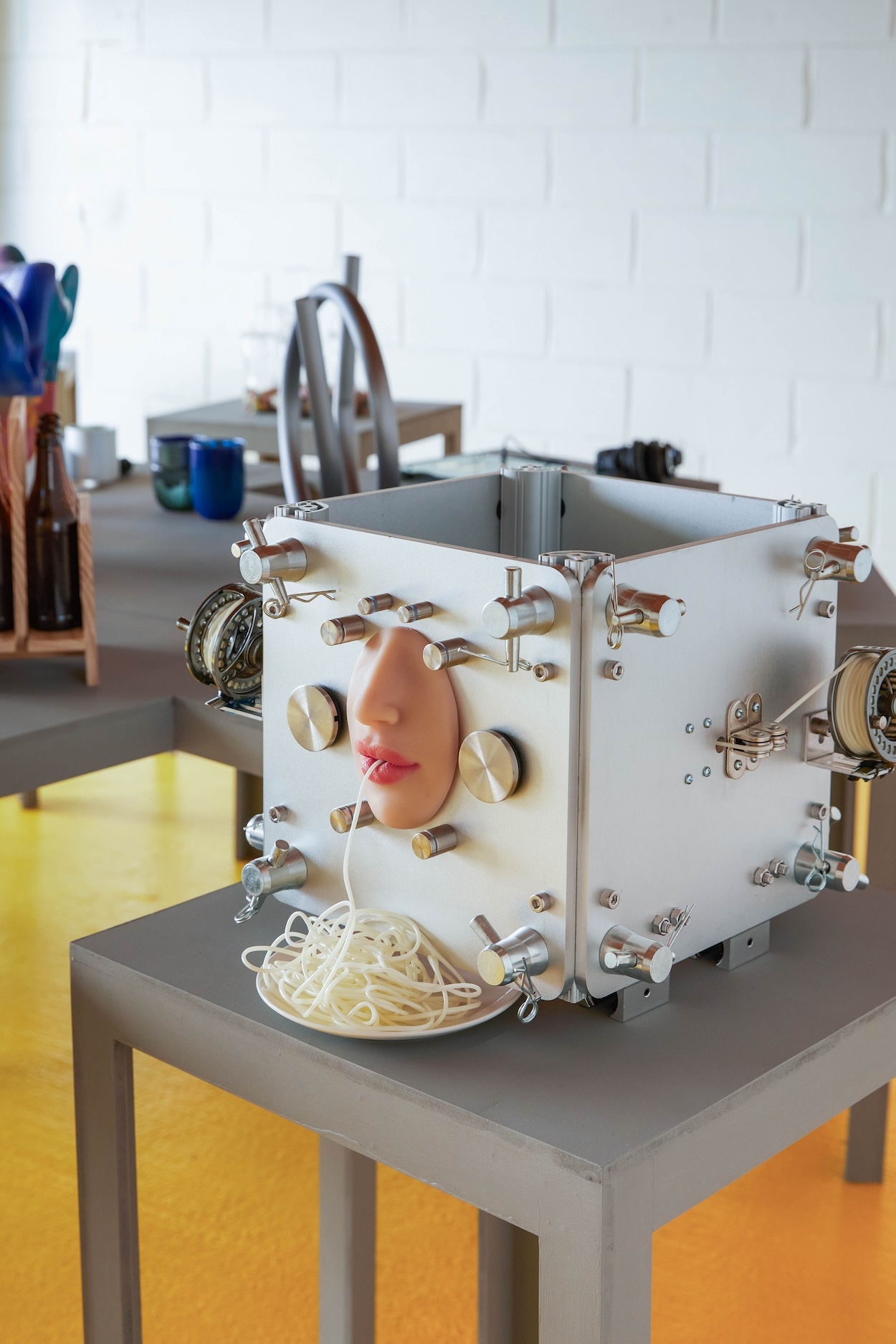
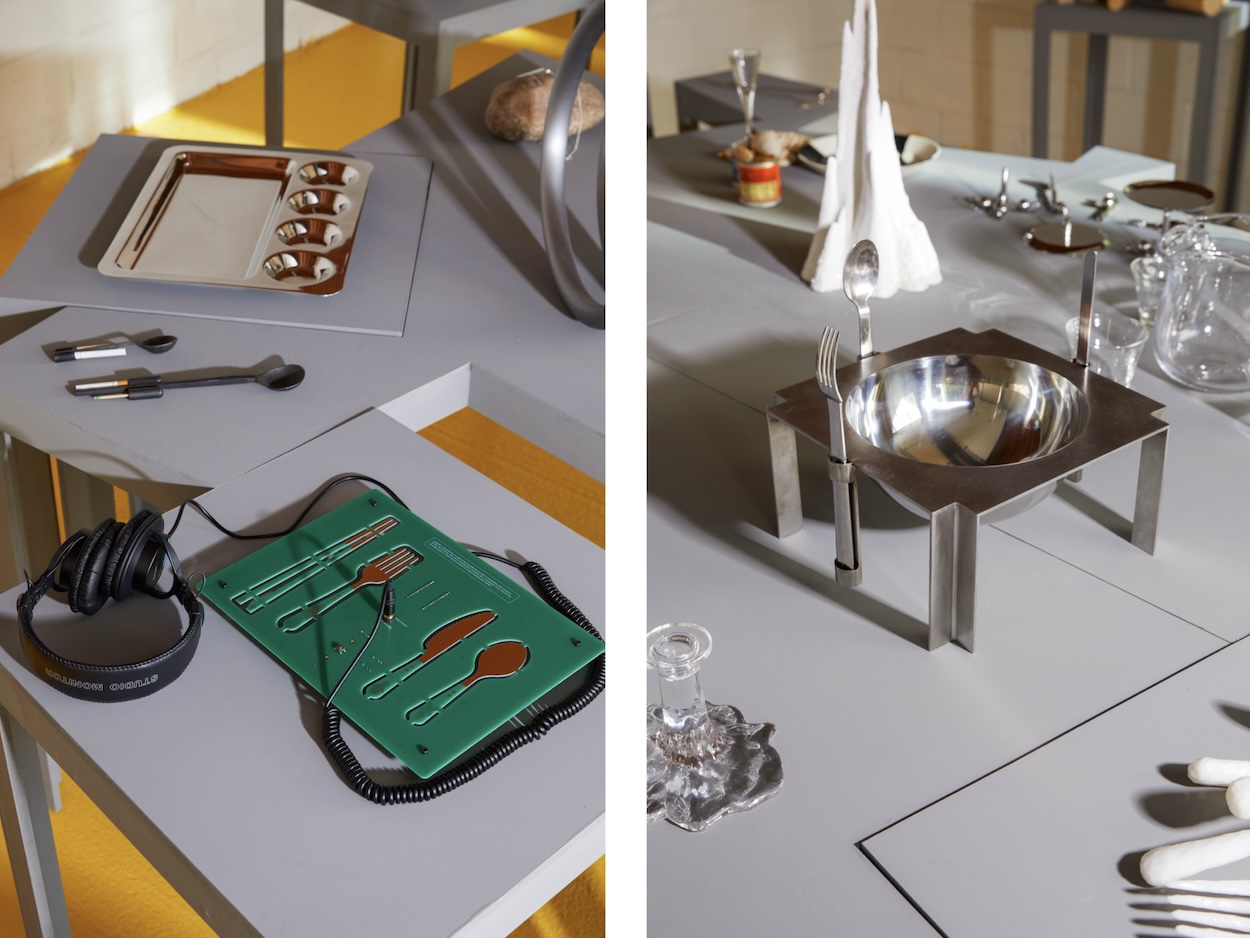
Mid-August is hardly the high season of art and design exhibitions in New York City, but that didn’t stop artist Allan Wexler and architect-designer Michael Yarinsky from gathering 24 artists and staging “Table Top,” an end-of-summer show in the Rockaways earlier this month. Wexler and Yarinsky co-curated the show’s assortment of—as the title suggests—tabletop objects that sought to challenge the rituals around eating. Staged at Driveway, a garage art gallery just three blocks from the beach, the show’s opening reception all but encouraged sandy-footed attendees to take in Brecht Wright Gander and Georgia B. Smith’s spaghetti-slurping, cyborg-esque Date Night Device, or Carson Terry’s match and Marlboro-slinging steel spoons.
“Table Top” is just one such conceptual exploration that Wexler and Yarinsky are including in A New Futurist Cookbook, which will document the installations, dinners, and art at the center of the collaborators’ efforts to question and expand the ideas of function, purpose, and routine as they relate to food consumption.
“We tried to identify a wide range of artists whose way of thinking might fit our loose definition of ‘futurism,’ that we are outlining throughout A New Futurist Cookbook,” Yarinsky told Surface. “Artists and designers presented objects that could redefine our interaction with food and the table. These pieces aim to be evocative of how people may be able to interact in the future.”
For attendees of the 2025 edition of design fair Collectible, that future is not so distant. On its opening night, Wexler and Yarinsky will bring “Table Top” to life in a series of performances with chef Marissa Lippert. In performance form, “Table Top” will make use of Wexler’s conceptual table, Pulling Together, Pulling Apart in a choreographed work that explores how physicality and space go on to inform the social mores of a family-style meal.
Yarinsky spoke with Surface about the exhibition, its place within A New Futurist Cookbook, and its future at Collectible.
Let’s talk about when you and Wexler staged “Table Top” at Driveway. We’re at the end of summer, a time when, it’s said, “no one” is in New York. What made that the right moment for it?
Much of our work around the A New Futurist Cookbook project is about putting work into new contexts and around new audiences. If there is a large community that will make the trip to support the work, the context of a residential garage gallery in the Rockaways is perfect. It doesn’t hurt that it was right by the beach and Alec Kugler and Andre Wiesmayr who run Driveway are incredible collaborators.
How did the artists you approached receive the opportunity to participate in a provocative and conceptual show like “Table Top?” Was there enthusiasm, curiosity, confusion?
When writing the brief for this show we tried to identify a wide range of artists whose way of thinking might fit our loose definition of “futurism” that we are outlining throughout A New Futurist Cookbook. As mentioned, at its core was an invitation to harness the innovative spirit, the unwavering commitment to multi-sensory engagement, the boundary-pushing ethos, and the call to be both provocative and evocative.
We had a very short list we reached out to for this show and the majority of artists enthusiastically accepted.
Which single work or vignette of works epitomizes the show?
It’s very hard to pick just one because the subject matter of historic futurism is so wide ranging—but I’ll do my best to name a couple. Suna Bonometti’s Take Away Cup in lost-wax cast brass excellently elevates the everyday and the mundane. Brendan Timmins’ Vessel/Bowl is a lovely shift in scale from furniture to object and humanizes the cutlery. Brecht Wright Gander and Georgia b Smith’s Date Night Device is an incredible commentary on how humans interact around food and around each other. Ellen Pong’s She was fearless and krazier than him vessel for mixing five sodas is charming and a joyful reflection of her personal history with food.
Who hadn’t you worked with, that you were especially excited about including in the show?
Almost all of the artists are among our combined communities between Allan, Driveway, and myself. Two that I was particularly happy to include were James Wines and Joyce Lin. James for his almost heroic stature in the field of experimental architecture and Joyce as she is one of my favorite contemporary artists working today.