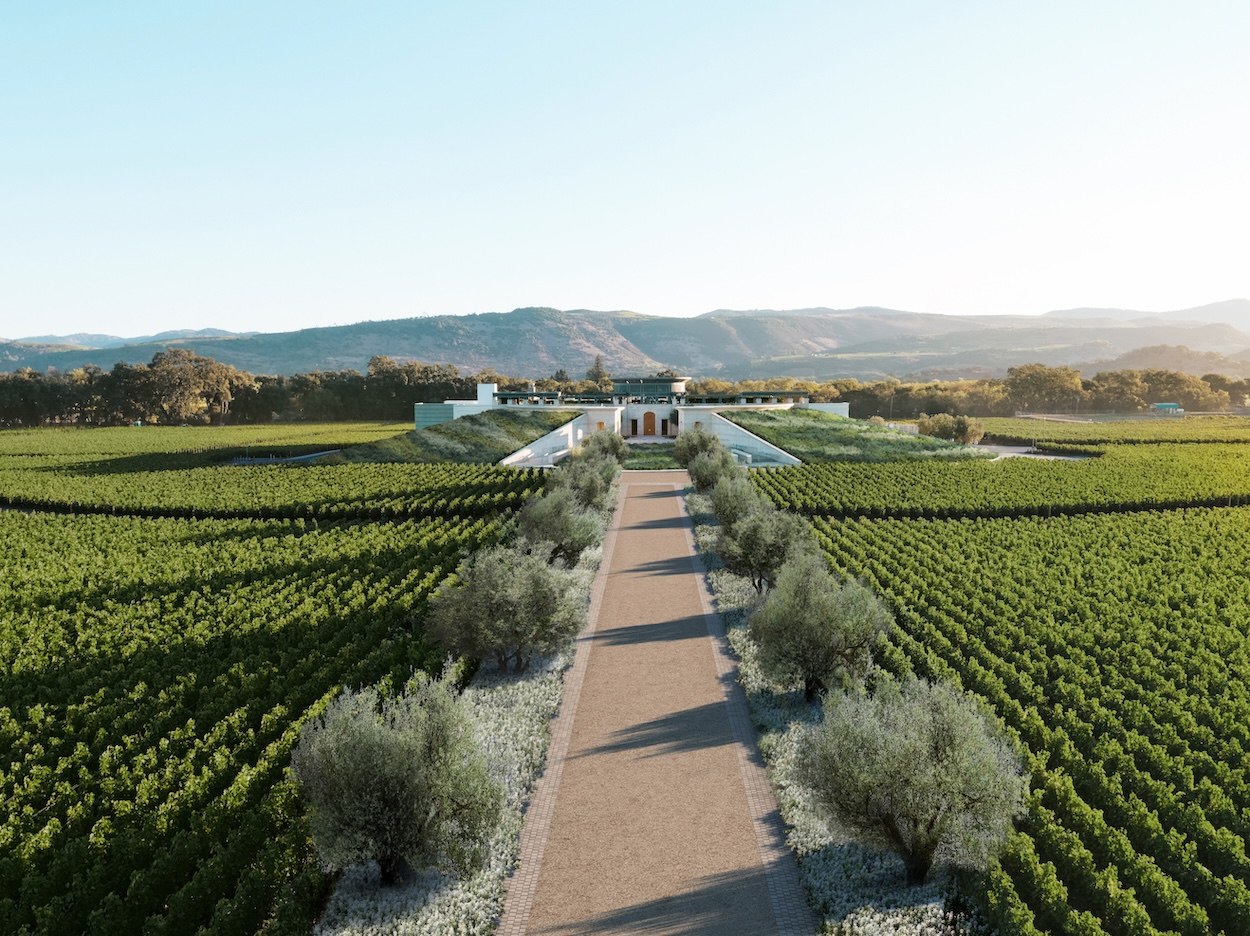
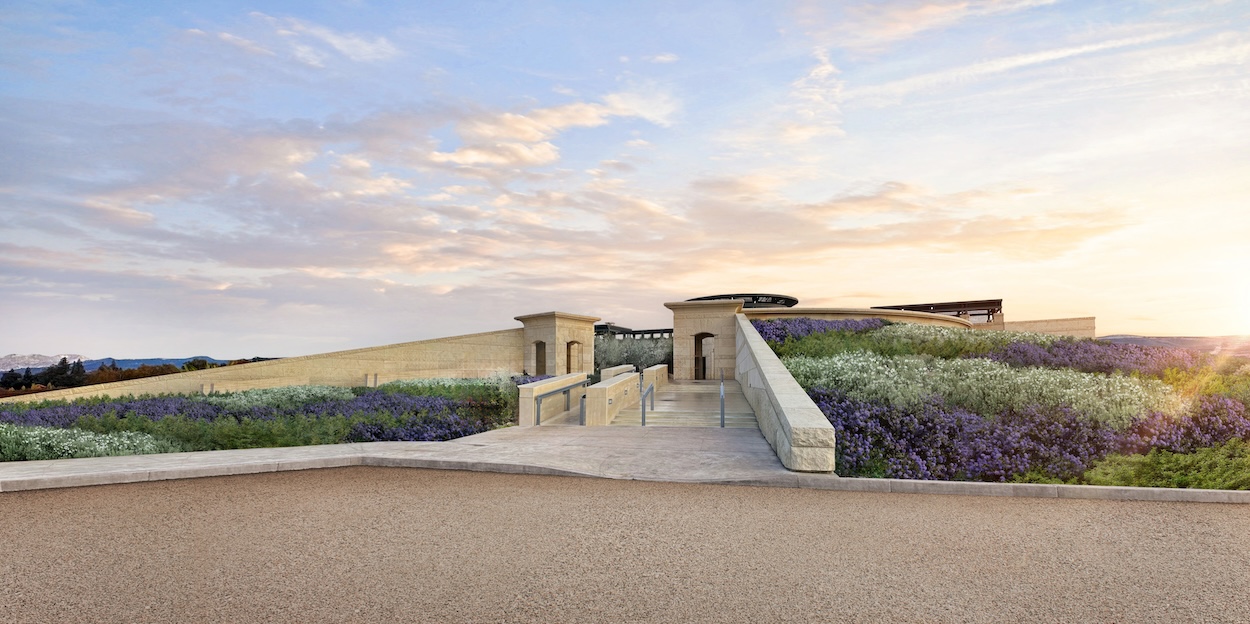
Since it was built in 1989, the façade of Napa Valley winery Opus One has commanded attention. Its sculpted symmetry—half buried—rises from the earth like a modern temple to winemaking. But this season, one of Napa’s most stately silhouettes will become something more elemental. The lawns that soften its monumental geometry will be updated with a new language of living architecture, set for completion by December.
The transformation was conceived with East Coast landscape architects Reed Hilderbrand and reframes the winery’s identity from the ground up. What was once a pastoral foreground is now a composed terrain of native flora and limestone paths, a new design language that recalls original architect Scott Johnson’s vision. “We share with Opus One a dedication to beauty, craft and a true expression of place,” says Kristin Frederickson, Principal at Reed Hilderbrand. “This new landscape embodies that ethos, reflecting the thoughtful graciousness of an Opus One welcome.”
From the approach, low berms ripple outward in gradients of silver and green. The palette is pared back, more attuned to the dry light and native shrubs of California, with species like Ceanothus and Westringia that were tested and chosen for their ecological benefits and resilience. “Opus One has taken this initiative as part of our stewardship efforts for the estate and for the environment,” says Christopher Barefoot, Vice President of Communications at Opus One. “While the aesthetic change is dramatic…the final result will more closely correspond with the original concept of the architect.” This renovation is also set to reduce water consumption by 40 percent or more – a significant standard in California where wildfires and droughts remain familiar threats.
The courtyard reads like an architectural still life. Under a canopy of century-old olive trees, winding limestone paths cut through flowering shrubs and blooming perennials, meant to evoke the atmosphere of an Italian garden ina subtle tribute to Opus One co-founder and viticulture legendRobert Mondavi. And keeping watch over the vineyards is a gilded statue of a robed St. Francis by Beniamino Bufano, that stands tall and protective at the foot of the fruit beds.
To the north, a new culinary garden furthers the dialogue between design and ecology. More than two dozen lichen-covered boulders, rescued from a local quarry, are arranged like sculptures within islands of edible herbs and flowers. This reimagined landscape recalibrates Opus One, replacing ornament with intention and effectively mirroring its winemaking philosophy: restraint, precision and an understated confidence.