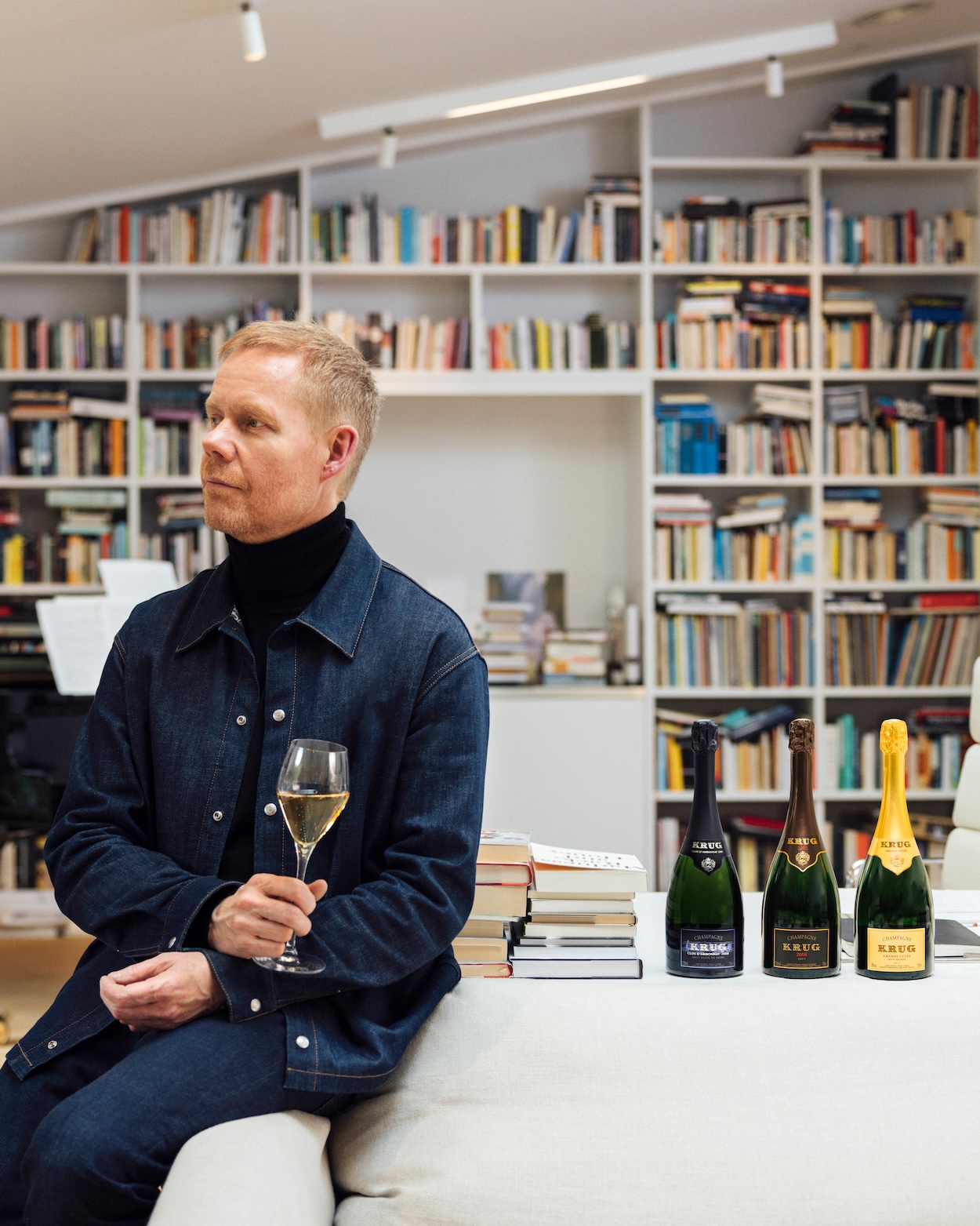
German-born British composer, producer, and pianist Max Richter—perhaps best known for his contemporary classical masterpiece, The Blue Notebooks; his eight-hour-long ambient experiment, Sleep; enveloping sonic contributions to the cinematic worlds of Arrival and Shutter Island, and the scores for Waltz with Bashir, The Leftovers, and the forthcoming Chloe Zhao feature, Hamnet—is the latest musical collaborator with Maison Krug. Following the prestige champagne house’s effervescent 2022 Ryuichi Sakamoto commission, “Suite for Krug in 2008,” Richter’s “Every Note Counts” has been artfully composed to be experienced alongside a trio of releases together known as Krug from Soloist to Orchestra in 2008 (Act 2).
Though “Every Note Counts” represents Richter’s triptych of musical compositions and a documentary about the collaboration, both to be unveiled in February 2026, it also epitomizes the maison’s approach to winemaking. Further, all three original Richter pieces were designed in dialogue with the cuvées (not just to pair with them), as well as the listener. “I think, to some extent, one of the pleasures of doing creative work is that you learn a lot about it from what listeners bring to it,” Richter tells Surface. “In a way, a piece of music is one half of a conversation; the other half is the listener and their biography, all the music they listen to, all the champagnes they’ve sipped. It’s by definition unique to each individual. That’s part of the magic.”
“2008 was a singular year in Champagne for two reasons, for Champagne [as a region] and for Krug,” Cellar Master Julie Cavil shares with Surface. For the former, “it represents one of the last vintages where we faced northern classical climate conditions, which means it was—overall—cool, with contrasts between seasons and between night and day. There were no extremes.” Through this balance, grape maturation occurred slowly, almost with restraint, leading to intense, finessed wines.
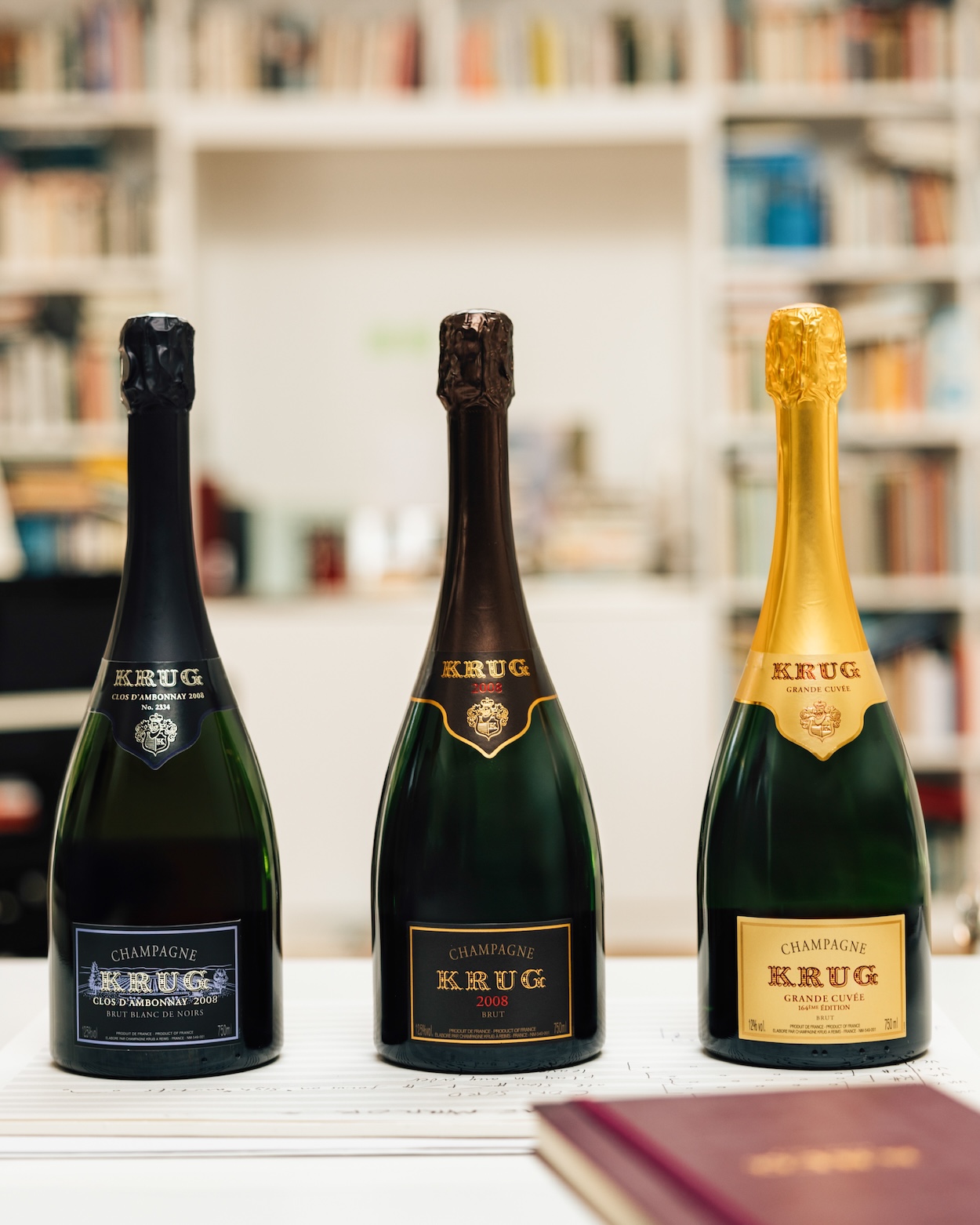
For Krug, in particular, these growing conditions allowed for the vintage to be explored. “It’s not that often that we can express a vintage from the soloist to the full orchestra—to create three different expressions that can, in one tasting, explain the entire philosophy of Krug.” For Cavil, a soloist champagne represents a cuvée drawn from one grape variety, harvested on one plot, in one year. Here, that is the Krug Clos d’Ambonnay 2008. For the ensemble, which Cavil describes as the epitome of one year, she points toward Krug 2008. With the symphony orchestra, here the Krug Grande Cuvée 164ème Édition, notes harmonize from 127 wines produced over 11 years.
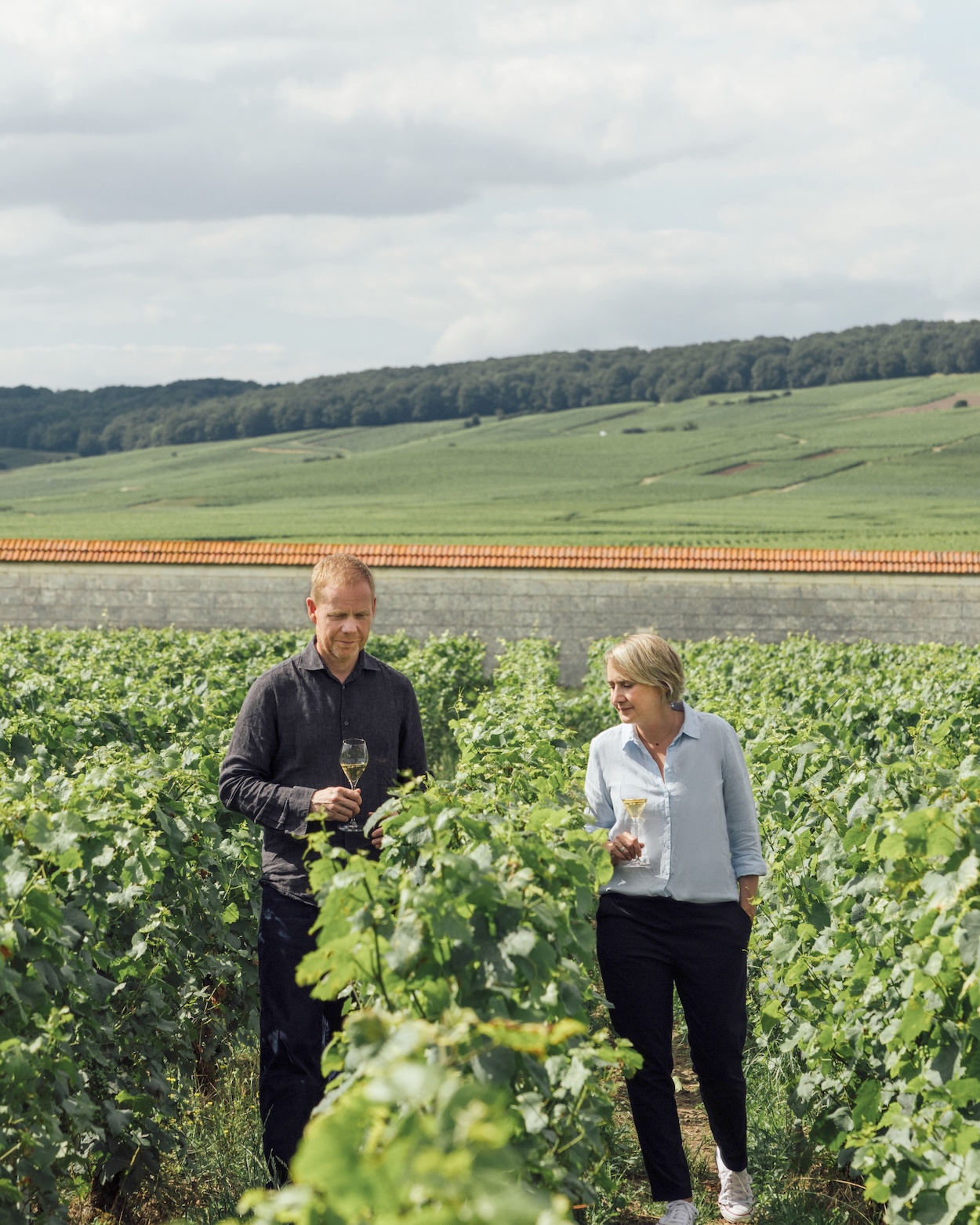
Richter visited Champagne, and toured the vineyards and cellars of Krug. “It provided a lot of insight into everything that goes on,” he says, “in order to kind of transform all of these natural elements into this amazing thing, which sits in your glass.” He observed commonalities between Cavil’s process and his own. “At the beginning, I was collecting images, impressions, and sensations, as well as the language that is used to describe this world, rich with adjectives and metaphors. Those were good jumping-off points for the music because music is a way to symbolically express those things too.”
Rather than interpret the sensory experience of champagne, he looked toward the moments where it is served. “Opening a bottle of Krug is about a special moment. It’s about a connection with people at a specific time. All of these things fed into the musical landscape I was building,” he says. Richter describes the piece for Clos d’Ambonnay as first person, almost as if someone were quietly talking to you. With Krug 2008, a piece of chamber music invokes more voices. Of course, the Krug Grande Cuvée 164ème Édition is of symphonic scale.
“You don’t need to be an expert or a musician to enjoy listening to music,” Cavil adds.” But with champagne, sometimes we hear people say, ‘ah, I’m not an expert enough to enjoy Krug. I think this parallel, with this work, is really a translation from wine into music. This tasting from soloist to ensemble to orchestra is a tribute to that—to the fact that there are hundreds of growers represented in your glass.” After an immersive session with Richter, earlier on in the process, Cavil now even feels the sound of the Krug she composes.