In his debut solo exhibition with Jeffrey Deitch, the artist is ready to test the limits of painting, emboldened by a newly expanded understanding of color.
Credit: Charles White/JW Pictures. Courtesy of the artist and Jeffrey Deitch.…
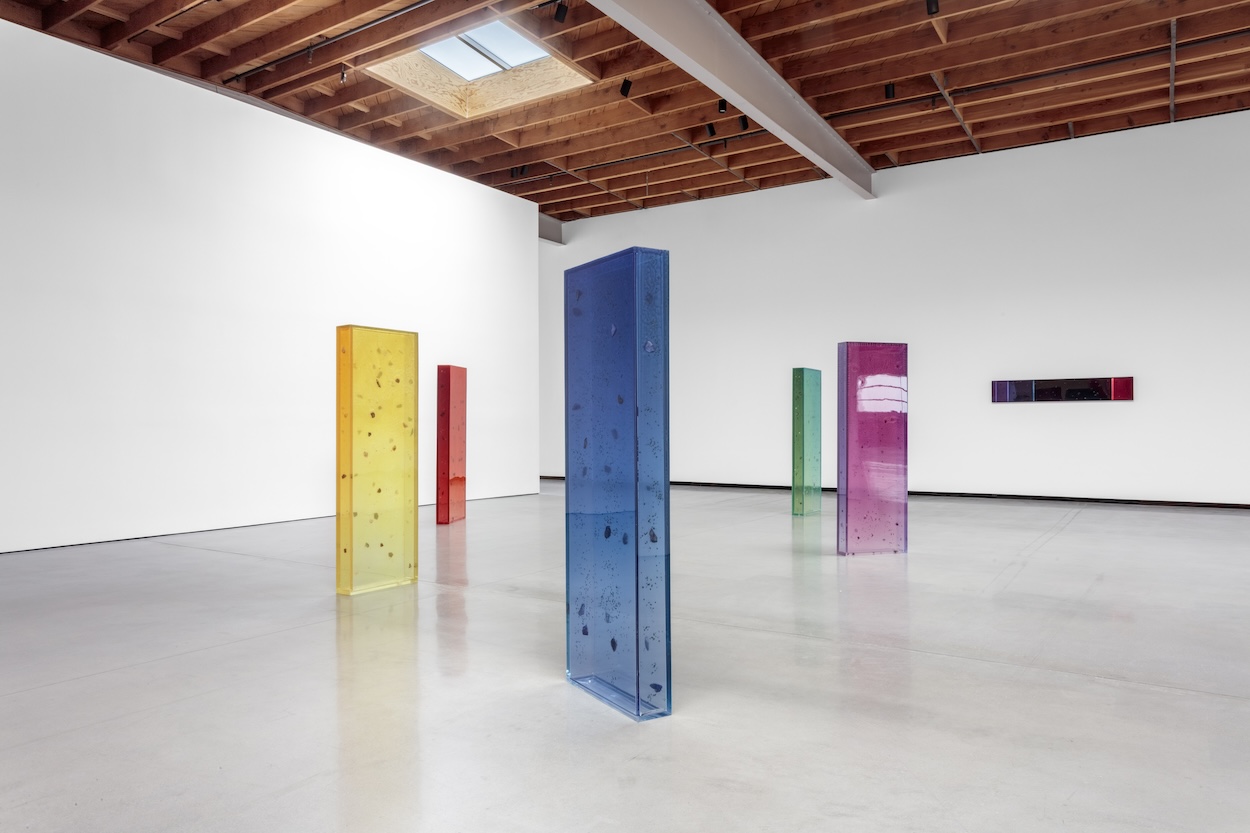
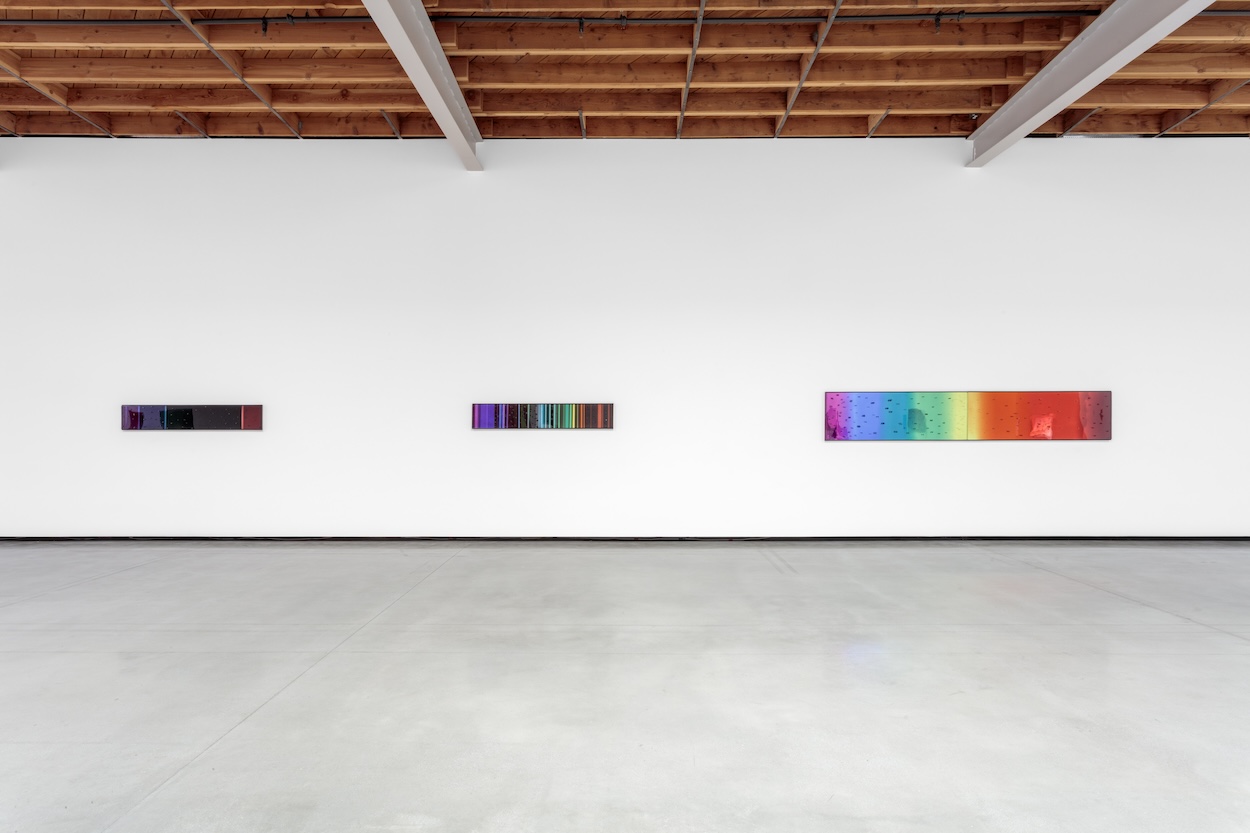
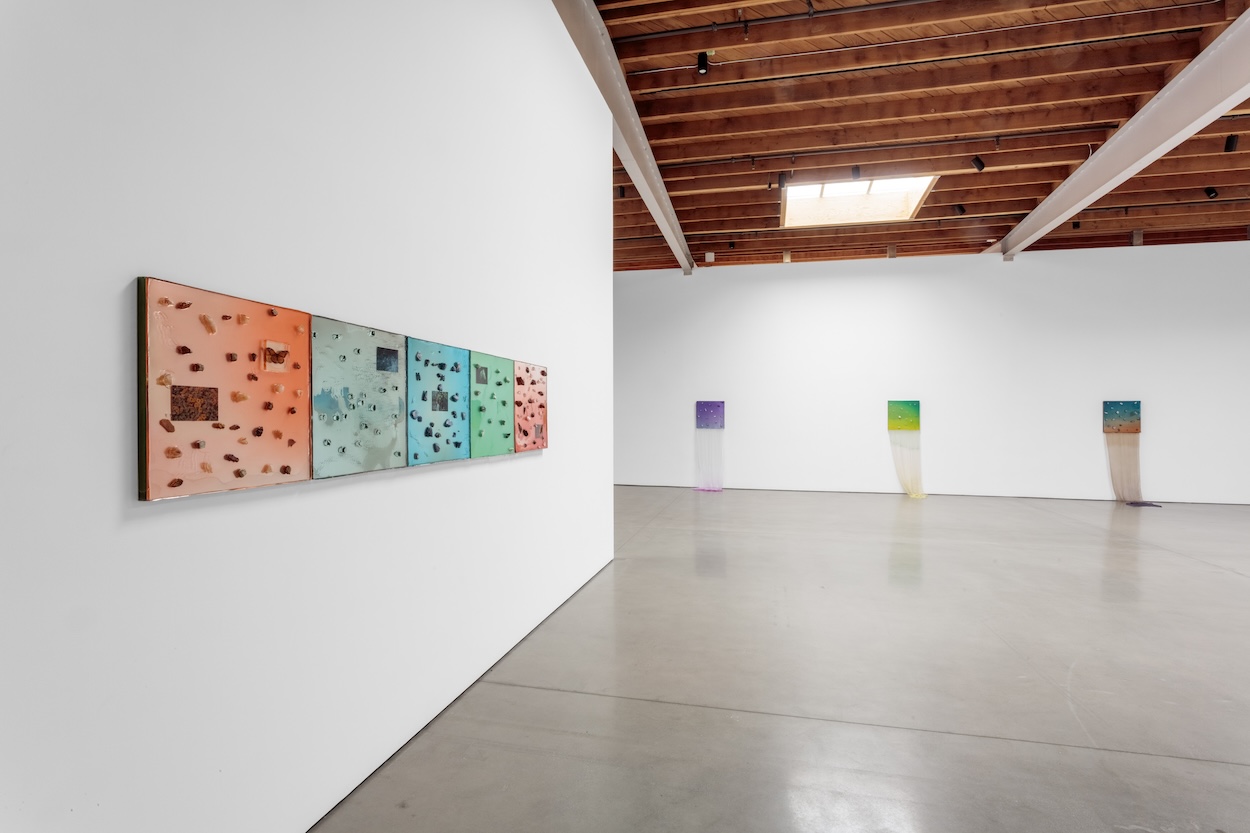
Alteronce Gumby’s first solo show with Jeffrey Deitch, “Walk on the Moon,” is as much an exploration of perception as it is a showcase of his command of color. Across four “movements,” the exhibition unfolds like a symphony: paintings open the rhythm, dyed silks extend into three-dimensional space, monolithic resin sculptures pulse with concentrated light, and the gallery’s skylights become “light wells” that activate natural sunlight, bringing color itself to life.
For Gumby, the show represents an expansion of his long-running investigation into color as energy, material, and spiritual force, a line of inquiry that has always intertwined the scientific and the mystical. In this conversation, he traces the questions that led him here: how color can guide form beyond the frame, how materials—from gemstones to glass to silk—channel and transform light, and how immersive, spatial experiences allow viewers to inhabit the vibrancy of his work. The result is a show that not only maps the latest discoveries in his practice but invites the audience to move, reflect, and feel color in ways that defy traditional painting.
“Walk on the Moon” reads as a summation of your long-running investigation into color’s physical and metaphysical charge, but it also marks a shift in scale, ambition, and interdisciplinarity. Now that this is your first solo show with Deitch, what questions were you finally ready to ask—or answer—at this stage of your practice that you couldn’t in earlier bodies of work?
With this body of work, I was finally ready to ask myself: Where can color really take me? I’ve always known that color could take me to vast places in my imagination, but I wanted to understand where it could take me materially, aesthetically, and formally within art. I’ve long described myself as a painter—an abstract painter—but I wanted to test the limits of what painting could become when led entirely by color.
Credit: Charles White/JW Pictures. Courtesy of the artist and Jeffrey Deitch.…
Color is an endless road. Like the universe, it’s ever-expanding. Painting, on the other hand, historically comes with specific boundaries. Once I recognized that color is a form of energy—capable of transforming materials, space, and perception—I realized painting could expand too. With centuries of artists building languages within a two-dimensional plane, I wanted to see how far I could push that lineage. How could color guide me beyond the frame? How could it lead to the next evolution of my practice?
The exhibition is organized into “movements”—language that evokes a symphonic structure—threading painting, sculpture, installation, and sound. How did working with this almost musical architecture shape the logic of the show, and what does it allow you to express about color that a single medium can’t quite hold?
The idea of “movements” came from wanting the show’s experience to feel like a journey. Musically, a movement signals time, progression, and emotional shifts. I wanted each gallery to function that way—each space offering a change of material, mood, energy, and light. As visitors move through the exhibition, their physical bodies are invited to engage with the work from multiple perspectives, not just the traditional position of standing in front of a painting.
The first movement—the paintings—invites you into a left-to-right rhythm, letting you track how the light shifts across each surface. The second movement pulls you from two dimensions into three, as the dyed silks embedded in the paintings extend into the space, inviting a new spatial awareness. The third movement is fully sculptural; the Luminaires ask you to walk around, between, and through them, activating proximity and distance. And the final movement—the light wells—brings the body into a different form of engagement: you can walk around and inside them. From there, natural air currents animate the silk, making movement visible and alive.
Movement, then, becomes another way of talking about perception—how color, light, and material shift as you shift. And on select Saturdays, that musical influence becomes literal through performances, completing the symphonic architecture of the show.
Credit: Charles White/JW Pictures. Courtesy of the artist and Jeffrey Deitch.…
Your “tonal” paintings and the new monolithic resin sculptures both compress intense material research—glass, gemstones, metals—into concentrated fields of energy. As you deepen this vocabulary, where do you see the boundary between the scientific and the spiritual in your work? And how conscious are you of pushing that boundary forward in this exhibition?
I’m very intentional about pushing the boundary between the scientific and the spiritual—partly because I see them as deeply connected. Before something becomes a scientific fact, it often first exists as unexplainable, mysterious, or even magical. Once a phenomenon can be proven and repeated, we label it science. But the origin—the awe, the wonder—that comes from the same place.
In my work, I draw from both. I was raised in the Pentecostal church—my mother was a minister—so spirituality has always been a part of my life. At the same time, I’ve always been fascinated by science: how things work, how energy moves, how the universe is structured. Curiosity led me to see these fields not as opposites, but as parallel streams that can converge.
As an abstract painter, I think about how color can hold both scientific truth and spiritual resonance. The materials—glass, metals, gemstones—carry geological and energetic histories. When combined, they become concentrated fields of light, vibration, and meaning. In this exhibition, I leaned into that convergence more consciously, allowing the work to sit at the edge where the measurable and the immeasurable collide.
Credit: Charles White/JW Pictures. Courtesy of the artist and Jeffrey Deitch.…
The final installation turns the gallery’s skylights into “light wells,” essentially using the building as a prism. This feels like your most environmental gesture yet. Did working with natural light in such an immersive way reshape your understanding of color’s behavior? And how do you see that experiment influencing what comes next for you, whether inside or outside the studio?
The light wells emerged from instinct and curiosity. The original plan for that space was a light-and-sound installation that would have required blacking out all the skylights. But the skylights were the reason I wanted to show at Deitch in the first place. Instead of covering them, I started thinking: What if I worked with the natural light instead of against it?
At the same time, I had been dying silk for the “Following Rainbows” series. It seemed natural to bring that material into the skylit space, letting sunlight activate the color. From there, the idea of the light wells was born. We dyed hundreds of yards of silk to create these cascading forms that catch, filter, and project sunlight into the room. Working with natural light reshaped my understanding of color by emphasizing its elemental qualities. Color can behave like a solid, liquid, gas, or even plasma—it absorbs, reflects, vibrates, and responds to its environment. The light wells made that behavior visible. Some moments feel architectural, like standing among pillars; other moments feel fluid, like being inside water or air.
The quartz clusters mined in Arkansas add another layer of energy, grounding the installation with the geological history of the gemstones. Together, they make the room feel alive—constantly changing, always in motion. This experiment leads me deeper into working outdoors, with natural light, and into creating environments where color can behave freely. It’s opened up a new chapter for me—one that extends beyond the studio walls.