When Simone Bellotti talks about his vision for Jil Sander, the language is precise but warm. “What I want to keep, for sure, is this attention to an ideal perfection,” Bellotti tells Surface. “This search for an ideal perfection. It means working a lot on the quality, as was always done, and the research for the best details, the best materials.”
For him, this is not nostalgia; it is continuity. The discipline that has long defined Jil Sander, the commitment to rigor, is not something he sees as fragile. If anything, it is foundational. Where Bellotti begins to push forward is not in form, but in feeling. “What I would like to add,” he says, “is trying to represent a feeling of maybe a bit more emotion in this brand.”
Courtesy of Jil Sander…
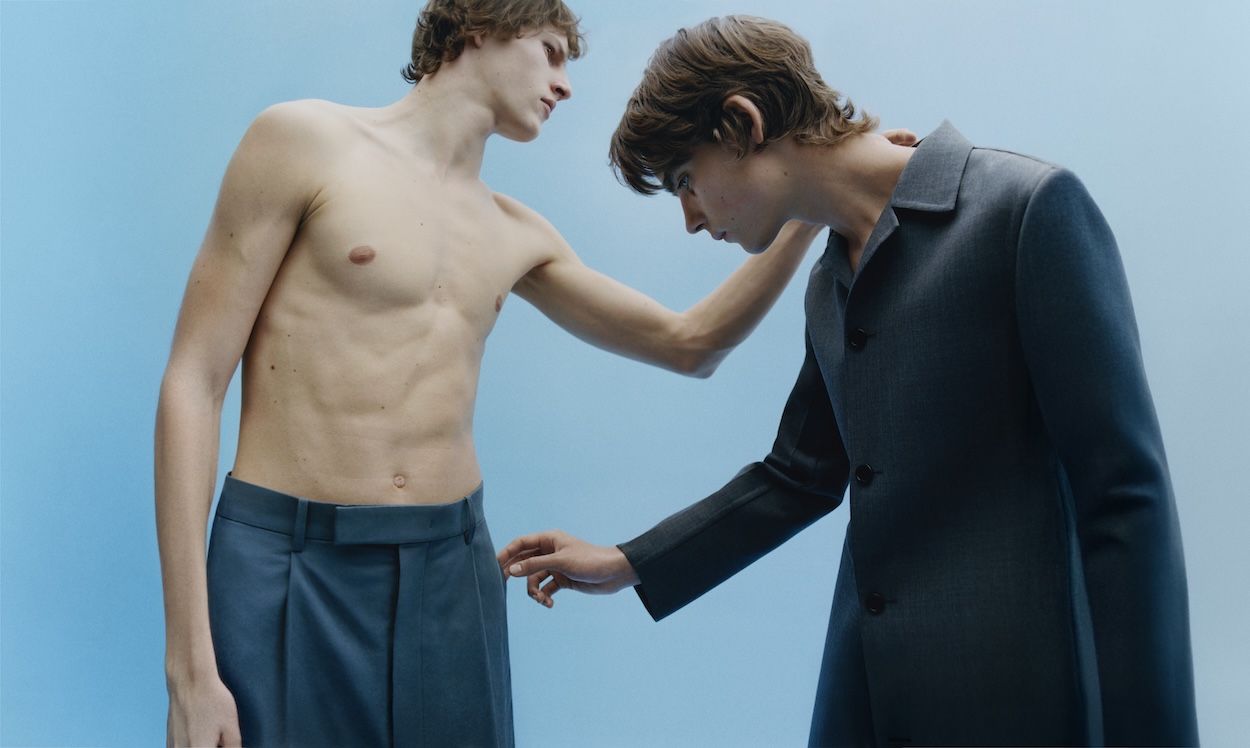
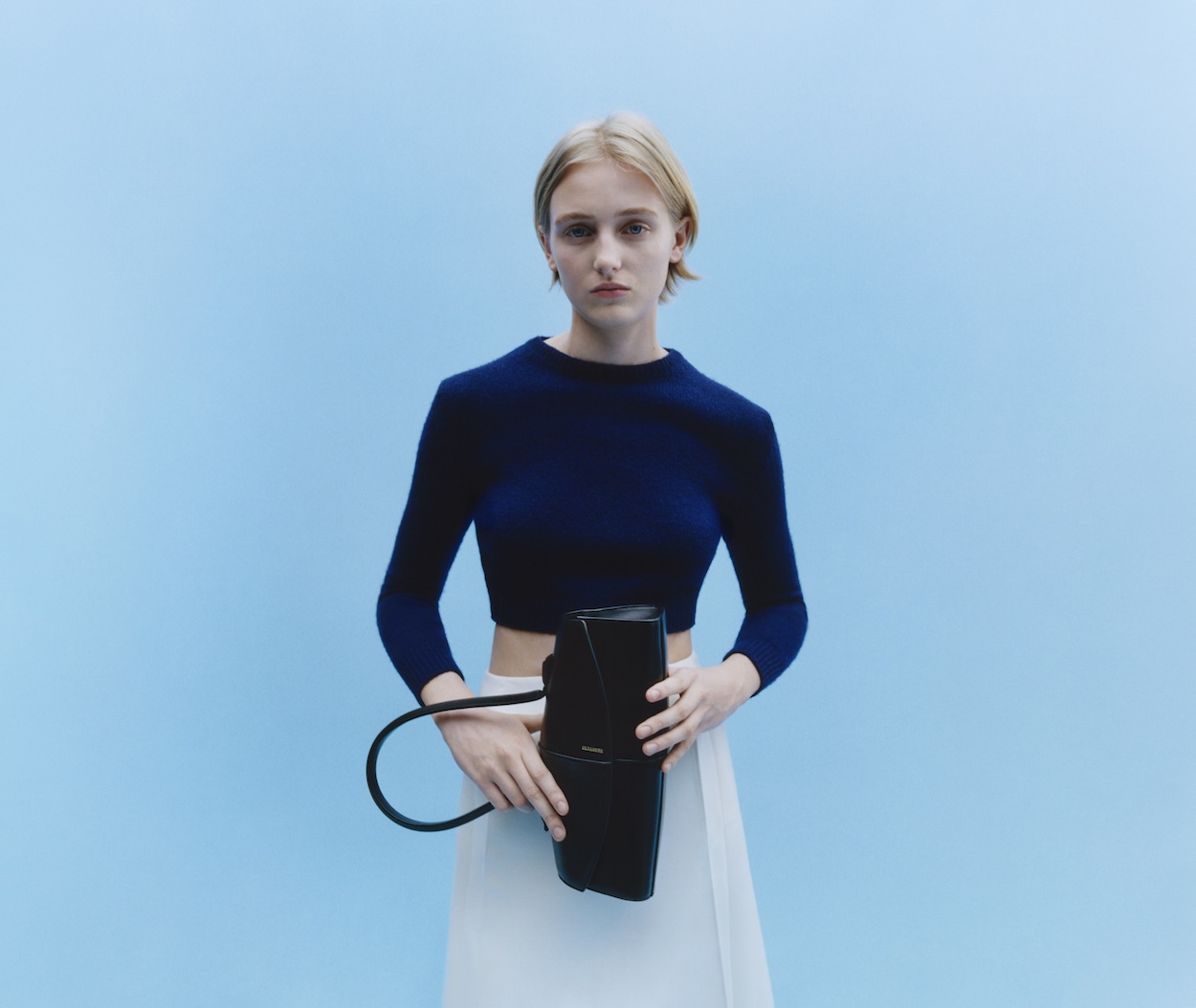
That shift is already visible in his first campaign, shot by Stef Mitchell and released earlier this week, which quietly reframes how bodies exist within the Jil Sander universe. The models are close and attentive. They’re almost dependent on one another. “I wanted to try to represent this sense of proximity between these characters,” Bellotti adds. “I wanted to let them be curious about each other. I wanted [it to look like] they needed each other, in a way.”
“If I can manage to find a balance between this more intellectual and rational aspect, and something more related to humanity and emotion,” he says, “that would already be something for me.” That balance has been shaped by a career spent inside some of fashion’s most demanding environments. Bellotti is quick to acknowledge the influence of the designers and houses he has worked with since the early 2000s, spending 16 formative years at Gucci before moving through Dolce & Gabbana and most recently Bally, each chapter leaving a distinct imprint on how he thinks about rigor, emotion, and craft.
Courtesy of Jil Sander…
What unites those experiences, despite their differences, is a shared intensity. “They had very different tastes, very different characters,” Bellotti continues. “But for sure, all of them were really obsessed with what they were doing. And I would love to keep this passion, this obsession, forever.” That obsession becomes especially relevant when Bellotti speaks about minimalism. He is cautious with the word.
“Minimalism today can sometimes be associated with a way to do something simple,” he says. “But this idea of purity, more than minimalism, means a lot of work. A lot of layers. A lot of concepts. All together, it’s not minimalist at all. So maybe we should find a new definition of minimalism today.”
Courtesy of Jil Sander…
Bellotti attributes patience and collaboration to success. “Being connected with the people you work with,” he says. “Creating a dialogue. That’s very important. Question yourself,” he adds. “Never stop thinking about what you can do better. That’s maybe the key to go deeper in this research.” That instinct to go deeper did not begin in a studio. It began years earlier, in Milan, on dance floors and in the city’s house music scene. As a teenager, Bellotti spent weekends going out, often not returning home until Sunday.
“For a long time, I thought maybe that was a waste of time,” he admits. “Just thinking about having fun.” Only later did the value of those years become clear. “Now I see that even if we were a bit crazy,” he says, smiling, “this is helping me now.”