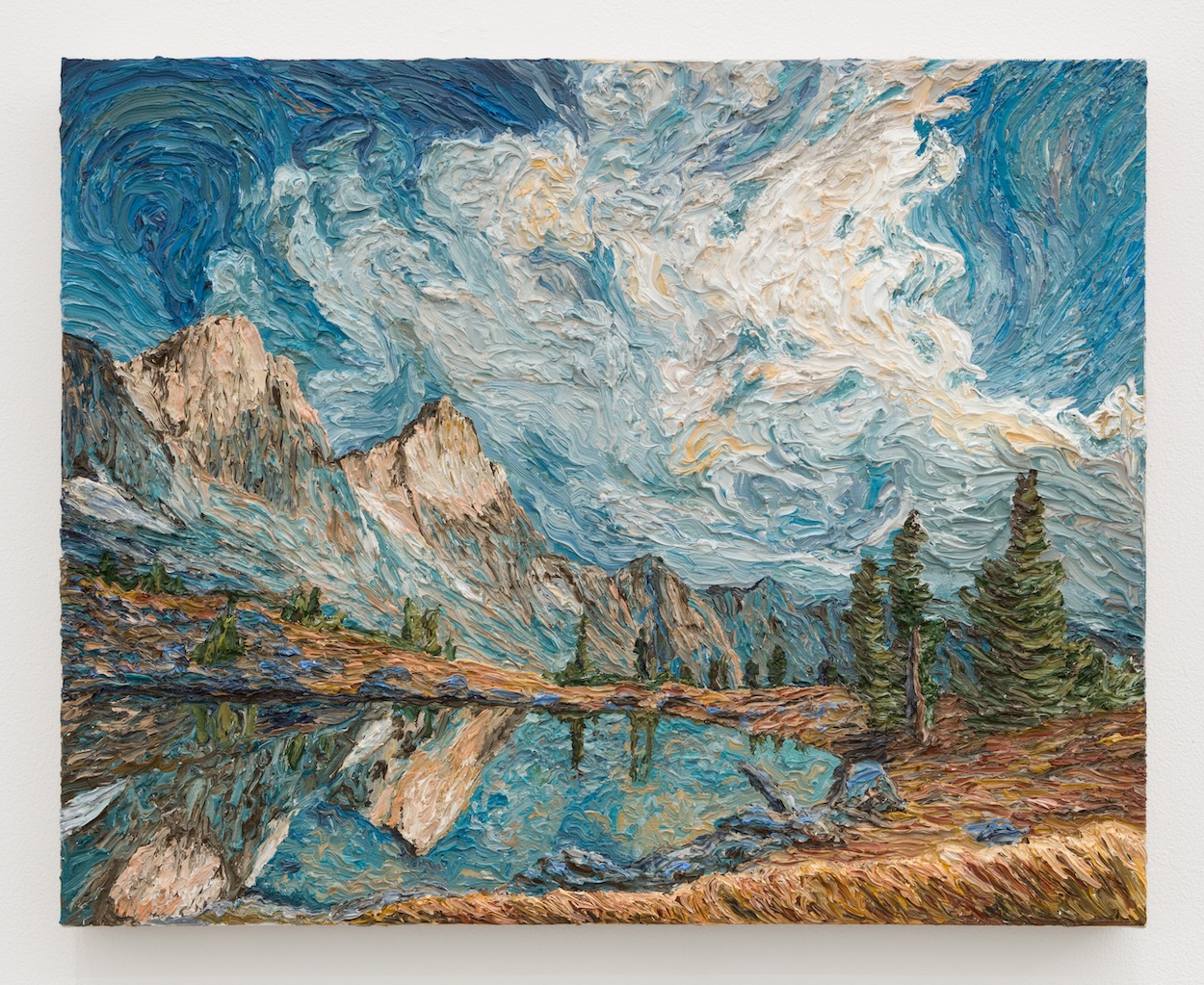
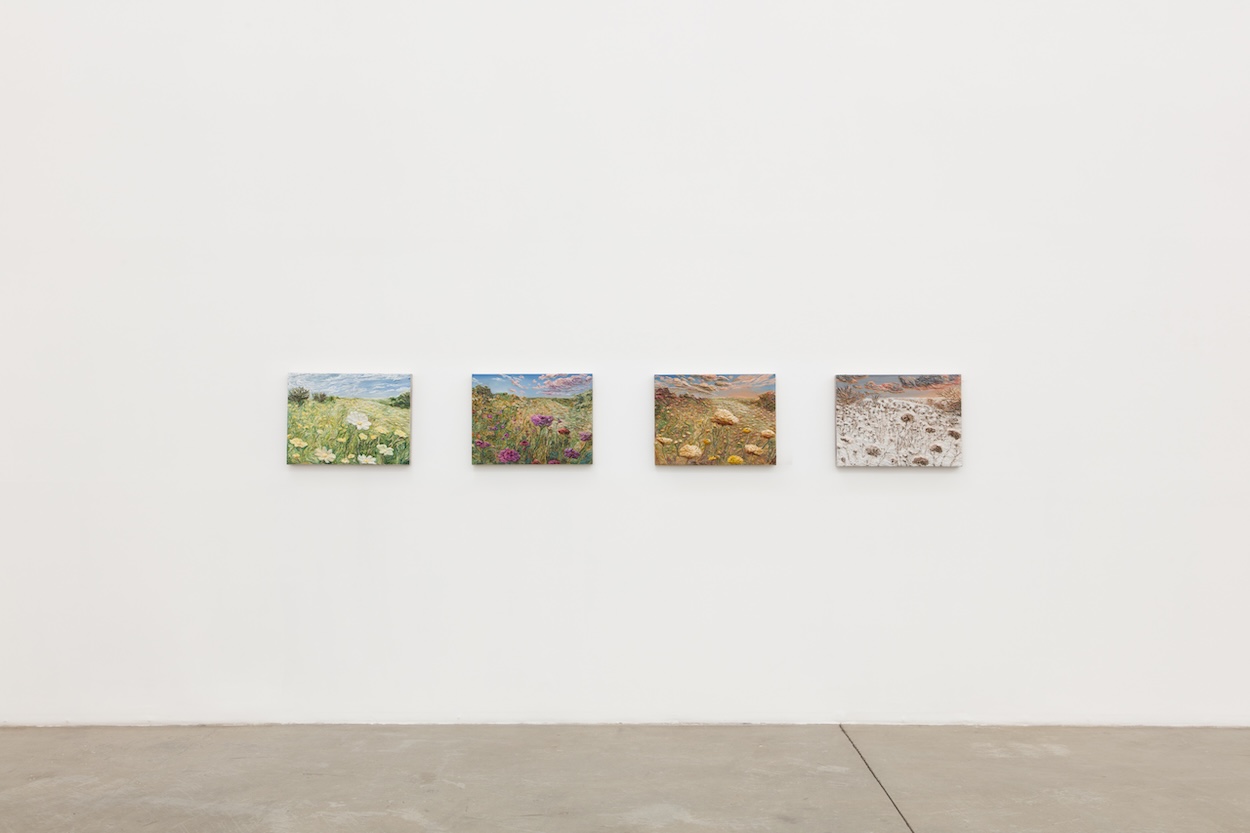
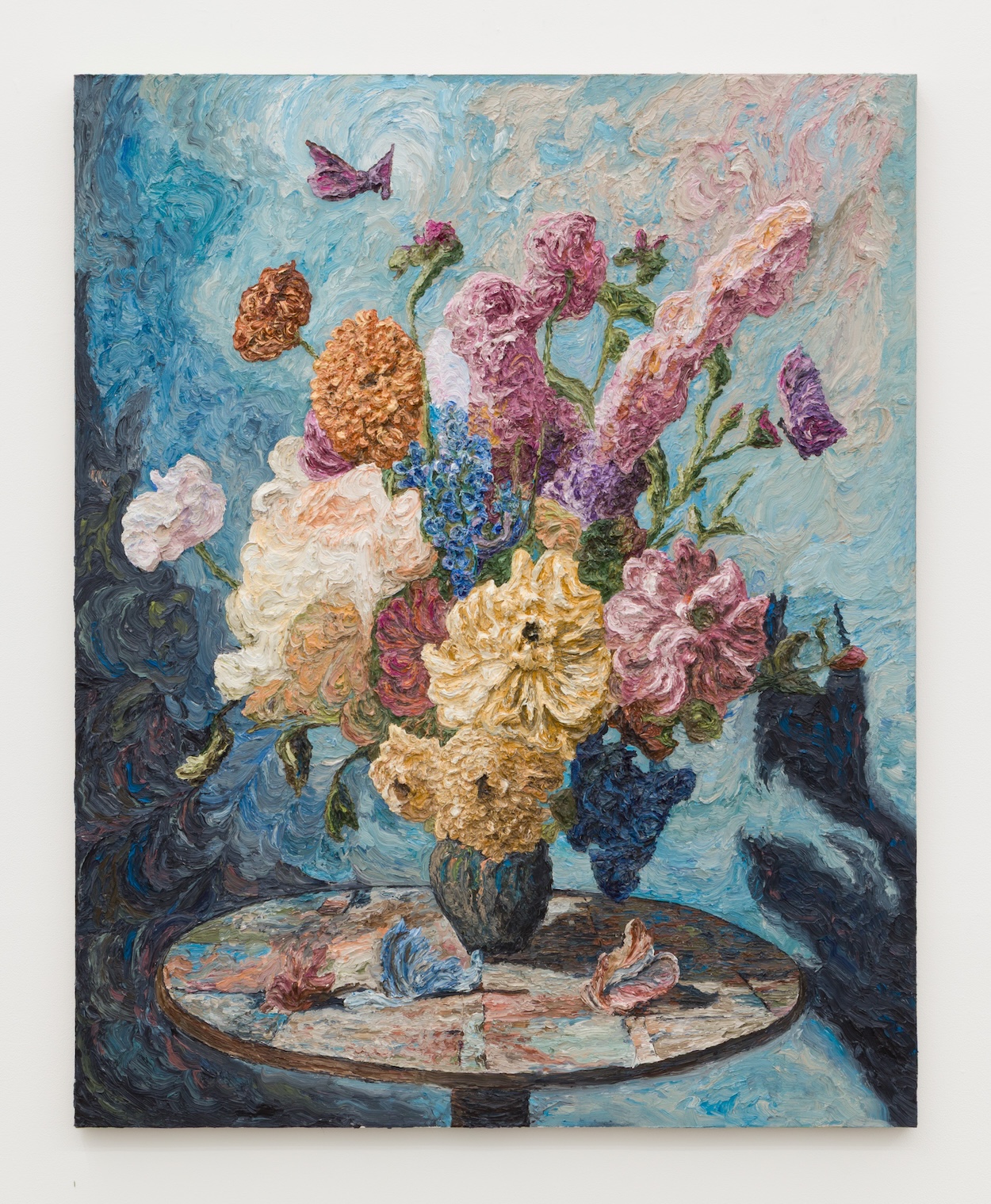
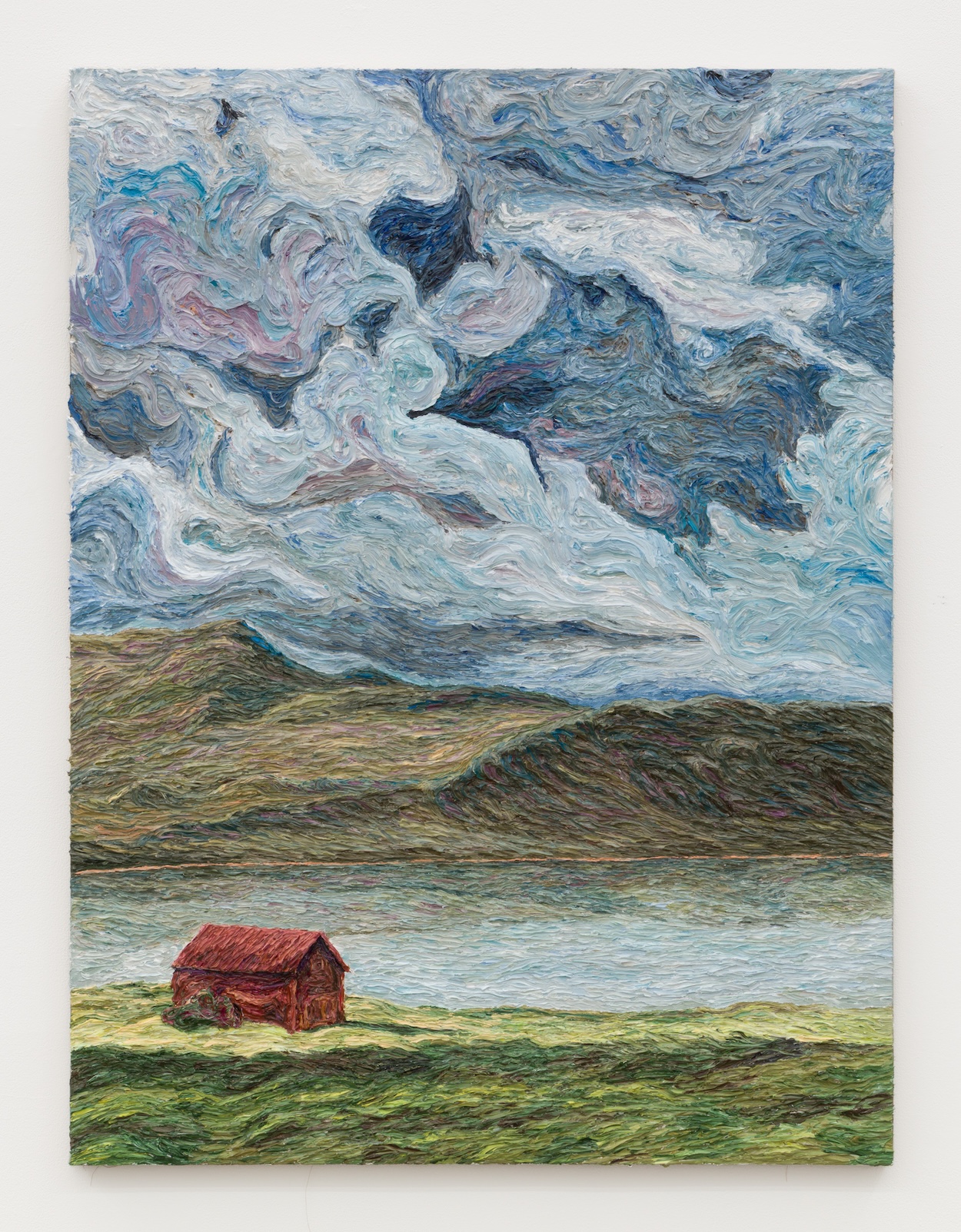
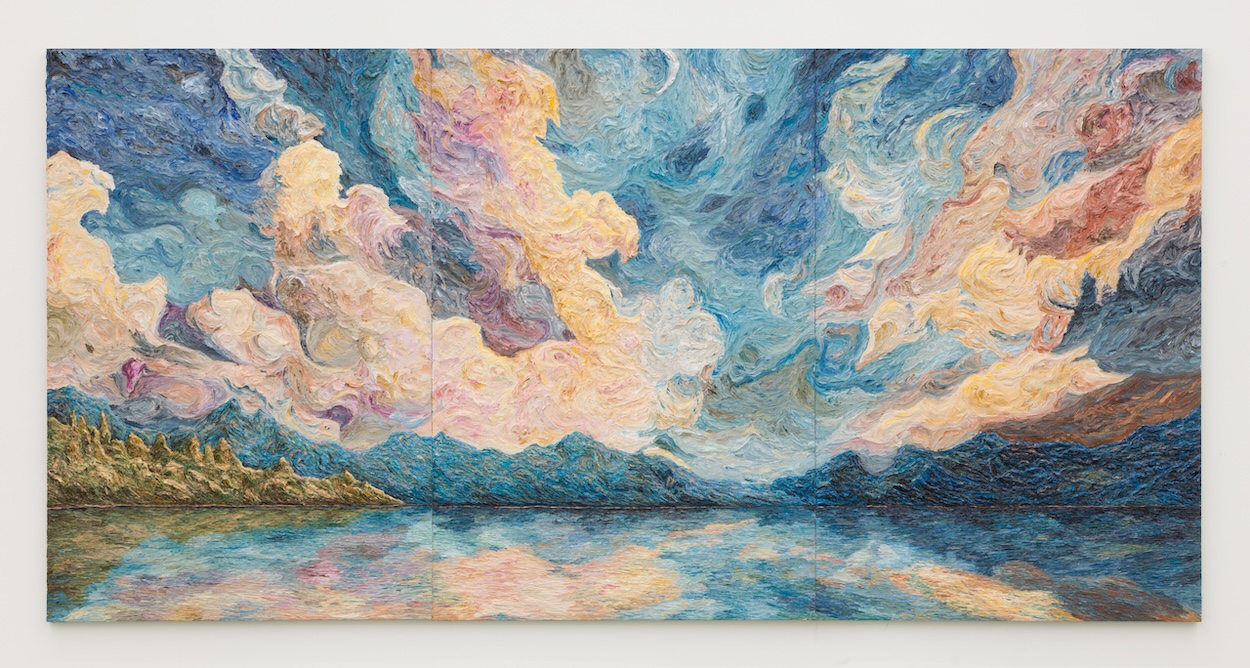
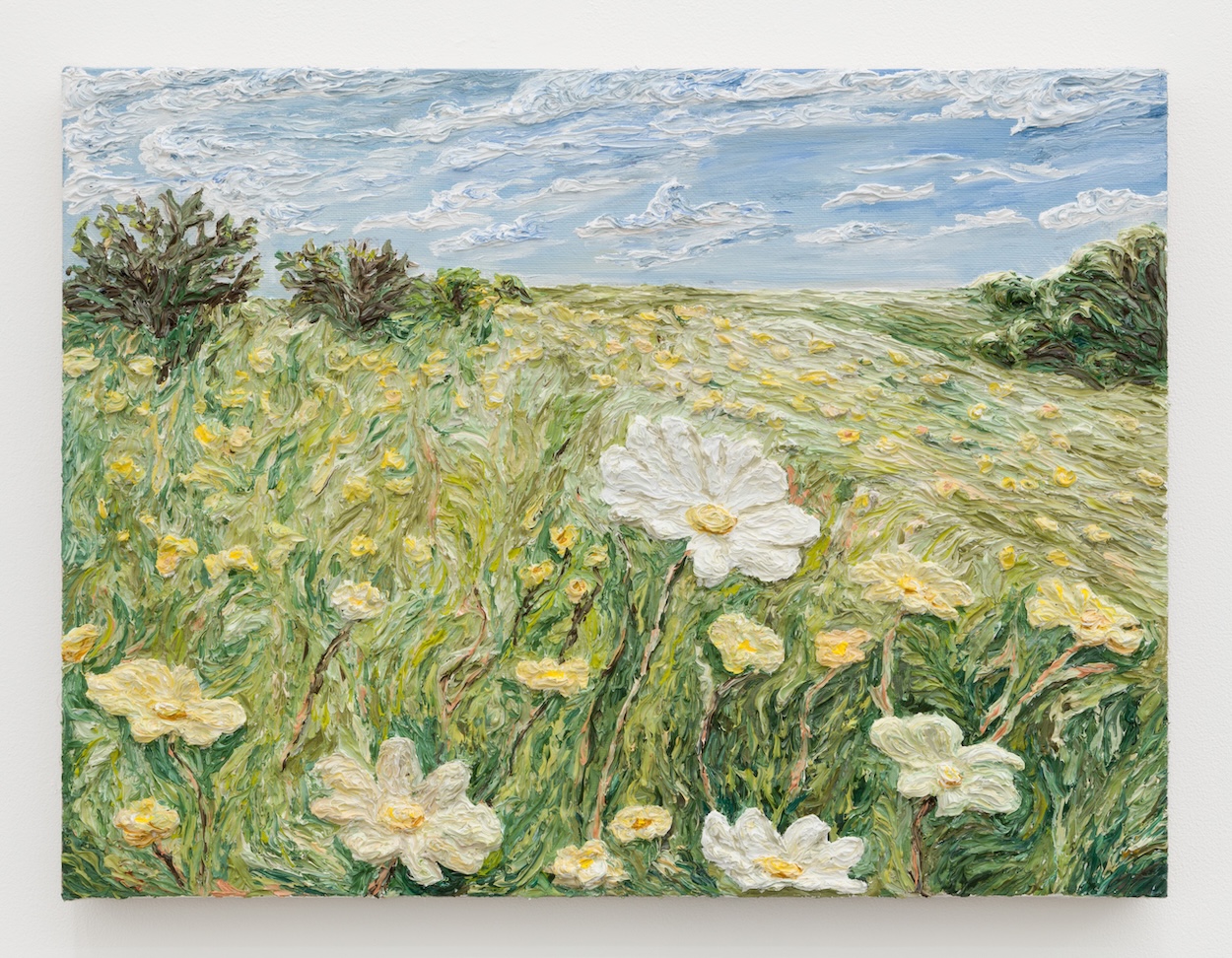
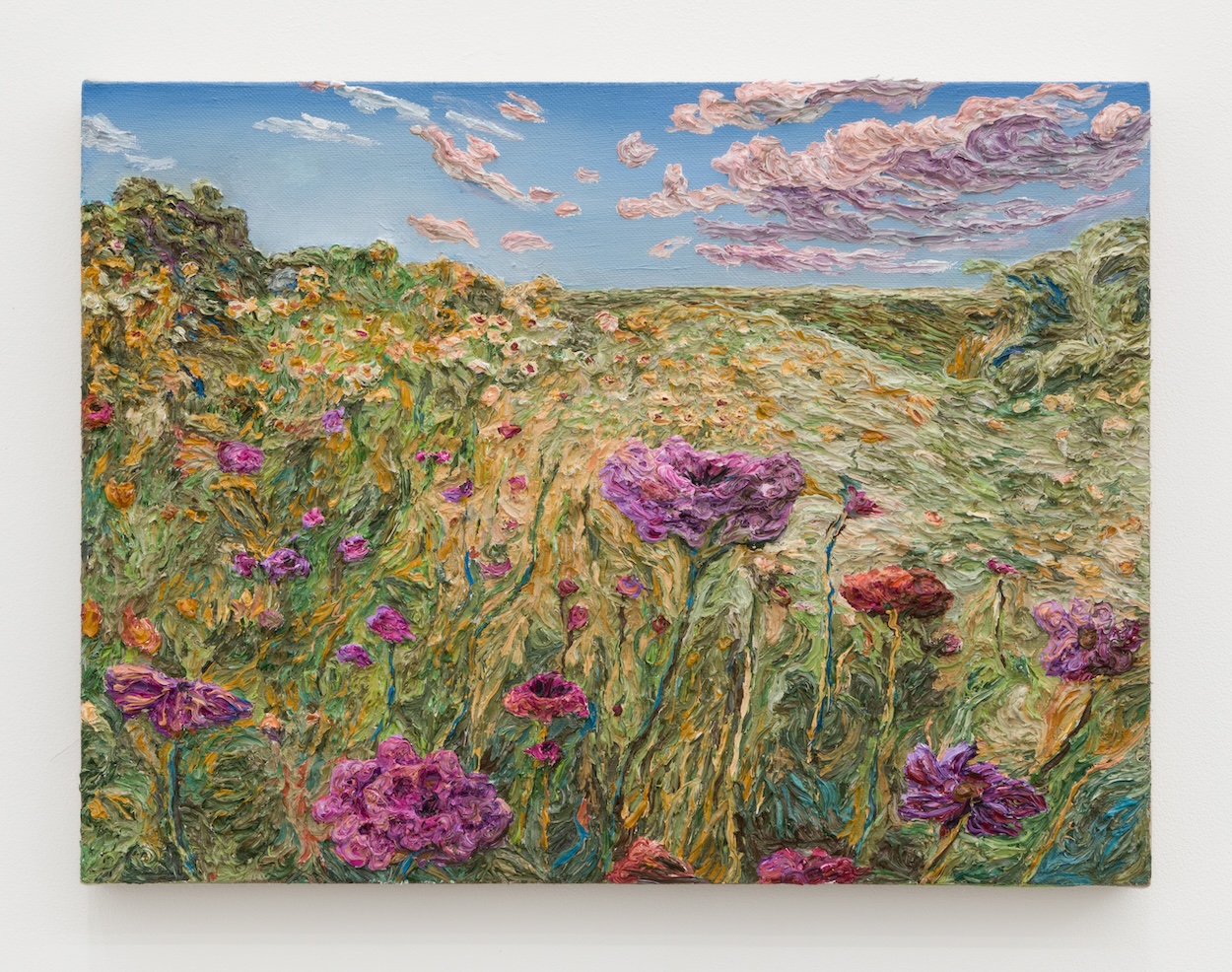
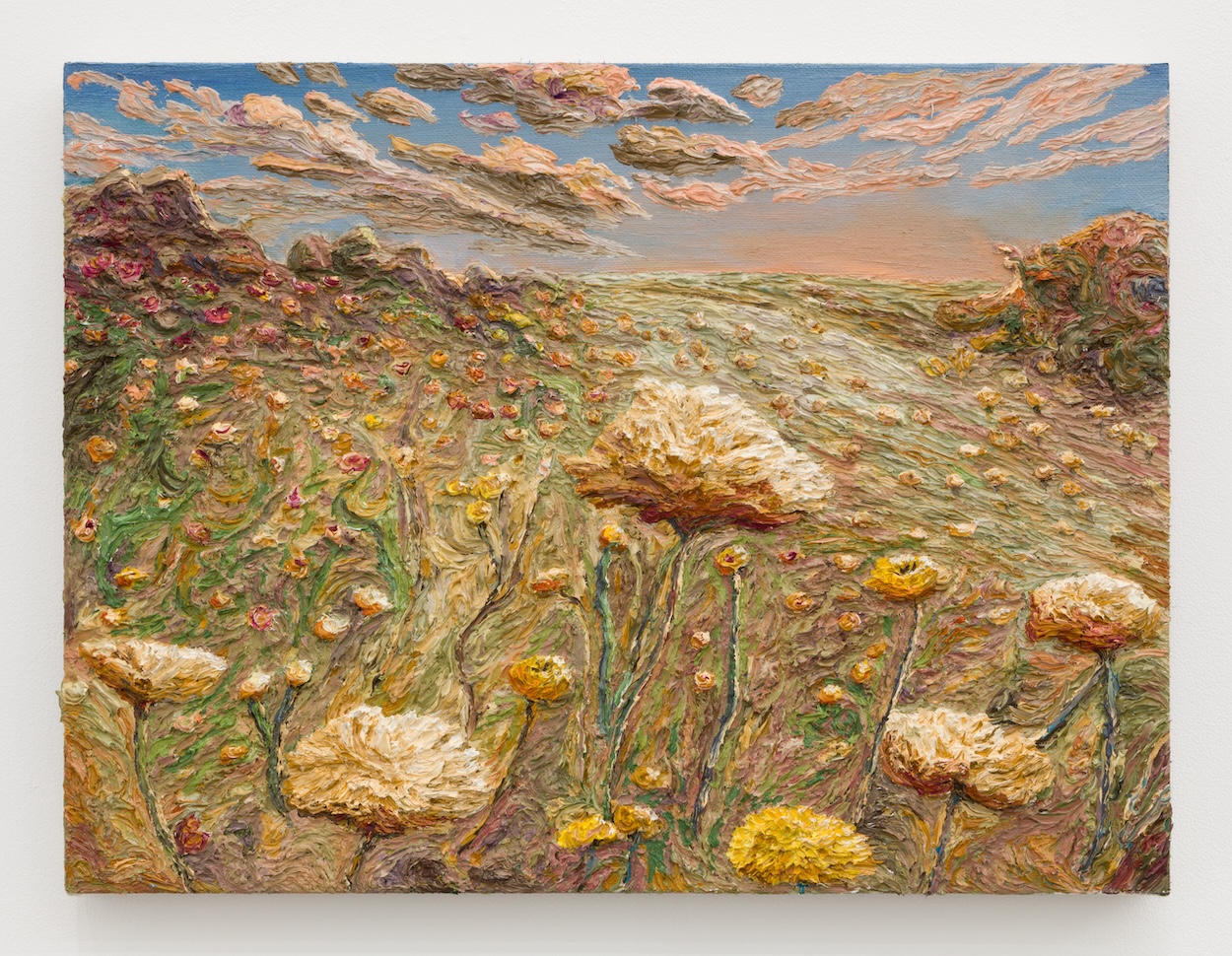
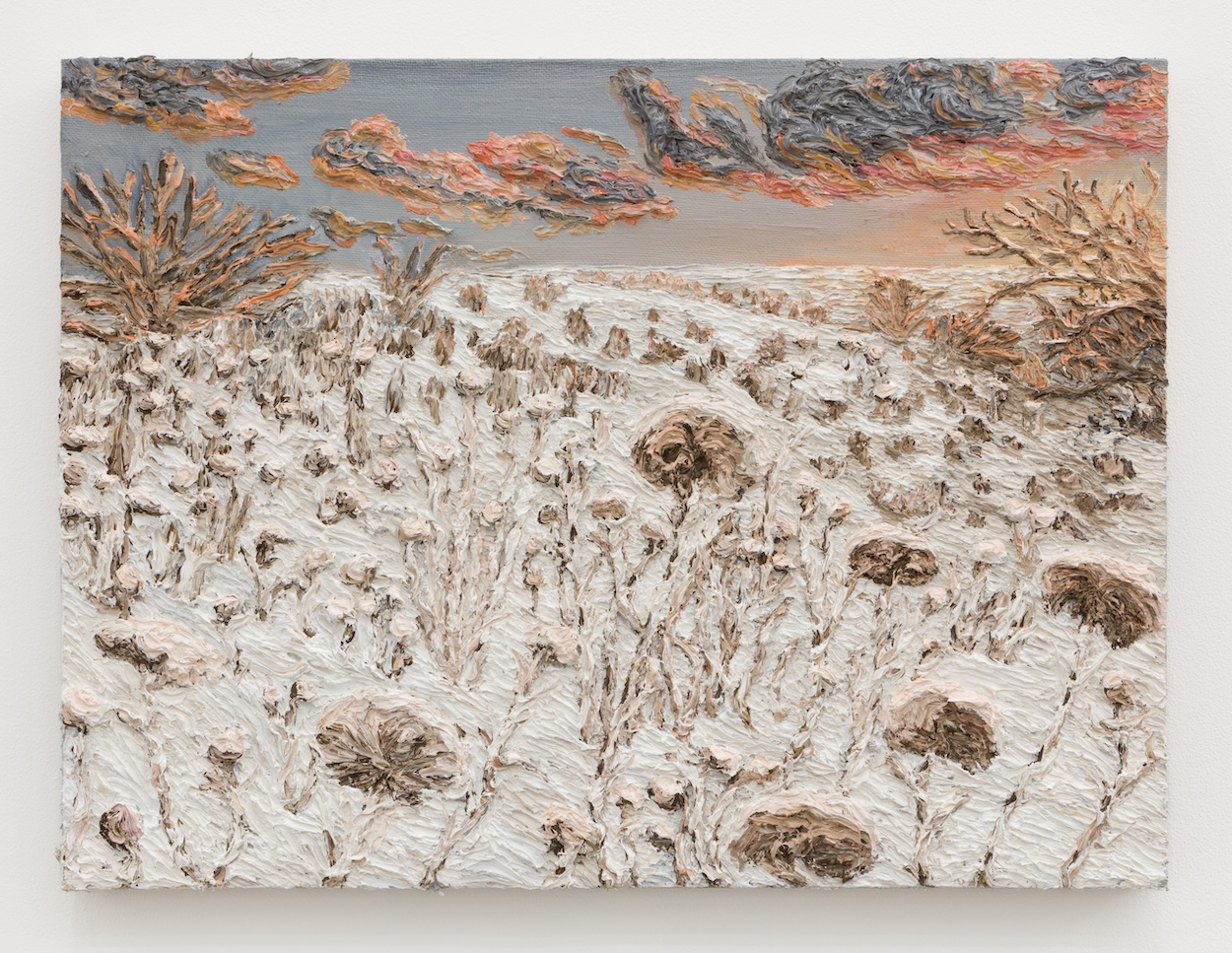
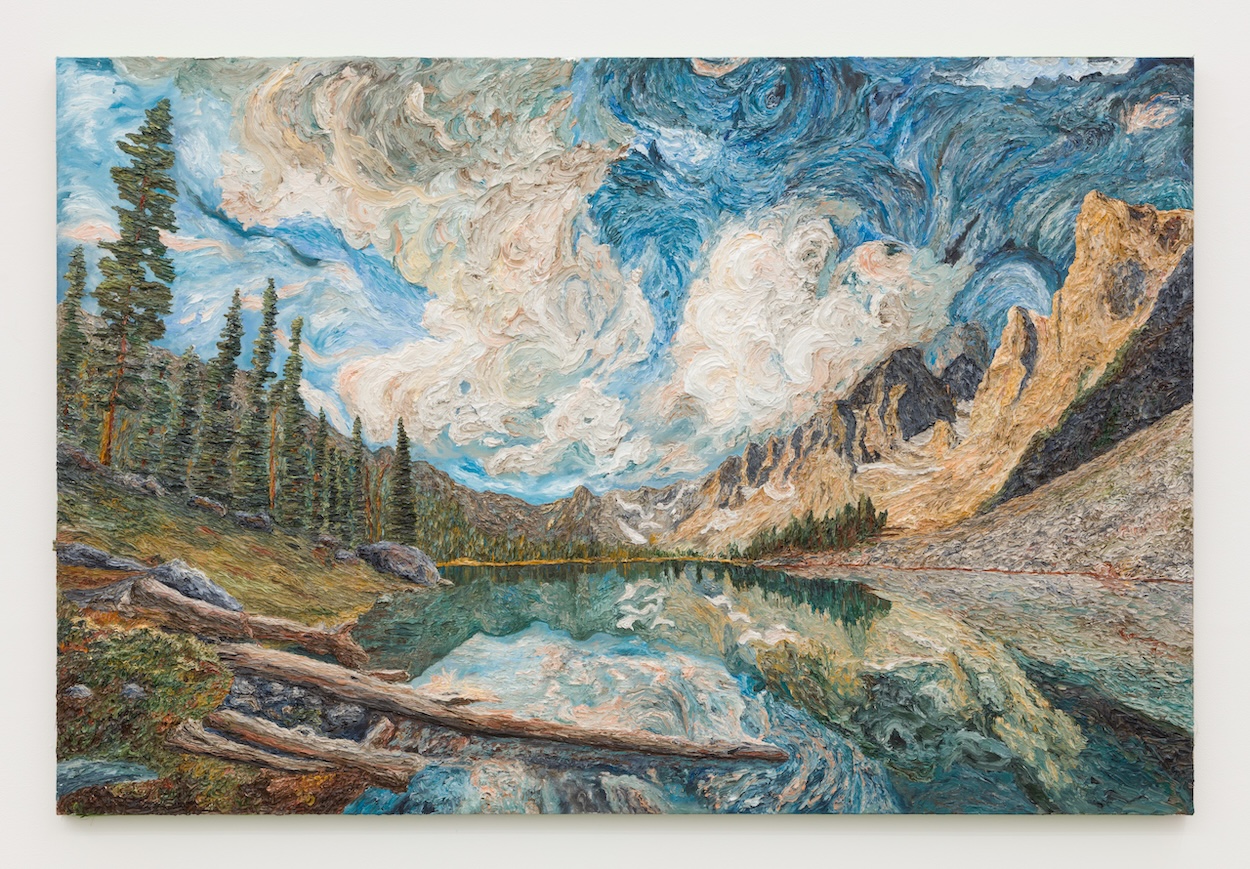
The mesmeric works of Brooklyn-based fine artist Cooper Cox transmute thick grooves of oil paint into scenes of spectacular dimension, nearly sculptural in nature. With “The View From Upstairs,” on view now through April 4 at Ochi Gallery in Los Angeles, Cox exhibits his most powerful pieces to date—mountainous landscapes, pastoral reprieve, and fields of flowers paused in movement during each season.
Cox produced this body of works while in a residency at Ochi’s Idaho location. The studio space, from the gallery’s second floor, reminded the artist of the view from his childhood bedroom in Sun Valley, Idaho—a setting that Cox says shaped his attention to nature, scale, duration, and even isolation. To gaze upon the paintings is to feel this, and to be lost in stillness derived from Cox’s desire to suspend time and place, “as if,” he tells Surface, every depiction is “holding a breath.” To learn more about the process of establishing his psychological atmospheres, we spoke with Cox in advance of the exhibition, which opened concurrently with Frieze Los Angeles.
Courtesy of the artist and Ochi Gallery…
Let’s begin with your experience at Ochi Idaho. Can you talk us through when it was, how it came to be, and what your routine was?
Ochi asked me to paint a work to be on view in the gallery during the week of Frieze Los Angeles. I flew from Brooklyn to Idaho–where I grew up and where Ochi Idaho is based–and set up what was initially meant to be a short, focused residency to produce a single painting. While I was there, an unexpected opportunity emerged for a solo exhibition at the Los Angeles gallery that would open during Frieze week. The timeline was tight and offered just two months to produce an entire new body of work. Rather than hesitate, I decided to stay and fully commit. I worked seven days a week, often 12 to 15 hours per day.
Most mornings began at the base of the ski hill. I’d wake early, start the car, and drive to a close friend’s wellness center called Monarch, where I spent 45 minutes in the sauna. Painting at that pace was physically demanding, and the sauna genuinely saved me. After that, I’d head straight to the gallery, meet with the team, and show them what I’d completed the day before. There was very little time for rest. Any pause had to be productive, mapping out materials, prepping surfaces, or staging the next canvas.
What started as one painting quietly expanded into a full, immersive cycle of work shaped by repetition, discipline, and a kind of self-imposed isolation. The intensity of that period is embedded in the paintings themselves.
Courtesy of the artist and Ochi Gallery…
These scenes examine the landscape as real, imagined, and experienced. Can you talk about the difference between all three categories in the context of your art?
For me, those three categories describe different states of proximity to the same source.
Real landscape is the physical world. It entails places I’ve stood, driven, or returned to over time. It carries weight because it’s bodily. There’s memory in it, weather in it, scale in it. But I’m not interested in transcription, and I don’t treat the real landscape as something to copy.
Imagined landscape is where distortion begins. It’s what happens when memory, desire, and intuition start to recombine. Colors drift, proportions slip, spatial logic softens. In that sense, the imagined landscape isn’t fantasy, it’s closer to compression. Multiple moments, places, and sensations collapsing into a single image.
Experienced landscape sits somewhere in between. It’s not strictly external or internal. It’s the moment of encounter, when a place passes through the body and becomes sensation rather than description. I think of temperature, light, vertigo, calm, and tension. That’s usually the level from which I’m aiming to paint.
The real feeds the imagined, the imagined reshapes the real, and the experienced is the residue of that exchange. The paintings aren’t meant to declare which category they belong to. I want them to hover, recognizable enough to feel grounded, but unstable enough to feel psychological. That instability is where the viewer can enter. If a landscape feels simultaneously familiar and unplaceable, it starts behaving less like a picture of a place and more like a space for projection.
Courtesy of the artist and Ochi Gallery…
How did speculative A.I. factor into the development of each?
Speculative A.I. entered the process less as a tool for efficiency and more as a collaborator in disorientation.
With real landscape, A.I. became a way to loosen my allegiance to what I already knew. I would feed it fragments, references to places I’ve been, partial descriptions, sometimes even emotional states rather than visual ones, and let it generate interpretations that were slightly wrong. Those errors were useful. They interrupted my memory and prevented nostalgia from taking over. Instead of reinforcing what a place looked like, A.I. helped destabilize it, pushing the real into something more porous.
For imagined landscape, A.I. functioned more like an amplifier. It accelerated recombination. I could describe atmospheres, color tensions, spatial contradictions, and receive images that felt half coherent and half unresolved. I’m not interested in reproducing those outputs but in responding to them. They often present improbable juxtapositions that I wouldn’t logically arrive at on my own, and that friction becomes a starting point.
With experienced landscape, A.I.’s role was more subtle. The experienced landscape is rooted in bodily sensation, and that can’t be outsourced. But A.I. helped me externalize internal states. I could translate a feeling, pressure, suspension, vertigo, calm, into language, see how the system visualized it, and then measure the distance between what it produced and what I actually felt. That gap became generative. It clarified what only painting could resolve.
Speculative A.I. didn’t replace looking, remembering, or feeling. It complicated them. It introduced a layer of mediation that mirrors the way we already encounter the world as filtered, partial, and unstable. In that sense, it reinforced the conceptual framework of the work: landscape not as a fixed site, but as something constantly reconstructed between perception, memory, and projection.
Courtesy of the artist and Ochi Gallery…
You’ve made several large-scale works in this series. Is there a scale you’re compelled toward?
I don’t think of scale as a preference so much as a pressure. The larger works in this series felt necessary because of what they were trying to hold. When you’re dealing with landscape, especially one that oscillates between real, imagined, and experienced, intimacy alone doesn’t feel sufficient. There’s something about physical immersion that only happens when the body has to negotiate the painting. At a certain size, the work stops being an image you look at and becomes an environment you stand inside of.
That said, I’m not compelled toward monumentality for its own sake. Large scale introduces risk. Every gesture is exposed. Every inconsistency is amplified. You can’t hide in detail. I’m drawn to that vulnerability. It forces clarity and commitment.
There’s also a temporal aspect. A large painting records duration differently. It carries the accumulation of hours in a visible way, the revisions, the layering, the physical reach. In this series, especially given the compressed timeline, scale became a way to embed that intensity. The paintings feel worked because they were worked.
But I’m equally interested in the tension between large and small. A small painting can behave like a secret, something you have to approach and almost lean into. A large one declares itself more immediately. What compels me is not one scale over another, but the psychological shift that happens when the body’s relationship to the image changes.
Courtesy of the artist and Ochi Gallery…
Can you speak to your textural style and the amount of paint you bring to each stroke?
For me, texture is structural, not decorative. I don’t think of paint as something that describes an image; I think of it as something that builds one physically. The surface has to hold tension. If the landscape is suspended between real and imagined, the texture is what anchors it in the present moment. It makes the painting undeniable as an object.
I use a lot of paint because I want each stroke to carry weight. When the paint is thick, it records decision making. You can see where I hesitated, where I corrected, where I insisted. That visibility matters. It keeps the work honest. Thin paint can be atmospheric, but thick paint is declarative. It occupies space the way terrain does.
There’s also a bodily relationship to it. Large strokes require reach and force. Sometimes I’m pushing paint across the surface; other times I’m depositing it almost sculpturally. The difference in pressure becomes part of the image. The surface isn’t smooth because experience isn’t smooth.
Texture and color work together. The thickness of a stroke changes how light hits it. A cool blue laid thin behaves differently than a dense, loaded mark of the same hue. That physical interaction with light is crucial as it keeps the painting alive when the viewer moves.
Ultimately, the amount of paint I use is about conviction. A loaded stroke says: this is the moment. And once it’s down, I have to respond to it.
Courtesy of the artist and Ochi Gallery…
Can you address your use of color, as well?
Color is where emotion enters first. Before I think about subject or composition, I’m often thinking about temperature: what kind of psychological weather the painting is carrying. Is it holding heat? Is it cooling? Is it suspended in something ambiguous? Color establishes that atmosphere immediately.
I don’t use color descriptively. A sky doesn’t need to be blue. A field doesn’t need to be green. I’m interested in what a color does rather than what it represents. Certain hues create pressure. Others create release. I’m constantly adjusting relationships rather than chasing correctness.
A big part of my palette comes from compression. I’ll work within a relatively narrow range and push variations inside of it. That limitation creates density. When too many unrelated colors appear, the image can start to feel fragmented. I want cohesion, even when the color is intense.
There’s also an intuitive aspect that I trust deeply. I don’t map out palettes in advance. I respond to what’s already on the surface. One color proposes another. It becomes a conversation rather than a plan.
Ultimately, I want color to feel slightly unstable; not fixed, not symbolic, not illustrative. More like a condition. Something you sense before you name.
Courtesy of the artist and Ochi Gallery…
Finally, is there anything you’d like people to know about your practice, or this series, going in? Anything you hope they observe?
This series isn’t built around a single reading or a fixed narrative. It’s built around states of looking and sensing, of hovering between recognition and uncertainty. If someone walks in searching for clear symbols or explanations, they might miss what’s actually happening on a quieter level.
I hope people notice how physical the work is. Not just what the images suggest, but how they’re constructed, the weight of the paint, the accumulation of gestures, the moments where the surface tightens or opens up. I also hope viewers allow themselves to slow down. These works were made over long, repetitive days. They hold duration. Spending time with them matters. The longer you stay, the more they start to behave less like pictures and more like environments.
If there’s anything I’d want someone to carry with them going in, it’s permission to trust their own response. You don’t need the backstory. You don’t need the references. If something in a painting creates a subtle emotional reaction, that’s already enough. I hope the work feels open and can be a space where looking becomes a form of participation.