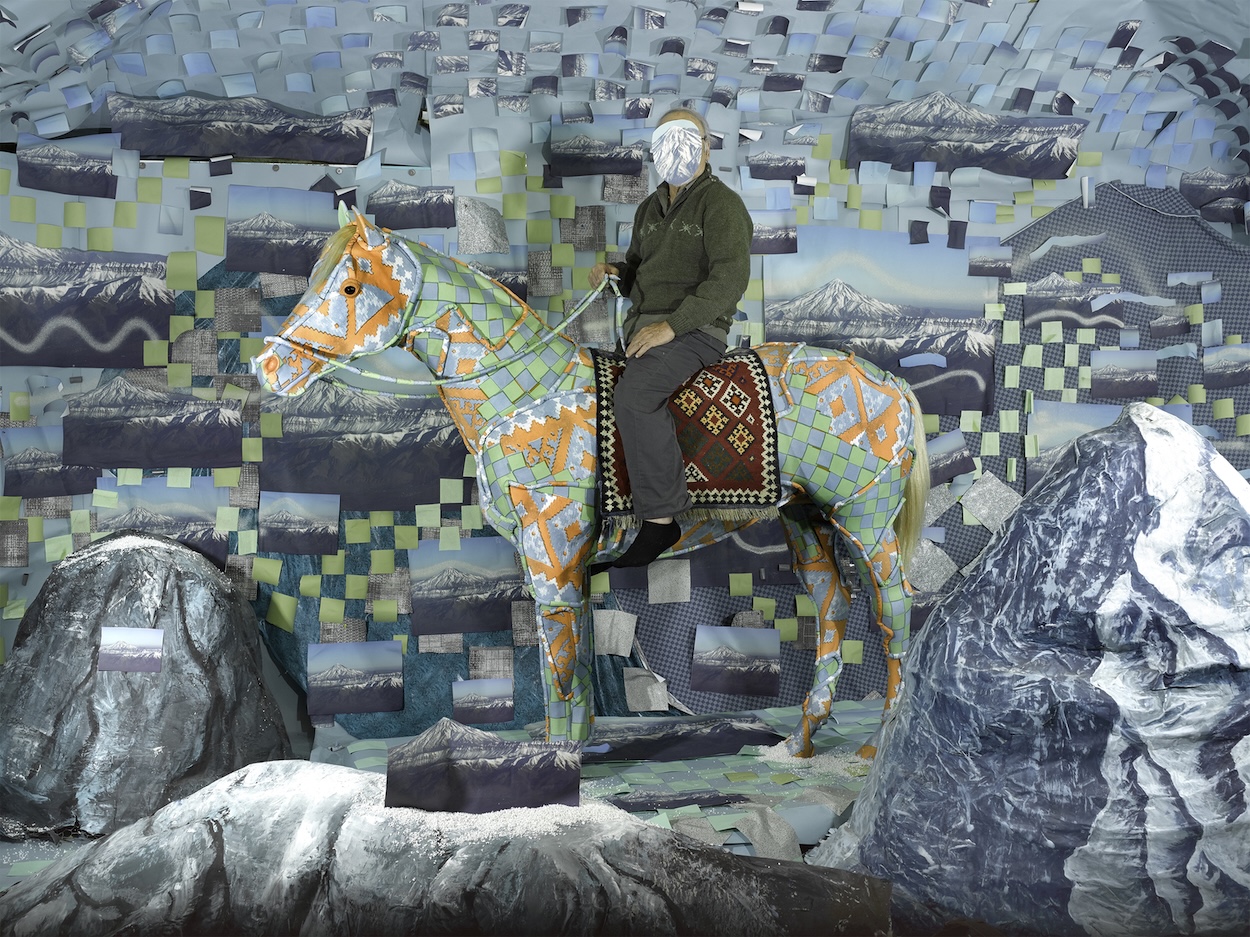
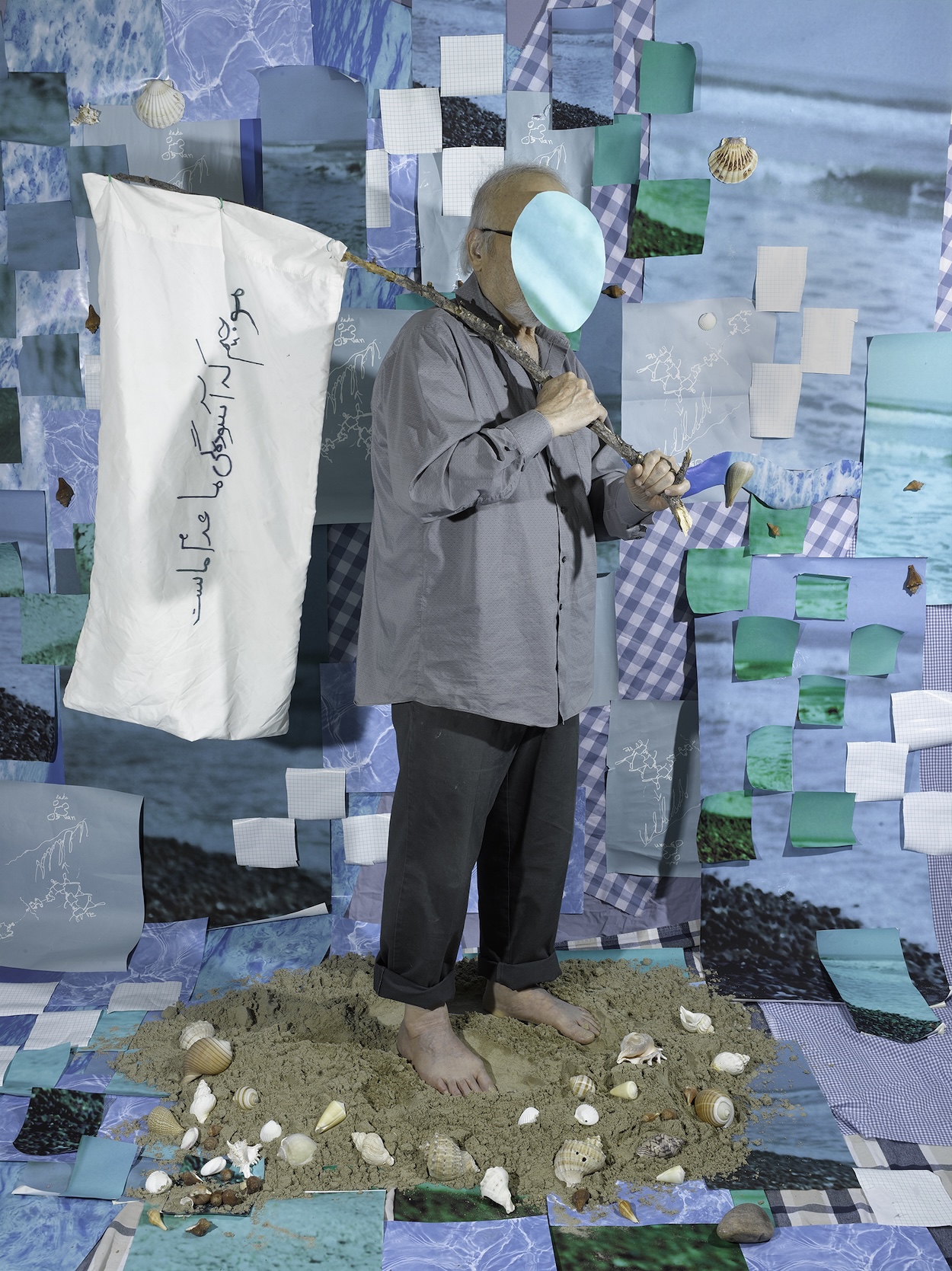
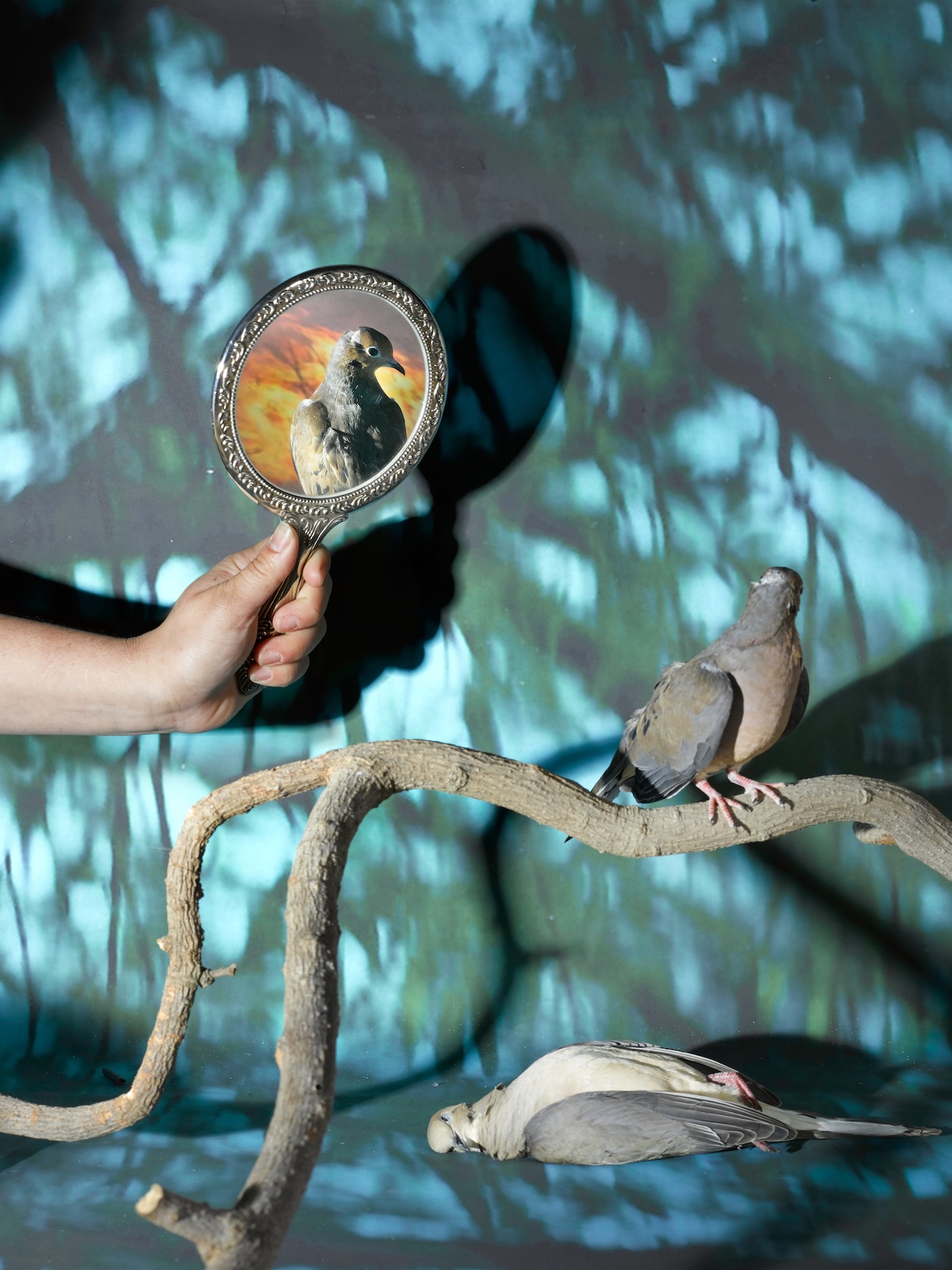
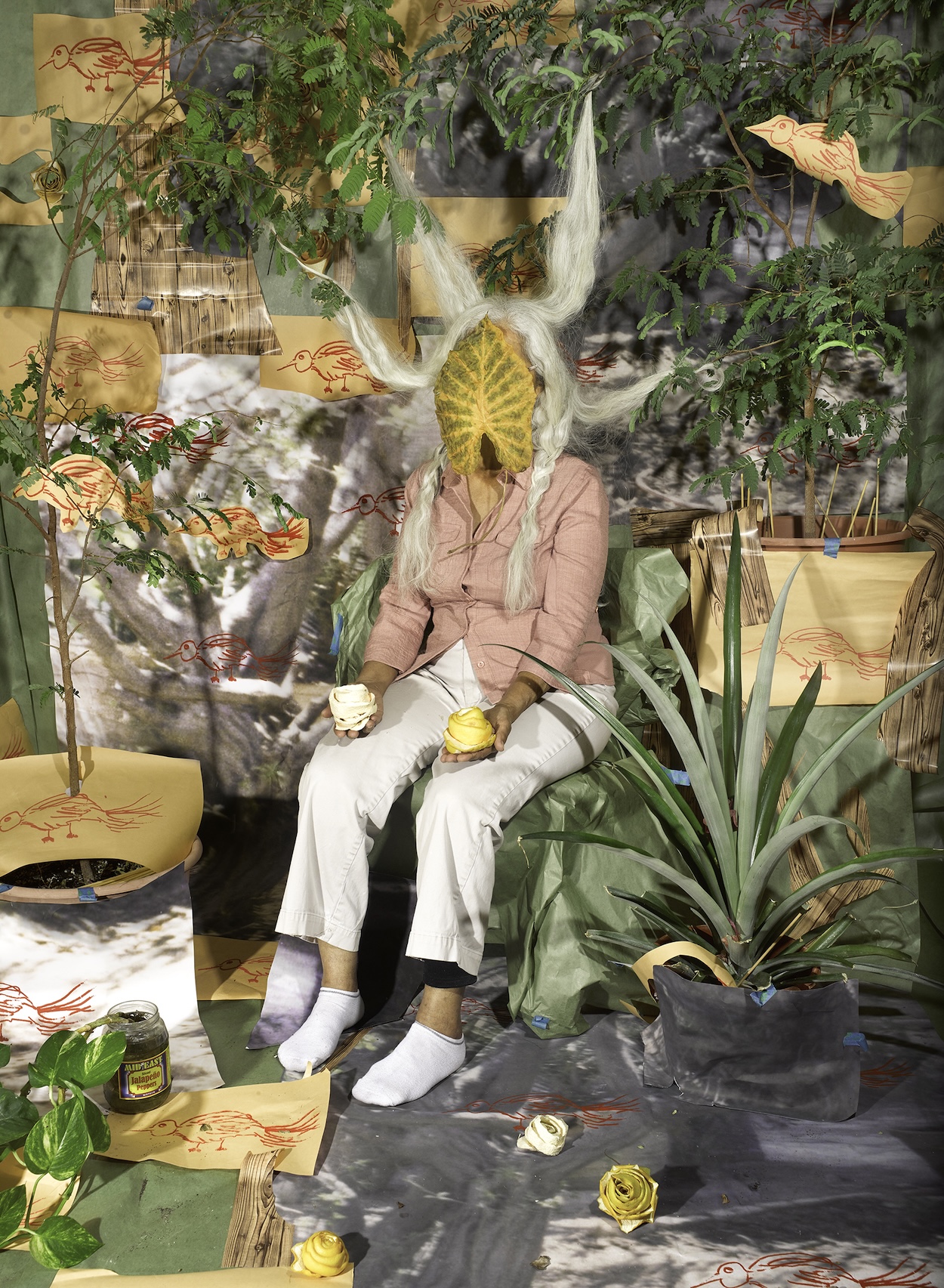
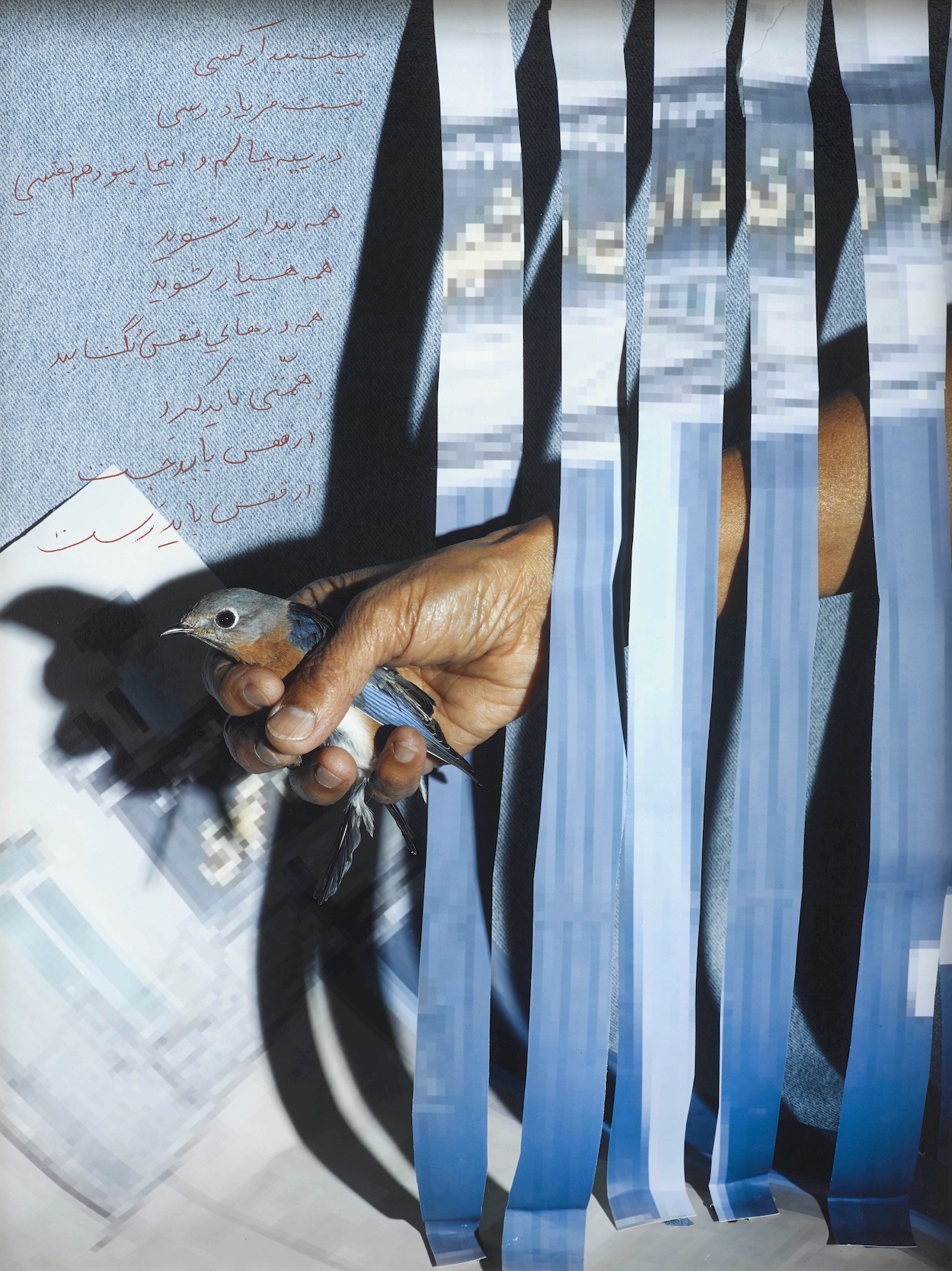
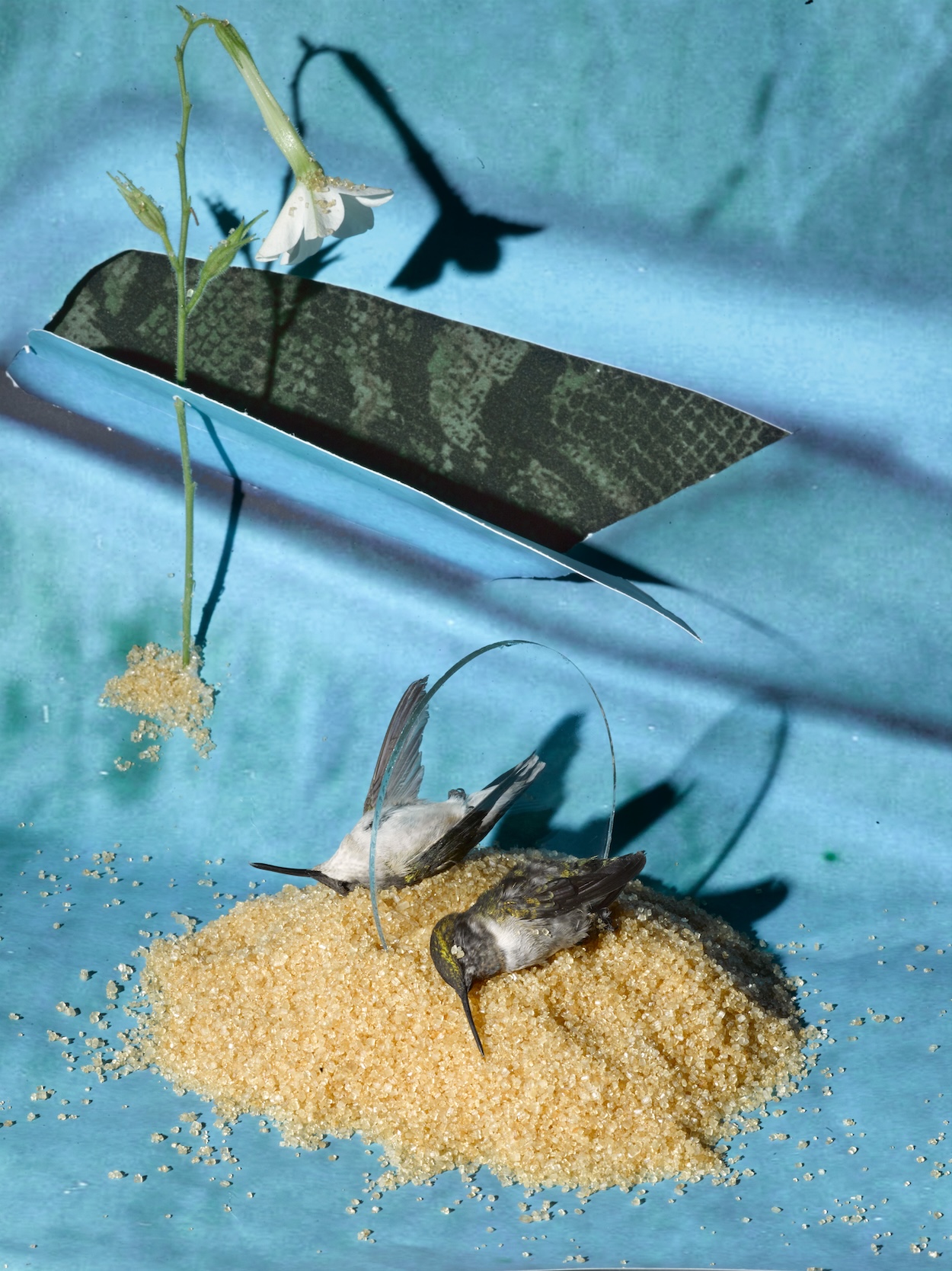
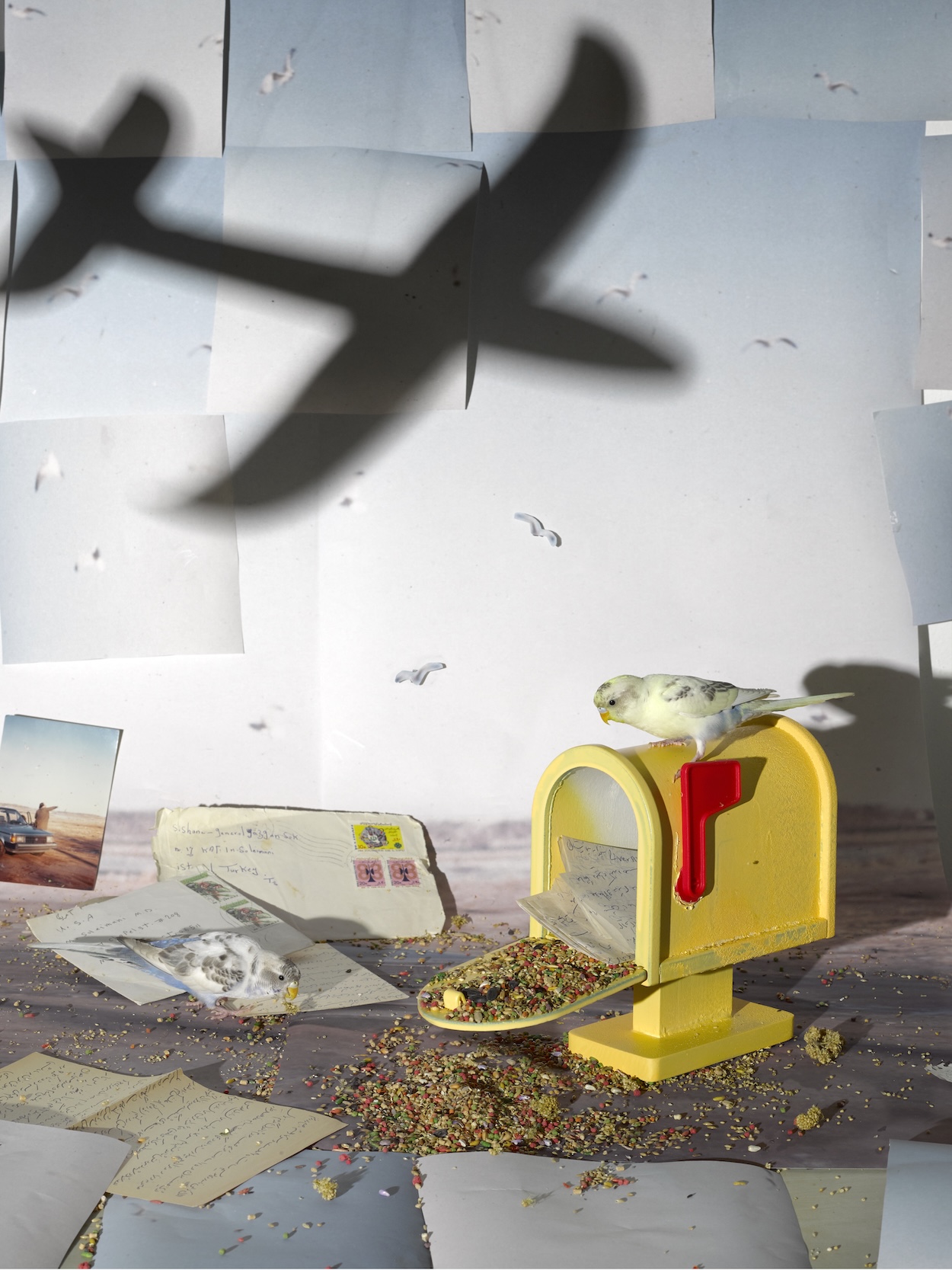
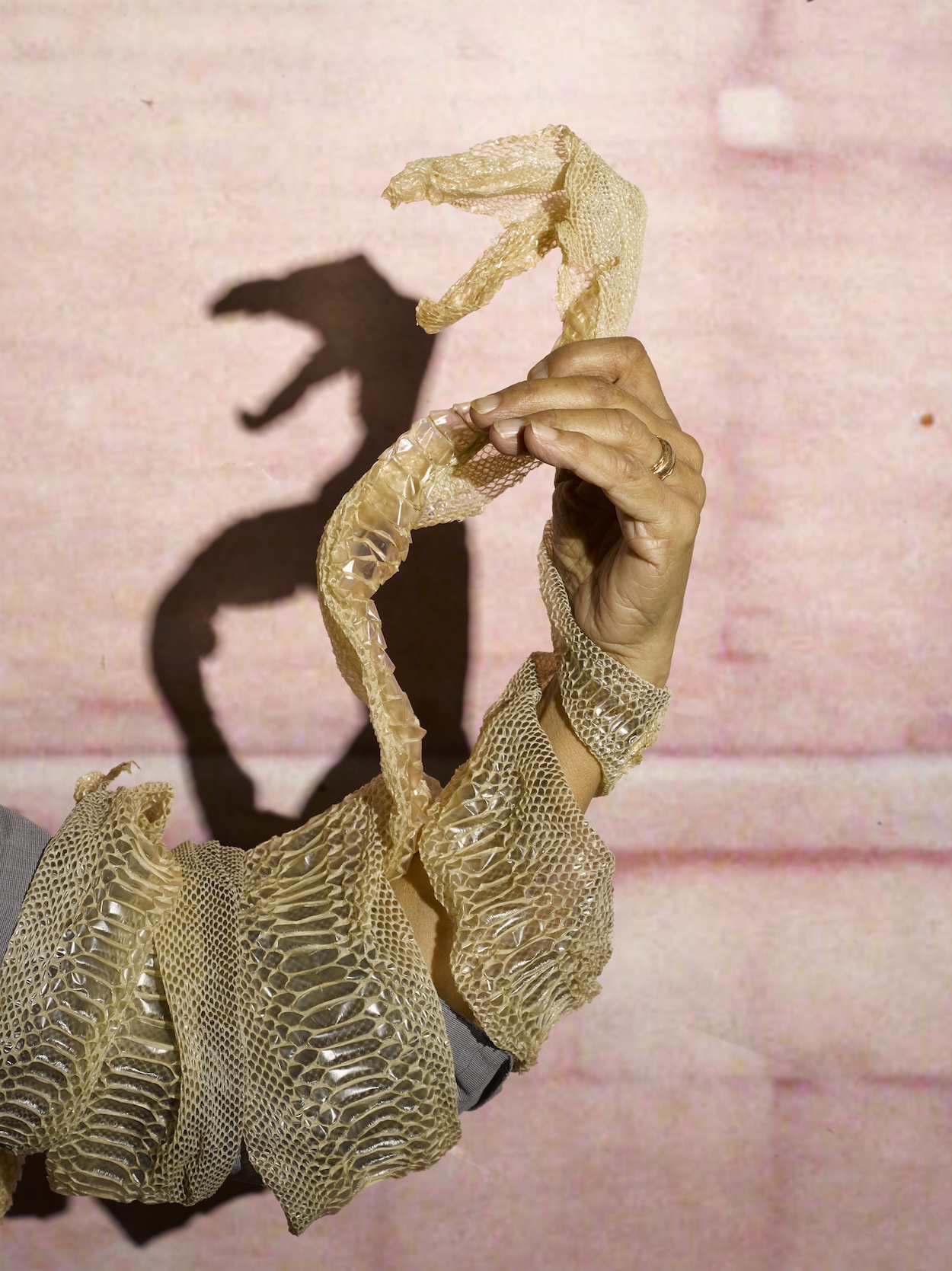
Artist, educator, and federally licensed wildlife rehabilitator Sheida Soleimani’s first exhibition with Yancey Richardson, “Forest of Stars,” open now through May 23, unifies two poetic bodies of work. First, Soleimani continues her ongoing Ghostwriter series of photographic tableaux—drawing from her parents’ lived experience as political exiles, following the 1979 Iranian Revolution. Second, the exhibition demonstrates an expansion of her practice through the inclusion of migratory birds, influenced by her work as the founder of a bird care center. In addition to subjects, these birds act as metaphors for themes central to the artist’s work: care, survival, and movement.
The scenes constructed by Soleimani—who has exhibited with the International Center for Photography, New York; the Museum of Fine Arts, Boston; and more, and whose work is held in the permanent collections of institutions including the Solomon R. Guggenheim Museum, the Victoria & Albert Museum, MIT List Visual Arts Center, and Cranbrook Art Museum—prod the gravity of reality with surrealist touches. To learn more about “Forest of Stars,” we spoke with the artist following the exhibition’s opening.
There’s a throughline of care in your work—familial, ecological, rehabilitation. You’ve described tending to vulnerable bodies as a political act. Would you share a bit more about how care operates as a form of resistance in your practice?
Care is something I do every day. It’s not abstract. It’s physical, repetitive, and often exhausting.
At the clinic, I’m working with birds injured by human infrastructure—window strikes, fishing line, rodenticides, cars…the list goes on. What we experience as open or transparent is, for birds, often an invisible barrier. They don’t perceive it until impact. A lot of what I see comes out of that disconnect—between how we design the world and how other species move through it.
That proximity shapes how I think. When you’re feeding a bird every 20 minutes, or stabilizing something that just collided with a building, you don’t get to think in abstractions. You’re dealing with a body in front of you.
In the work, that translates into a similar kind of attention. I’m not interested in distancing myself from the subject. Care becomes a way of staying close—of not reducing bodies or histories into something symbolic or easily consumed.
Your work engages your parents’ experiences of political exile following the 1979 Iranian Revolution, approached from a generational distance. How does that distance shape the way you interpret and construct these narratives?
I didn’t live those events. I came to them through stories, drawings, photographs—things that have already been shaped and reshaped over time.
What feels important to me is that these works aren’t constructed alone. There’s an ongoing collaboration between my parents, their memories, the materials I’m working with, and the people who help build and stage the images. Even the act of constructing the tableaux is collaborative. There are multiple hands involved in bringing these scenes into being.
That distance creates space for that. I’m not trying to fix a single version of a story. I’m building environments where different versions can exist at once—where memory can be partial, unstable, even contradictory.
Time doesn’t move linearly in that process. It folds. And the images reflect that—they’re less about documenting something that happened, and more about how those histories continue to be constructed in the present.
Your Ghostwriter series reconstructs your parents’ histories. What do you think about authorship in that space? What does it mean to write someone’s story through images, and where do you locate your own voice within that act?
I’m working from oral histories—stories I’ve heard over and over, that shift slightly each time they’re told. I think of it as a kind of transcription, but not a literal one. It’s carrying something across forms, knowing it will change in the process.
Authorship sits in that movement. The stories aren’t mine, but the way they’re constructed visually is. My voice comes through in how I build the images…what I include, what I leave out, how I layer different moments together. I’m not trying to arrive at a definitive version of anything. The images stay open and hold the instability of the source material.
This exhibition includes a site-specific drawing by your mother, making her presence in the work more direct and visible. How has collaborating with her influenced the project?
My mother’s drawings were the starting point for everything. They were how I first began to understand the environments she moved through, what Iran looked like to her.
Those drawings hold a very specific moment in time. What I’m doing in the photographs is building outward from that—taking something fixed and allowing it to shift, to become spatial and to be inhabited in a different way.
So while the collaboration has always been there, bringing her drawing directly into the exhibition changes how it’s experienced. It’s no longer mediated through me. It sits on its own terms.
It also makes visible the gap between memory as something held internally, and memory as something staged and externalized. That gap is where a lot of the work operates.
You incorporate objects, archival fragments, and sculptural elements when building your tableaux. How do you decide what enters the image?
Each image starts with a specific story or event, so what enters the frame comes out of that. The objects are tied to the narrative—sometimes directly, sometimes more loosely—but they’re never arbitrary.
I’m not looking for balance or ambiguity so much as specificity. The objects need to carry something; weight, memory, a kind of charge. Even if a viewer doesn’t immediately recognize what they’re looking at, there’s a logic to why it’s there.
A lot of the process is iterative. I build the scene, shift things, remove things, add them back. It’s less about resolving the image and more about making sure everything in it is doing something—nothing is just decorative.
Your work as a wildlife rehabilitator feels inseparable from the images. How does that practice shape the way you think about responsibility, both inside and outside the frame?
The birds I work with are not symbols. They’re individuals with their own needs, limits, and stress thresholds. That comes first. That means the image is never the priority. The work has to adapt to the conditions of care. If something would compromise the animal, it’s not an option.
It also shifts how I think about what an image is. It’s not a complete object—it’s a fragment of a much longer process. Intake, treatment, recovery, release—or sometimes loss. Responsibility extends beyond what’s visible. It’s embedded in how the work is made, and in the ongoing relationship to the animals themselves.
“Forest of Stars” suggests a layered vastness—both celestial and grounded. How did the title emerge, and how does it shape the way you think about the exhibition as a whole?
The title comes from Aftabkaran-e Jangal by Saeed Soltanpour, a revolutionary poem/song my baba used to sing. The line “یه جنگل ستاره داره”—“he carries a forest of stars”—always stayed with me.
The song moves through cycles—“سر اومد زمستون / شکفته بهارون”—winter ending, spring returning. The tulip is central to that: it blooms, disappears, and comes back multiplied. What looks like loss is actually continuation.
That’s how I think about the exhibition—histories that don’t vanish, but shift, accumulate, and re-emerge. Not one story, but many, held together.