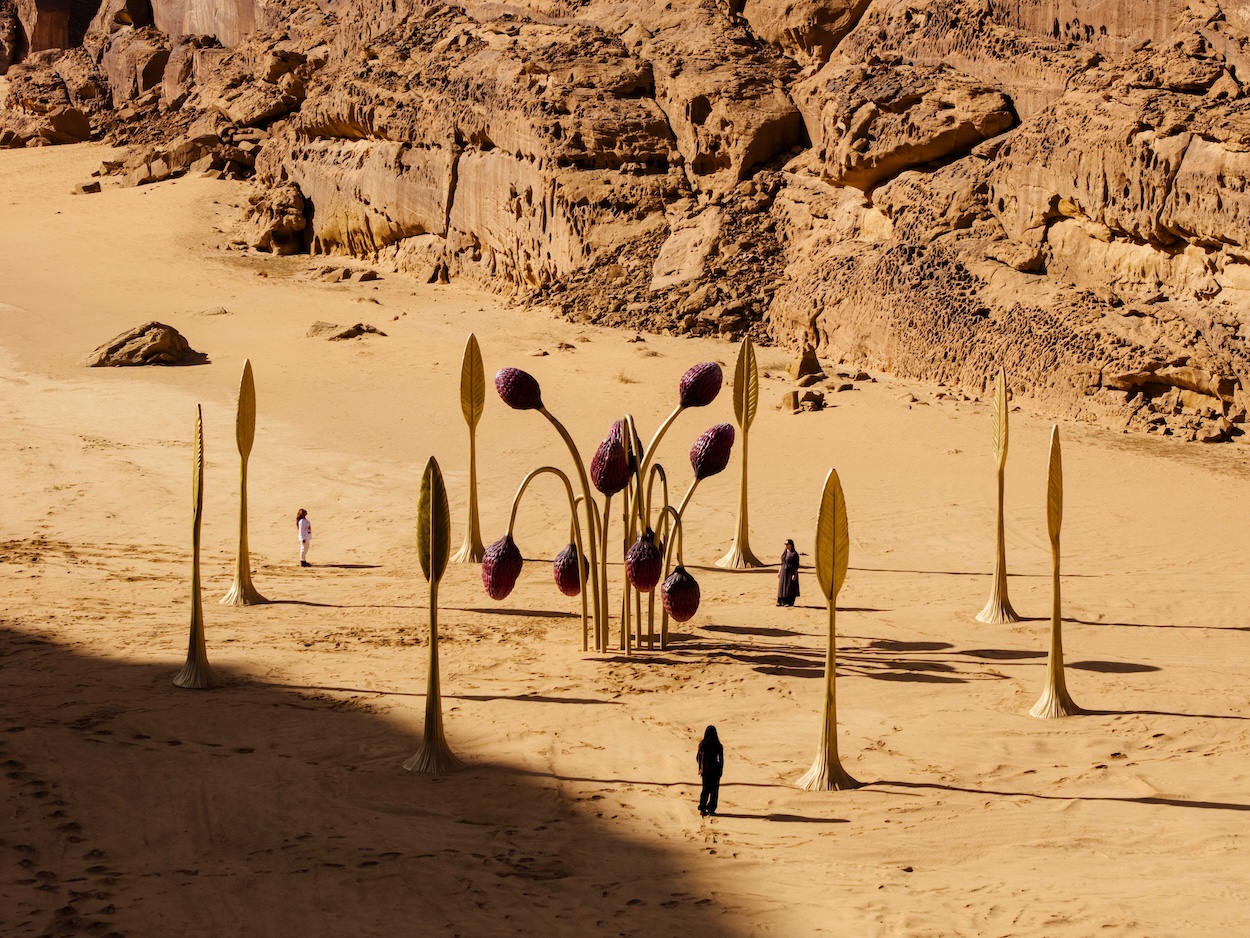
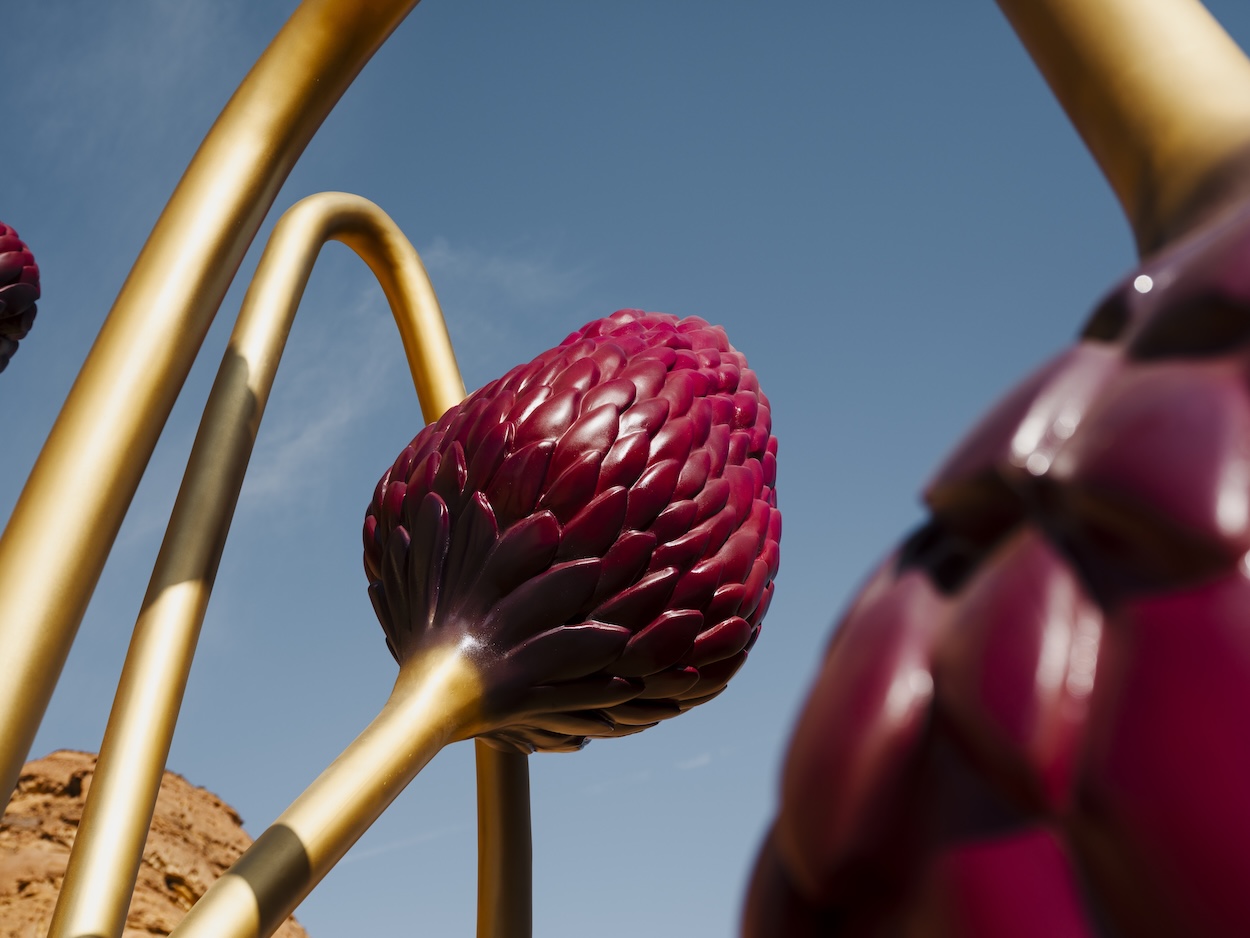
Maria Magdalena Campos-Pons, Desert X AlUla 2026, Courtesy of Lance Gerber…
AlUla might not be the flashiest place in Saudi Arabia. This seemingly quaint city is home to a dramatic landscape, rich history, and rapidly expanding cultural scene. The desert waystation—once a stopover for incense traders and pilgrims making their way to Mecca—has re-emerged as a tourist destination but not one overwhelmed by the type of sterile all-inclusive hotels and manufactured attractions found in other resort areas.
This wellspring city is undergoing a slower, more considered form of development. Earmarked as part of the kingdom’s overarching Vision 2030 project (pulling the country away from its sole reliance on oil), AlUla’s careful revitalization—managed by the Royal Commission for AlUla (RCU)—centers three areas: ecology (restoring its verdant palm tree oasis), cultural preservation (its status as Saudi Arabia’s first UNESCO World Heritage Site), and the arts: shedding fresh light on age-old local crafts but perhaps, more poignantly, making splendid use of the wind-swept limestone wadis (valleys) in its surroundings.
Maria Magdalena Campos-Pons, Imole Red, Desert X AlUla 2026, Courtesy of Lance Gerber…
This third mission—providing a platform for contemporary creatives and long-established practices specific to the area—relies heavily on bringing recognized international institutions and tastemakers in as partners: lending their clout but also engaging local creative output. The now closed-for-renovation Centre Pompidou collaborated on the just-opened “Arduna” exhibition—inaugurated a new permanent art museum. The Paris stalwart loaned several masterpieces that are displayed in strategic dialogue with 80 carefully selected works from the Saudi and regional canon. Regardless of the endeavor, everything new here is deeply rooted in place, site responsive, but informed by external forces.
California-based outdoor art exhibition Desert X has hosted bi-annual offshoots here as part of the AlUla Arts Festival since 2020; presenting works by regional and international artists. Staged in one of the towering wadis right outside of town, this year’s aptly themed “Space Without Measure” edition runs till February 28.
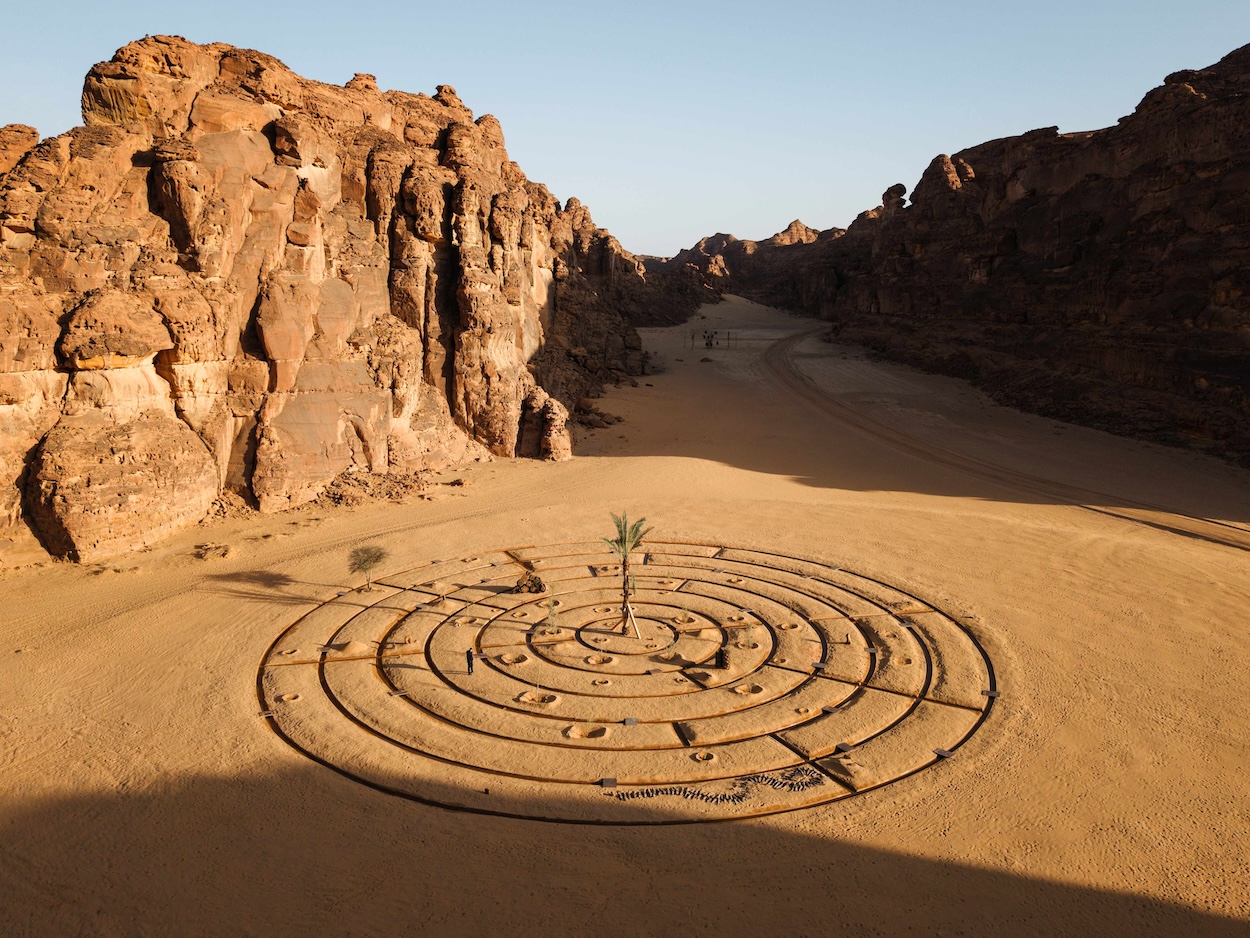
Mohammad AlFaraj, Desert X AlUla 2026, Courtesy of Lance Gerber…
Choosing this focus, guest curators Wejdan Reda and Zoe Whitley referenced Lebanese American writer Kahlil Gibran’s ruminations on how human perception and the sense of possibility can be boundless. Physically expressing the concept within this monumental and seemingly boundless context made complete sense. “AlUla’s landscape is a living archive of stories, traditions, and encounters that span centuries,” Reda said. “For this edition, [the exhibitors] have engaged with its valleys and historic routes to create works that honor its landscape while opening new spaces for imagination.”
The 10 large scale installations reflect this framework both as site-specific responses—playing off of different sensorial and visual attributes—and emotional explorations—the human factor. Each distinctive piece roots in its carefully chosen siting—a muddy flood plane, narrow crevices with special sonoric qualities, or an open sand patch that takes in ample amounts of direct sunlight for optimal visual effect.
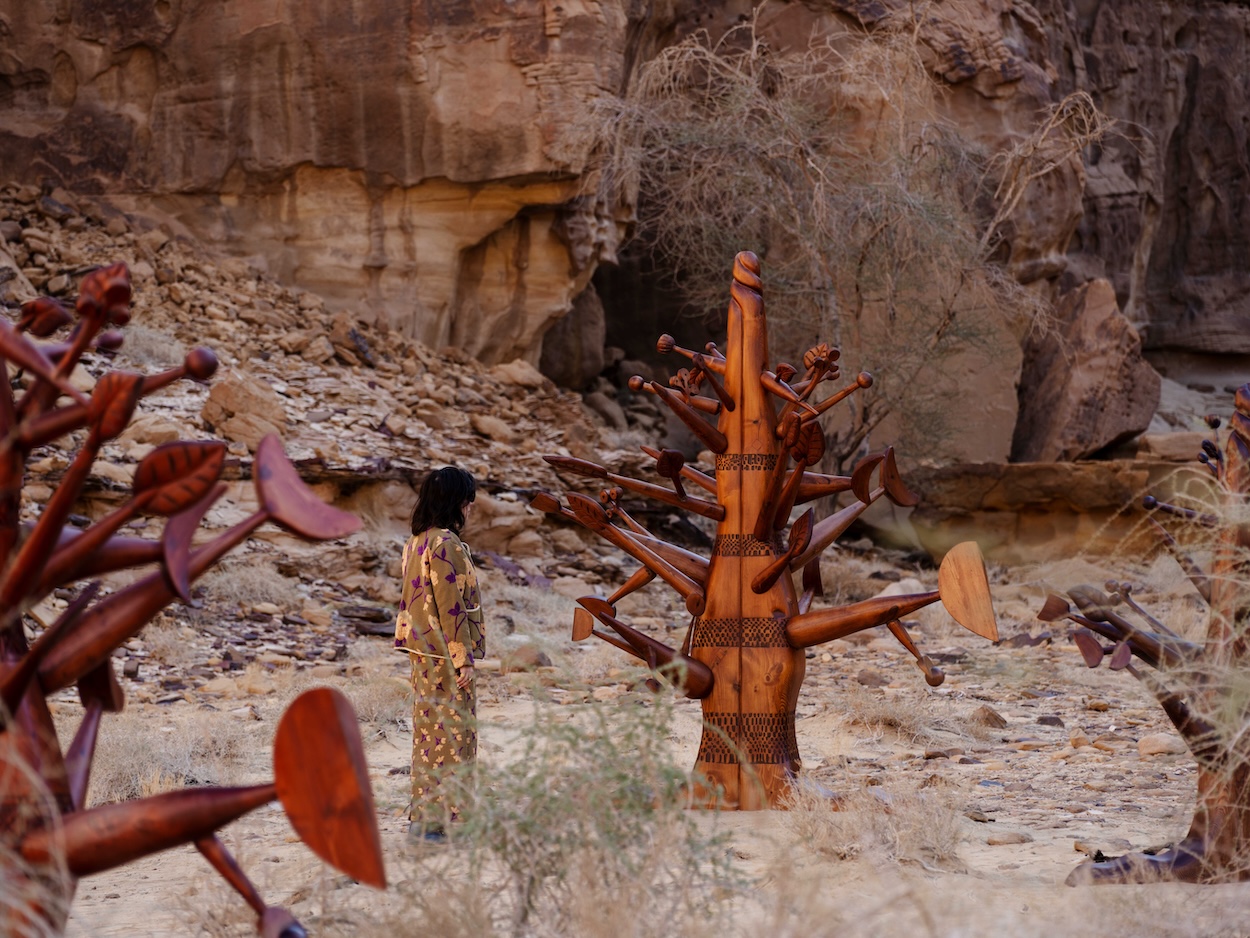
Ibrahim El-Salahi, Desert X AlUla 2026, Courtesy of Lance Gerber…
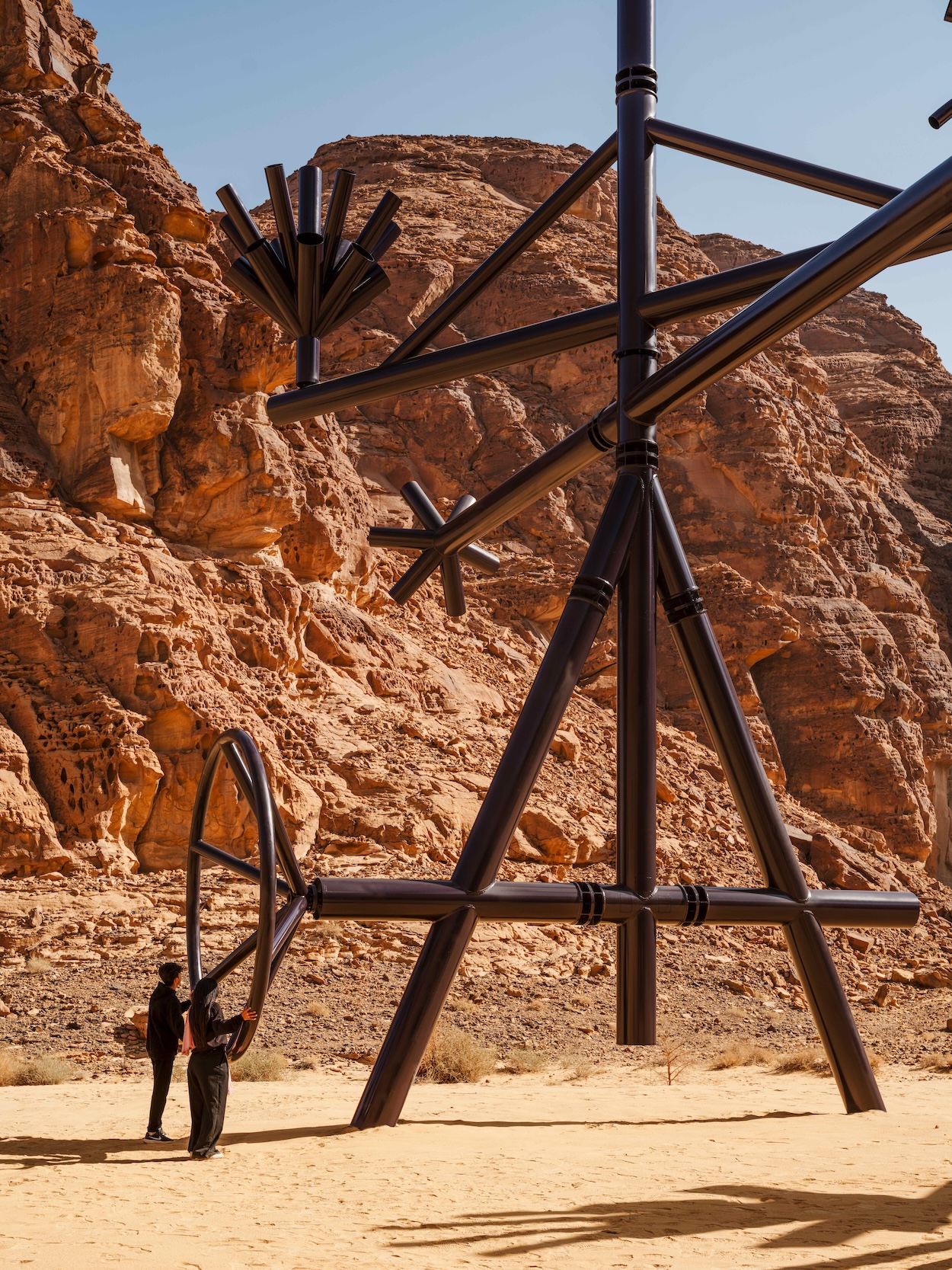
In this latter context, multidisciplinary collective Bahraini-Danish—named for the origin countries of its members—mounted Bloom. The larger-than-life kinetic sculpture—somewhat akin to a Mark di Suvero piece—takes on industrial dimensions in its welded metal assembly. But this structure isn’t the main attraction. Emulating the much softer, ethereal occurrence of desert flowers moving in the wind, the moving contraption’s long-cast, ethereal shadows are what is meant to be experienced.
Like certain architectonic treatments that engender unexpected acoustics effects—hearing one’s whisper on the other side of a large dome—wadis can also reverberate sound in surprising ways. Looking to translate what it might feel like to be both outside and inside a drum, Mexican artist Héctor Zamora created a large hyperbolic enclosure that becomes a massive percussion instrument when interacted with. The Tar HyPar piece echoes within its narrow gorge placement.
While Basmah Felemban’s Murmur of Yobbiet sculpture modulates the intricately water-worn limestone cliff faces in its midst, Mohammed AlSaleem’s glistening totems distill the formally symbolic language of sacred spaces found across Saudi Arabia.
Bahraini-Danish, Desert X AlUla 2026, Courtesy of Lance Gerber…
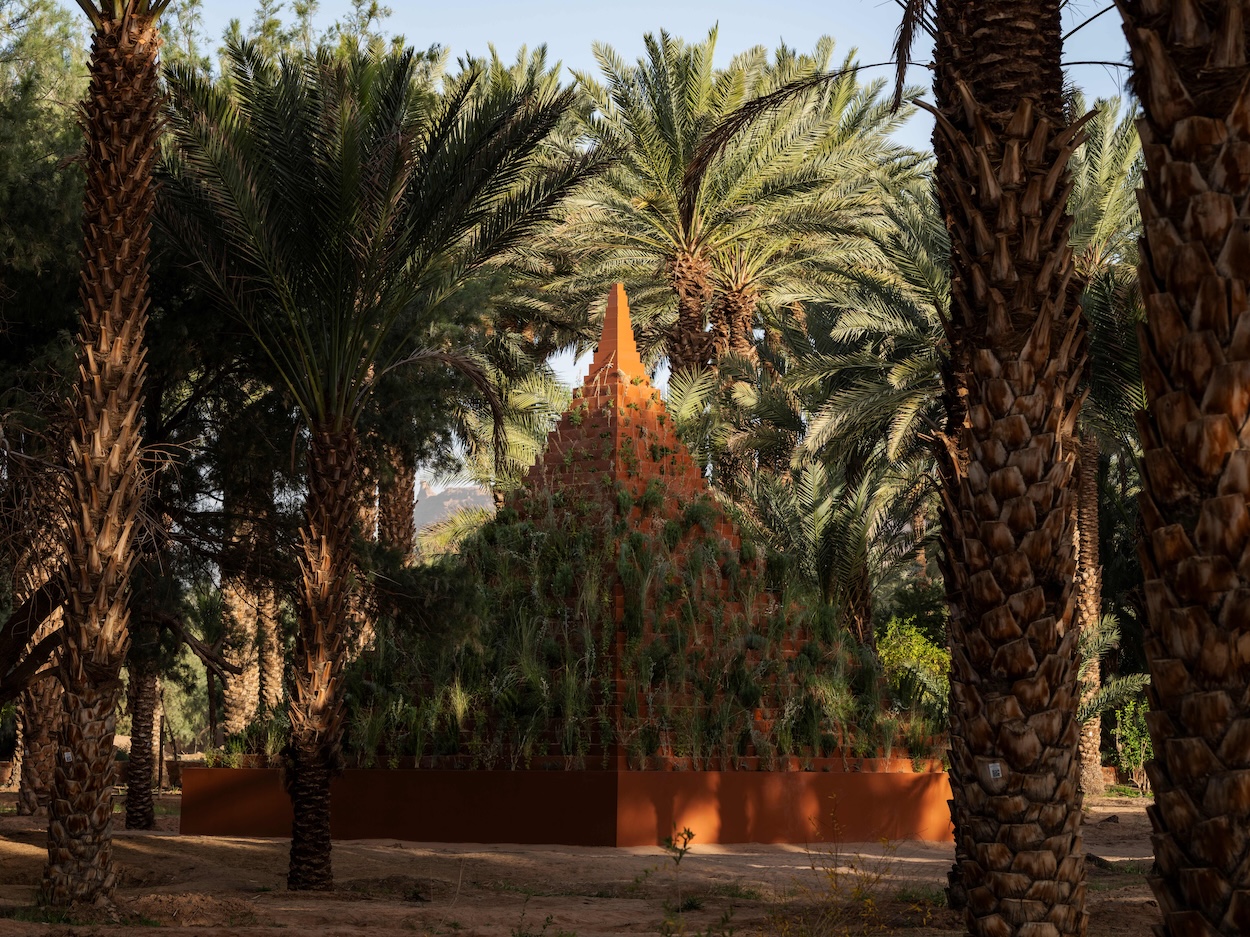
As an offsite Desert X installation, revered environmental artist Agnes Denes’ The Living Pyramid takes pride of place at the southern edge of AlUla’s oasis. Though boldly geometric in its formation, this transcendent structure takes on the reddish clay tone of nearby cliffs and its tiered bays are filled in with endemic plants. Though decidedly universal in shape—an iteration of similar installations presented around the world—the work is also emphatically site-specific.
A much grander version will serve as the focal point of the artist’s expansive contribution to the Wadi AlFann “living museum,” an impressively scaled project also spearheaded by RCU. A 24.7 square-mile site—comprising numerous unspoiled canyons and soaring cliffs—has been allocated for the creation of massive earthworks by the likes of James Turrell, Michael Heizer, and other art world heavyweights. These mammoth chefs-d’œuvre will remain in place, not just permanently, but for the next 1,000 years.
Agnes Denes, The Living Pyramid, Desert X AlUla 2026, Courtesy of Lance Gerber…
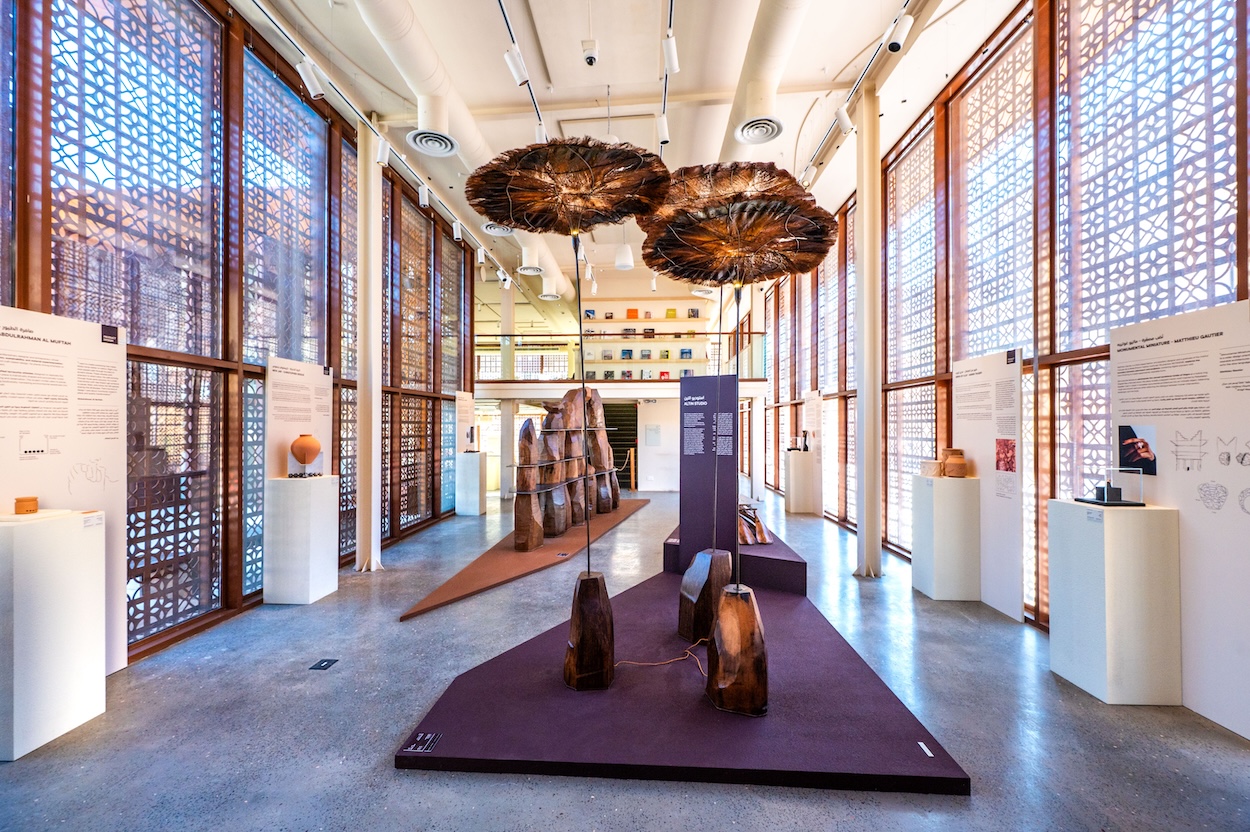
The idea of permanence—contextualization and again, site responsibility—was also the underlying thread for this year’s AlUla Arts Design Residency program. Through the initiative, five emerging, and mid-career studios were invited to spend three months in AlUla and conduct onsite research. They then developed new furniture concepts informed by the city and its distinct setting. Much of this exploration centered on material and form but also ethnographic observations of local civic life.
“From the onset, I was intentional about ensuring the pieces could be integrated back into AlUla and wider Saudi Arabia, and not just for displaying purposes,” said Dominique Petite-Frère, the curator of the program and subsequent “Material Witness” exhibition, presented as part of the arts festival. “The proposals needed to actually be lived with, in this context, and react to its conditions.”
Design Space AlUla 2026, Material Witness, Celebrating Design From Within, Courtesy of Arts AlUla and AlUla Moments…
Petite-Frère is the founder of new format platform Limbo Accra, a residency and exhibition platform also firmly rooted in the ever-relevant strategies of place-making and rigorous adaptive reuse; manifesting the dynamic re-implementation of underutilized and unfinished buildings in the Ghanaian capital. From the five resulting designs, two stood out as the most attuned to this mission, especially in terms of reimagining local public space and architecture.
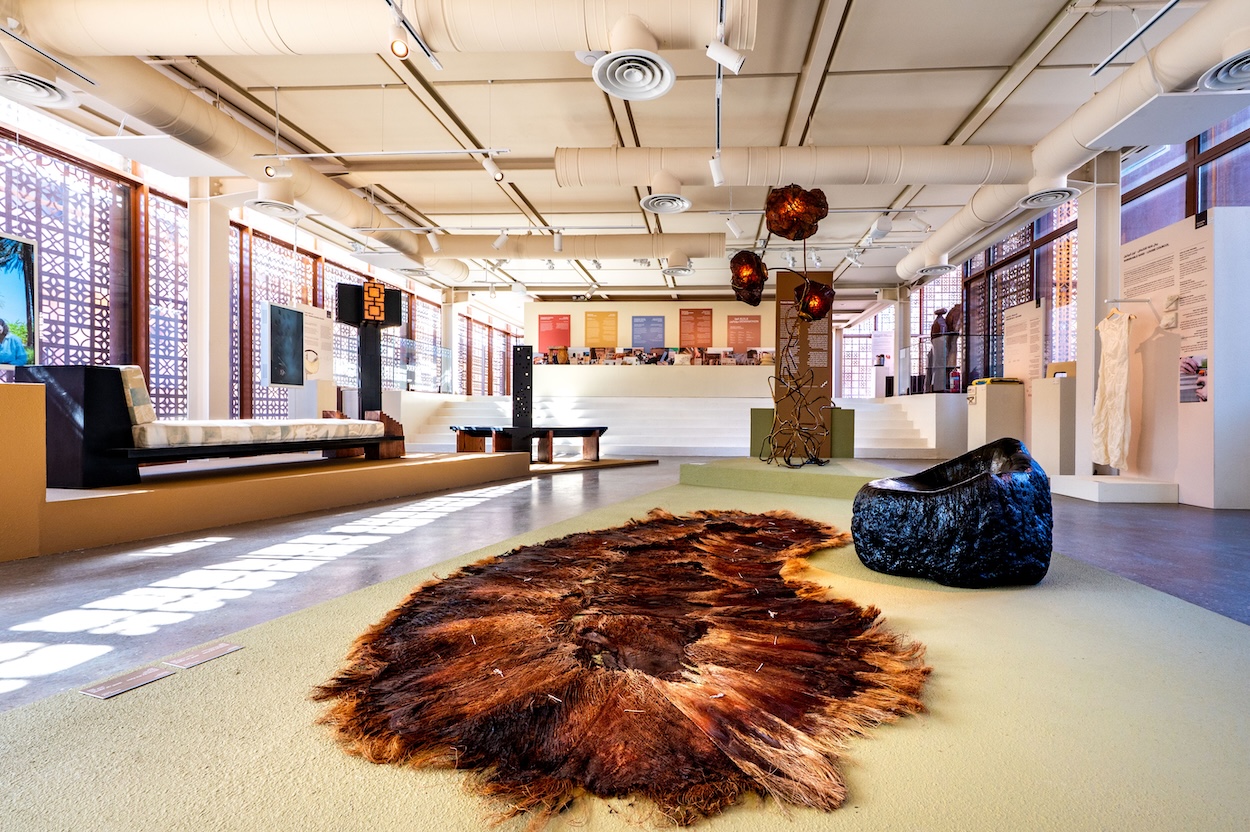
Riyadh-based Aseel Alamoudi translated her aesthetic exploration of the intricate rock formations encapsulating AlUla—a visual research similar to that of Basmah Felemban—into extruded, 3D-printed sand benches. Her concept and newly formulated process expands into a speculative proposal for a massive, desert floor-embedded playscape intended to inspire a less prescriptive form of activity than a standard playground.
Design Space AlUla 2026, Material Witness, Celebrating Design From Within, Courtesy of Arts AlUla and AlUla Moments…
Amsterdam-based material research practice Studio ThusThat probed the potential of combining basalt—the especially petrified stone found atop AlUla’s cliffs—and slag, a byproduct of industrial metal production. As part of Vision 2030, a new extraction industry is emerging in the country. The result of Studio ThusThat’s research and ideation is a new fortified material, applied as a tile.
The designers—Kevin Rouff and Paco Böckelmann—presented the new material as the finish of a circular bench, reflecting the shape of pre-historic desert kite wall structures prominent throughout the Arabian desert. The ultimate goal is to develop the tiles as a building material; potentially helping to establish a secondary industry here; serial producing the tile as an alternative facade material for new construction.
As evident throughout this year’s Desert X AlUla and AlUla Arts Design Residency programs, site-responsivity and cultural preservation don’t always have to be mired in tradition or explicit representation; turned into the same inauthentic and formulaic tchotchkes sold in souvenir shops.