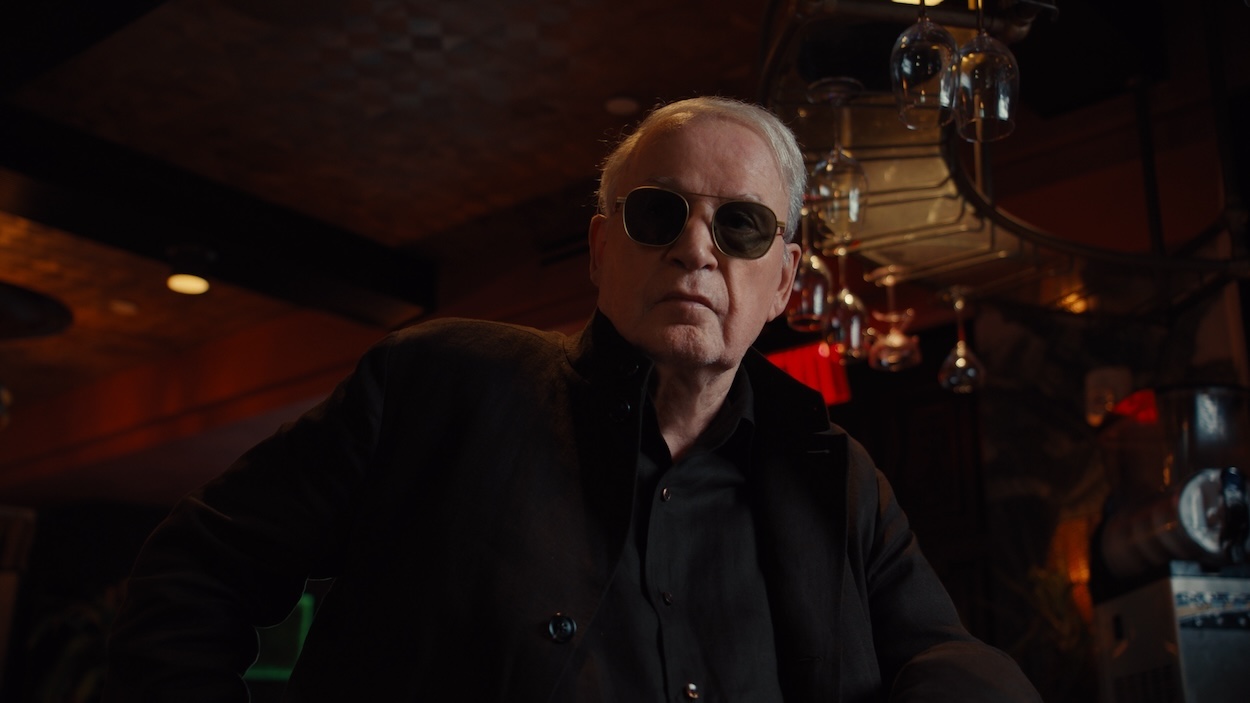
Earlier this month, Italian composer, disco pioneer, and forefather of electronic music Giorgio Moroder decamped from his peaceful retreat in the Dolomites for the frenzy of Miami during art week. But Moroder’s destination was far from the chaos of the fairs and Miami Beach. The composer was in town for a one-night performance at Villa Zegna: an invitation-only club hosted by the Italian fashion brand at global editions of Art Basel, where guests find common ground over culinary, fashion, and cultural connections. For the Art Basel Miami Beach edition of Villa Zegna, Moroder was the guest of honor at a rooftop dinner in the Miami Design District, where, for the first time, he recreated the production and composition process of Donna Summer’s 1977 disco track, “I Feel Love,” this time with vocals by Italian vocalist Arianna Bergamaschi.
Long before he influenced EDM, before his Oscar wins, and before his soundtracks for Flashdance, Top Gun, and Scarface, there was “I Feel Love.” Spurred on by the success of Serge Gainsbourg and Jane Birkin’s “Je T’aime—Moi Non Plus,” Moroder set out to up the ante. “I was thinking, I remember, ‘my sex song has to be much, much hotter,’” he recalled with a chuckle from Villa Zegna on December 2. He knew he succeeded when “The BBC didn’t play it,” he said. “Thank god, because we got a lot of promotion out of that.”
In an interview with Surface, Moroder shares a deep dive on his live demo and performance of “I Feel Love,” a career first for the composer, in Miami.
What was it like to show the audience in real time how you created a song that went on to become so emblematic of the disco genre?
Actually, to present it, it was very easy, and it’s fun to do it. To prepare it was quite a job. Not as much as the first time, but it took us about a week to prepare and schedule the sounds, and then, of course, the arrangement of the song.
It looked so effortless.
Yeah, but we had to do a lot of tests. I’d say “Give me the bass,” and Steve [the sound engineer] had to give the bass. It was relaxing for me, for the engineer.
It sounds like a difficult and complex presentation to put together. Why go through the trouble of showing it to an audience like that?
I get a lot of requests asking, “How did you do it?” It’s easy to tell, but it’s much better to show how it was. That’s the reason why we did it. It’s more visual now—if you hear it and you see it. You saw on the levels how the music worked. You saw every new track coming up, and it works quite well visually.
This was the first time ever that I recreated it. I recreated it before just by playing the song, but not visually. Now we could see all the tracks moving, and that gives you the feeling of how complex it is and how difficult it is to mix.
It went so well that I was feeling, “Oh, is it over already?” I would have continued for at least another minute.
Do you have a favorite memory of hearing the song play or seeing Donna perform the original?
This is technically a little difficult to explain, but at the very beginning I had the bass divided into two parts: the main bass on the left-hand side and the repeat on the right-hand side. So if you would stand or sit in the middle, it was a little confusing with the two sounds. But in the later mixes, I joined the sound—they were more mono than stereo.