Katie Stout’s Fantastical Creatures Crop-Up in the Miami Design District
The maverick artist’s largest works to date, the zoomorphic Gargantua’s Thumb sculptures are new playful, yet somewhat grotesque, protagonists for the ever-evolving commercial and cultural district
A fixture of the New York art and design scene for well over a decade, Katie Stout stands out for her particularly irreverent approach to sculpture and object making. Her hand-crafted works—often interpreting the female form—test the limits of function and traditional craft techniques; let alone common iconography. Her works are at once droll and eerie. That’s the point. Much of the RISD-trained talent’s output stems from a desire to turn conformity on its head; challenging the conventions—solemnity—of both fine art and high design.
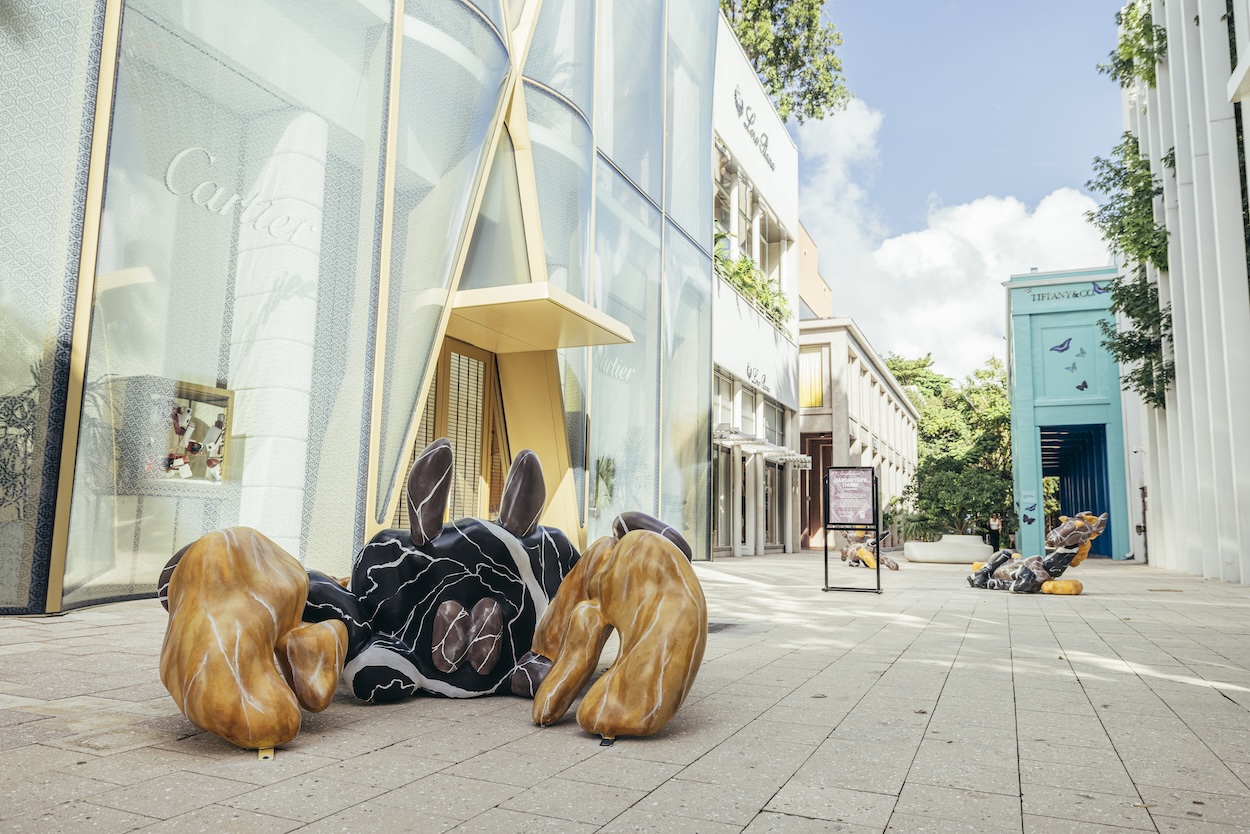
“I’m interested in the point where something becomes really awful or just kind of awful,” she says, “that line between kitsch and art, ugly and beautiful.” It’s no different with her latest project: the Gargantua Thumb sculpture series. Debuted during Miami Art Week , the abstracted, animal-like forms now hold pride of place along the glittering promenades of the Miami Design District. The commercial neighborhood has emerged as a concentrated repository of both experimental architecture and luxury retail, fashion, and furnishings.
The project, Stout’s largest undertaking to date, marks the 10th anniversary of the Miami Design District’s public art Curatorial Lab Annual Design Commission initiative, developed in partnership with foremost collectible fair Design Miami. Stout’s permanent contribution to this urban landscape joins benches by Samuel Ross, monkey bar playground equipment by Dozie Kanu, and equally interactive form by Studio Proba.
“Over the past decade, the Annual Design Commission has helped shape the Miami Design District into a global stage for bold, original ideas,” says Craig Robins, the founder of both the district and fair. “We’re proud to mark this 10th anniversary with Katie Stout, whose playful and provocative work challenges the boundaries of design.” For the maverick artists, creating works for this context and at this scale represented a next step in her already well-established and revered practice.
“I’ve never intentionally made outdoor sculptures before,” she says. “I’ve put things outside and have been surprised that they survived. Obviously there are more logistical challenges like weather, durability, safety but I liked the opportunity to design something outside of a domestic environment. Making work for a public space shifts the scale and the meaning and makes it feel more like infrastructure.”
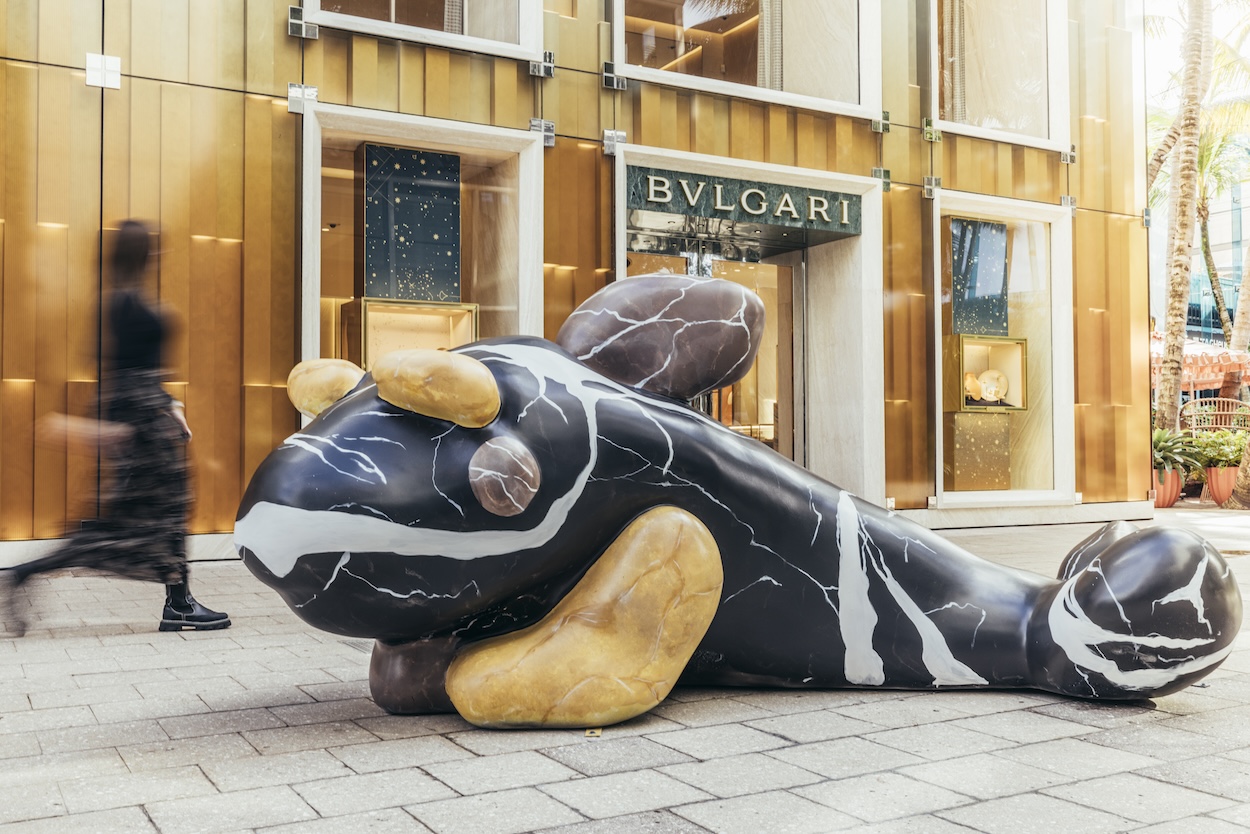
Like the previous commissions, the pieces—a kneeling dear and a crouching crab, among other creatures—are meant to be interacted with. The rigid foam and hard surface coating used—painted in a faux ‘zoomed-in’ marble grain—was essential to deal with Miami’s climate.
“It turns out that one foolproof way to make something survive Miami weather is to build it like a surfboard,” says Stout.” The artist first created the forms by roughly cutting and intuitively compositing distorted elements in clay on top of wire frames. The pieces were then scanned and enlarged using precise milling technology.
Though seeming to move across the environment of their own entropic volition, the obviously inert forms were carefully placed in situ. “The flopping trout and the pelican obviously needed to be near each other-they’re part of the same tiny world,” she says. “Some of the sculptures directly respond to the stores they sit in front of, like the horse placed at Hermès. Others are in conversation with each other.”
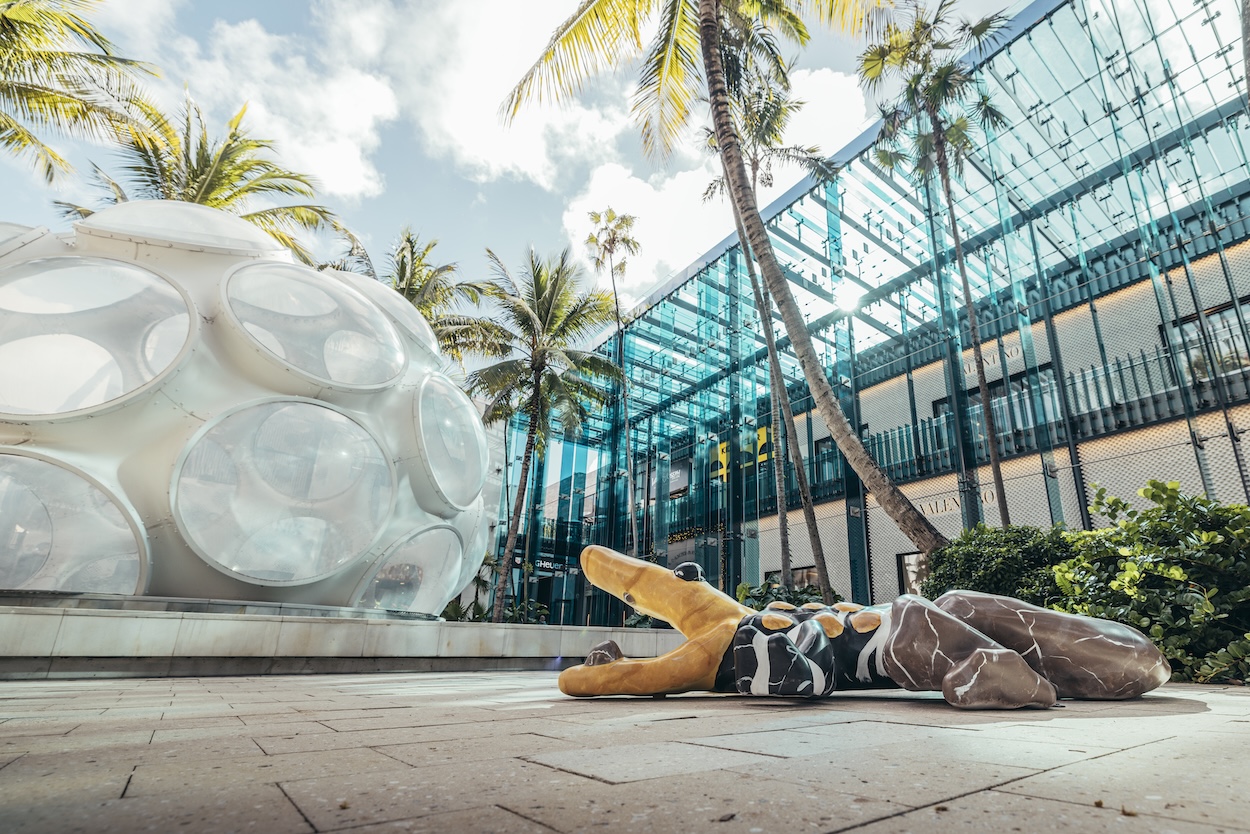
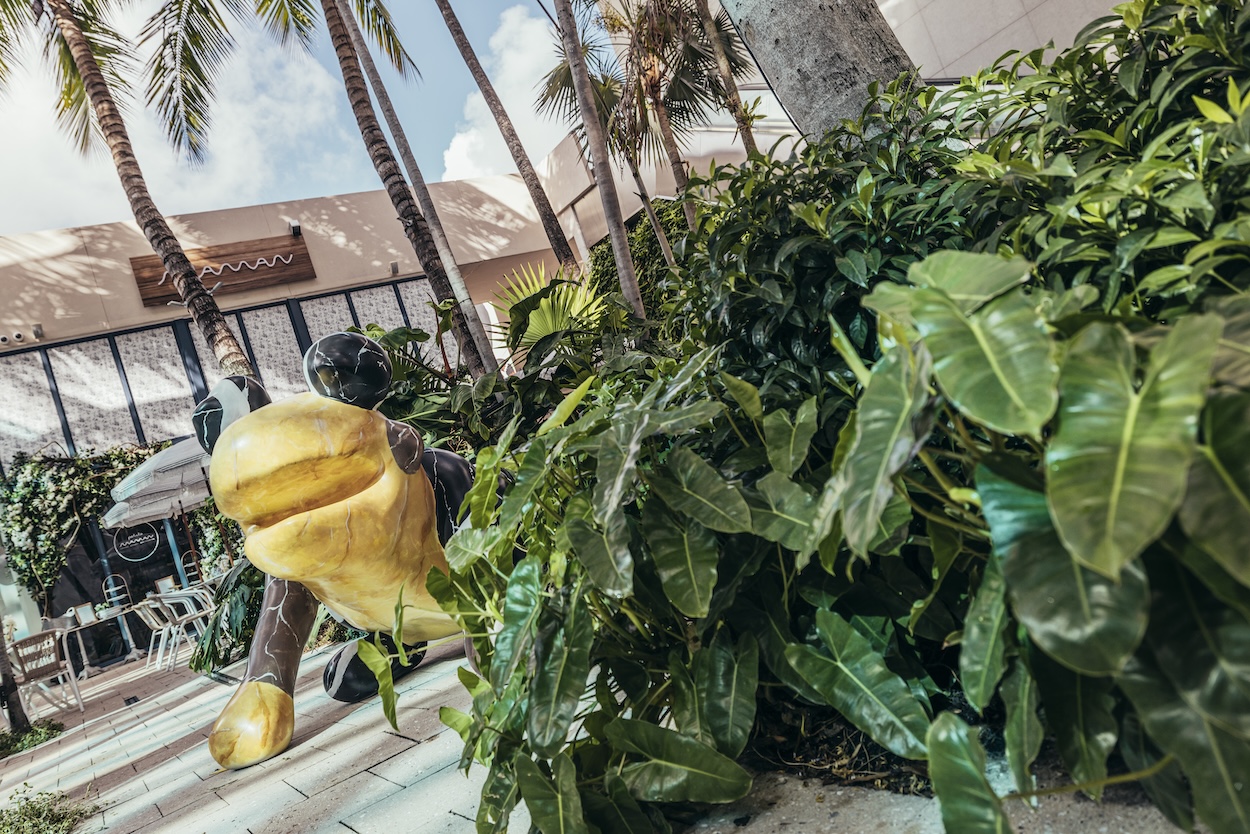
“I wanted the layout to feel a bit operatic: certain creatures lurking like the frog hiding in the bushes and others staging mini narratives, like the alligator trying to swallow the Buckminster Fuller dome,” she adds. First presented as part of Design Miami’s 20th edition fair, the Carousel piece—replete with ever more whimsical depictions—is the finishing touch. After the run of the show, the functional sculpture will also be installed in the Design District.