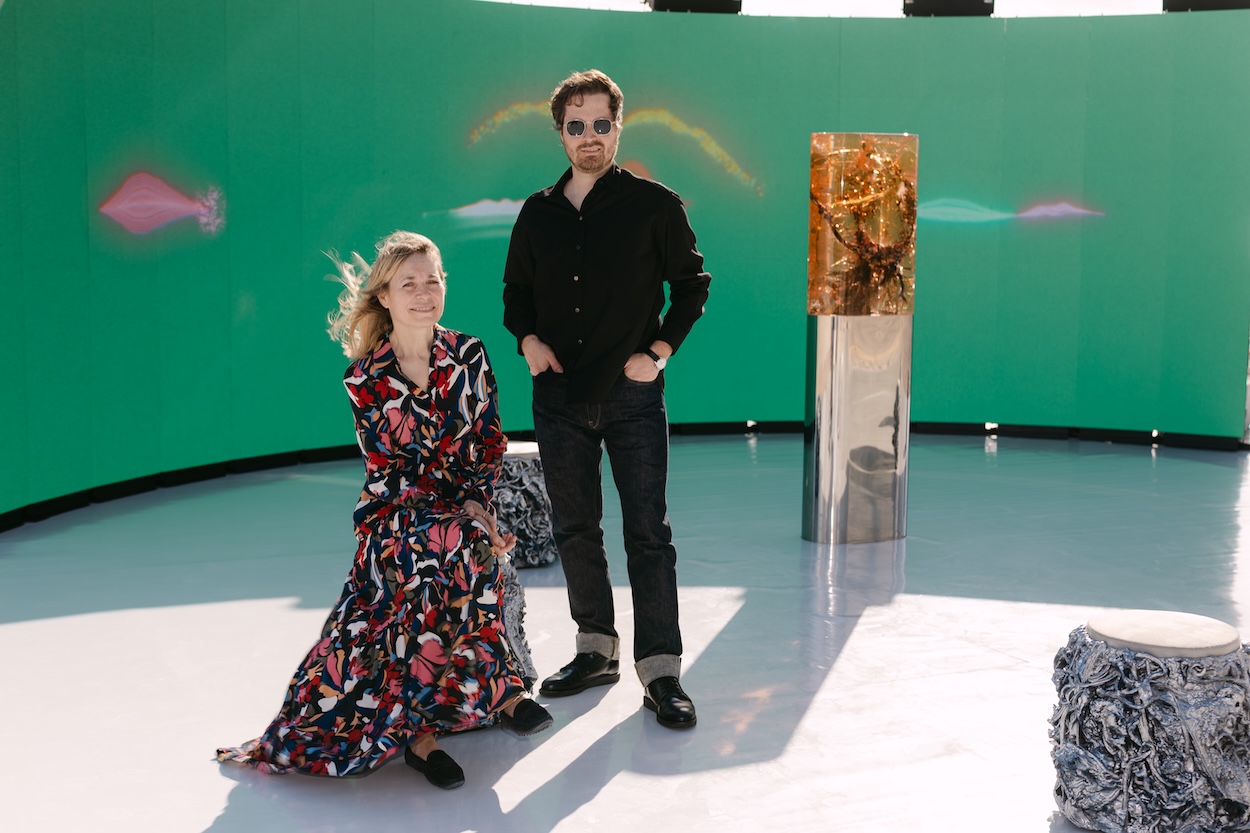
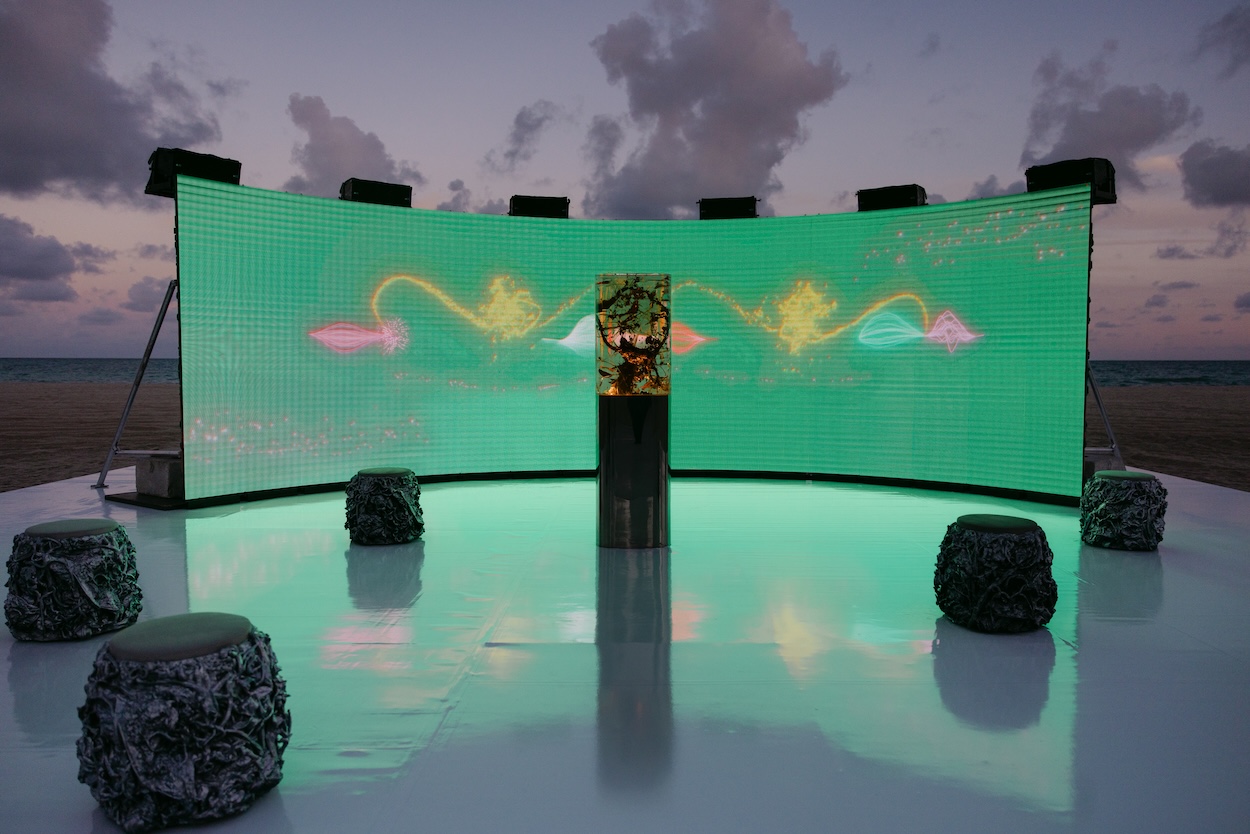
This Miami Art Week, one of the most compelling destinations was the beach itself due largely to the programming of Faena Art. It was here that the culturally curious (as well as those just seeking sun) found Warsaw-based multidisciplinary designer and artist Marcin Rusak’s Plant Pulses, an herbarium time capsule set in front of a large-scale curved screen presenting an animation paired to a manipulation of the tick emitted by vines. For those who didn’t dive deeper into the work, a collaboration with Maison Perrier-Jouët, it was another spectacular visual set into the sand close to Es Devlin’s The Library of Us.
On Miami Beach, Marcin Rusak Gives a Voice to Vines
For 'Plant Pulses,' a collaboration with Maison Perrier-Jouët, the multidisciplinary artist and designer transforms environmental data into a monumental work on the sand as part of Faena Art programming.
BY DAVID GRAVER December 08, 2025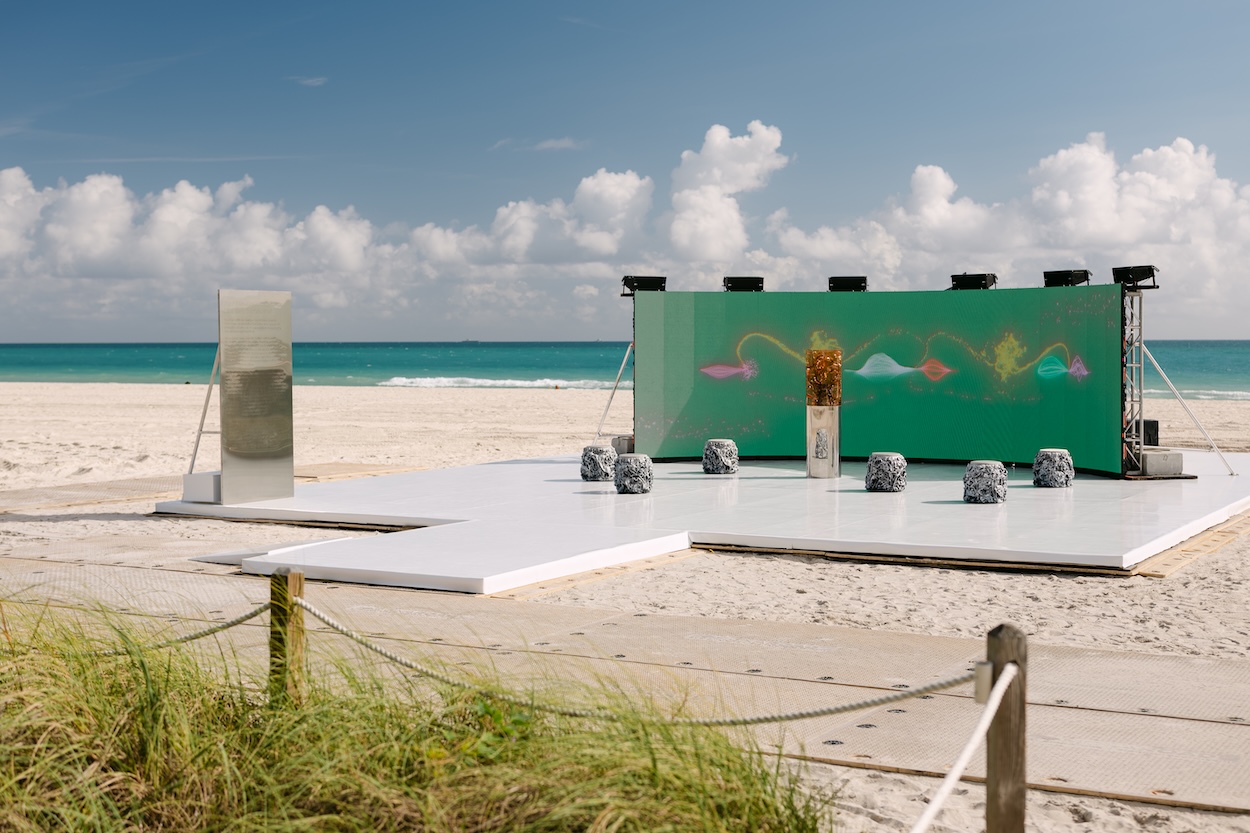
Courtesy of Maison Perrier-Jouët
…
Courtesy of Maison Perrier-Jouët
…
Rusak is a longtime partner of the prestigious maison. In 2015, he won the third Perrier-Jouët Arts Salon prize in the U.K. The corresponding show, titled “Inflorescence and Other Artefacts,” explored commercial flower production in the Netherlands. It’s typical of Rusak’s practice to use beauty as a vessel for environmental commentary. This is the second presentation of Plant Pulses, which made its debut earlier this year in a smaller indoor format at Tokyo’s Gendai art fair. Of course, there it was not in dialogue with the Atlantic ocean.
Courtesy of Maison Perrier-Jouët
…
The multipronged piece is the result of years of experimentation in Rusak’s studio and the coupling of sensory concepts as well as a sonic discovery by researchers Bartek Chojnacki and Klara Chojnacka at AGH University of Kraków. “I’m all about experimentation in the studio, and we try to open up a palette of tools for ourselves,” Rusak tells Surface. “Whenever there is something conceptually interesting to us, we tend to explore it. Then, when a partner like Perrier-Jouët comes, one that aligns with what we’ve been doing with nature, we start proposing things on a different scale.”
Courtesy of Maison Perrier-Jouët
…
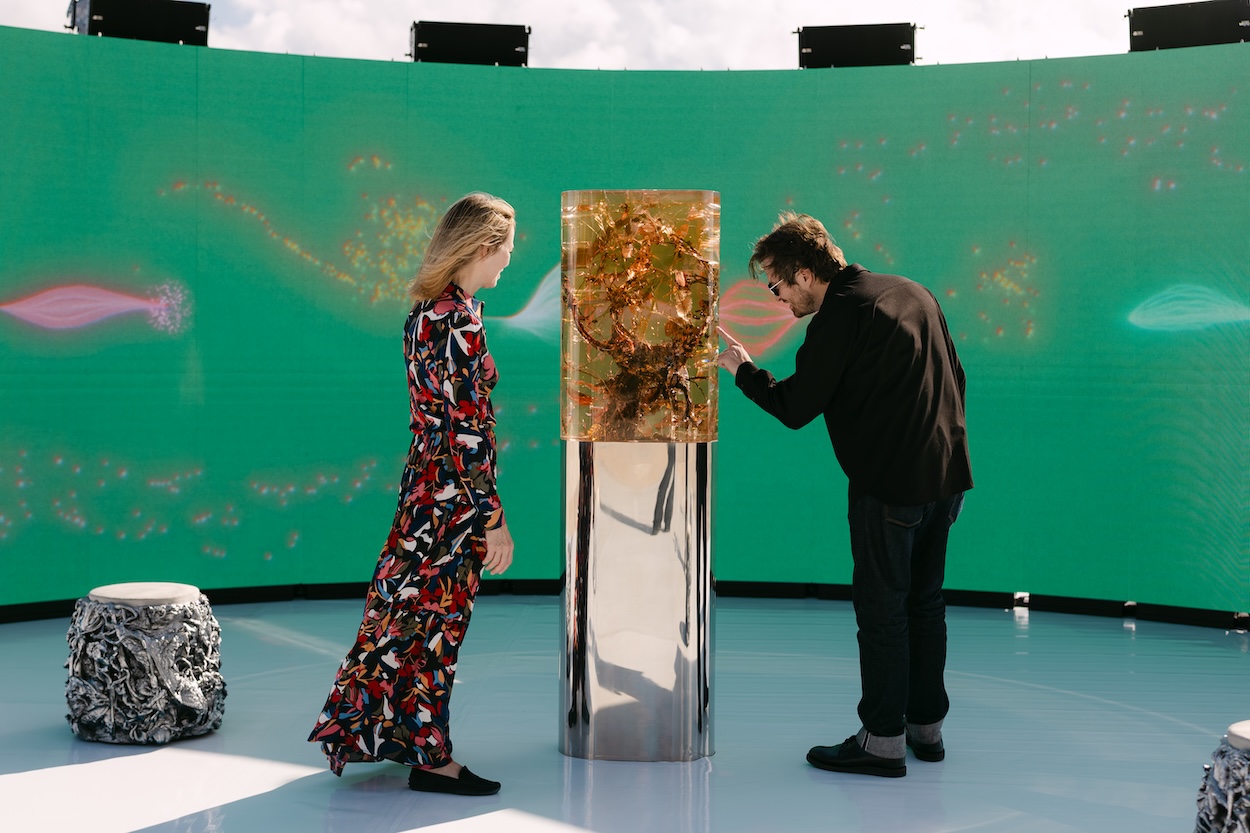
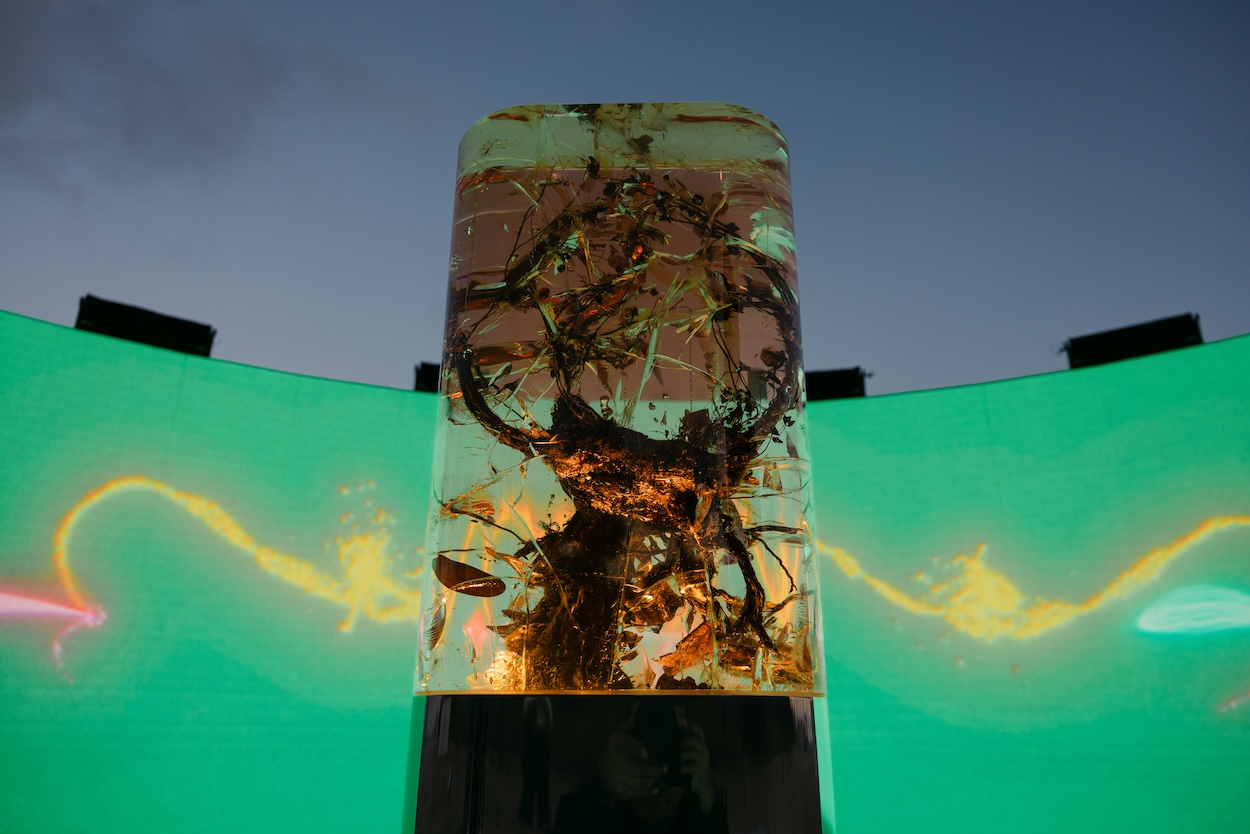
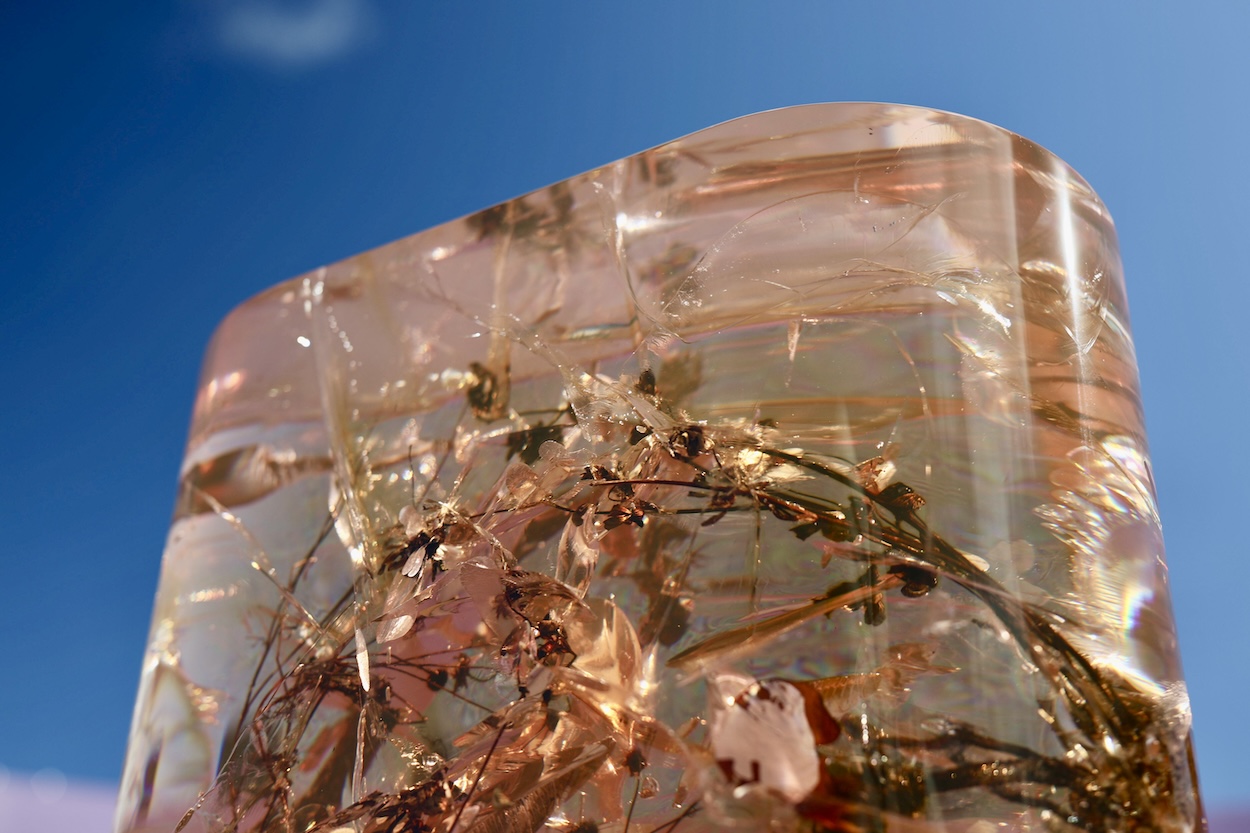
Within his resin herbarium, Rusak has frozen “hero plants” from Perrier-Jouët’s vineyards in Champagne, France. After meeting with biodiversity experts from the maison’s scientific committee, he ascertained that three plants—known as axiophytes—play a key role in indicating and preserving the health of the terroir. Rusak harvested them—the vine, European birthwort, and white clover—then he froze them in time. This central piece of the installation is, in essence, a guide to decoding the soil of Perrier-Jouët right now.

Courtesy of Maison Perrier-Jouët
…
“We had been investigating hero plants. When Perrier-Jouët came, and we learned about their biodiversity program and rejuvenation and preservation of the area, because it might not be there in 100 years, we started saying, ‘Okay, let’s determine which hero plants are in the region, and what can we do with them,’” he explains. He hopes the herbarium will last thousands of years.
Courtesy of Maison Perrier-Jouët
…
The scientists, Chojnacki and Chojnacka, were integral in the next step: isolating the sound plants make and translating it into something humans can hear. The soundscape Rusak presents is almost musical in nature—with its own beat drop. “When I met the scientists, the conversation was about plants emitting pulses. It’s interesting, but I wanted to dig deeper,” he says. “When they sent me the very first recording [recorded from a vine from E, which was a translation of the ultrasound into a hearable sound, which is just a tick that happens every hour, I immediately compared it to a heartbeat. It was a really emotional moment for me.”
Courtesy of Maison Perrier-Jouët
…
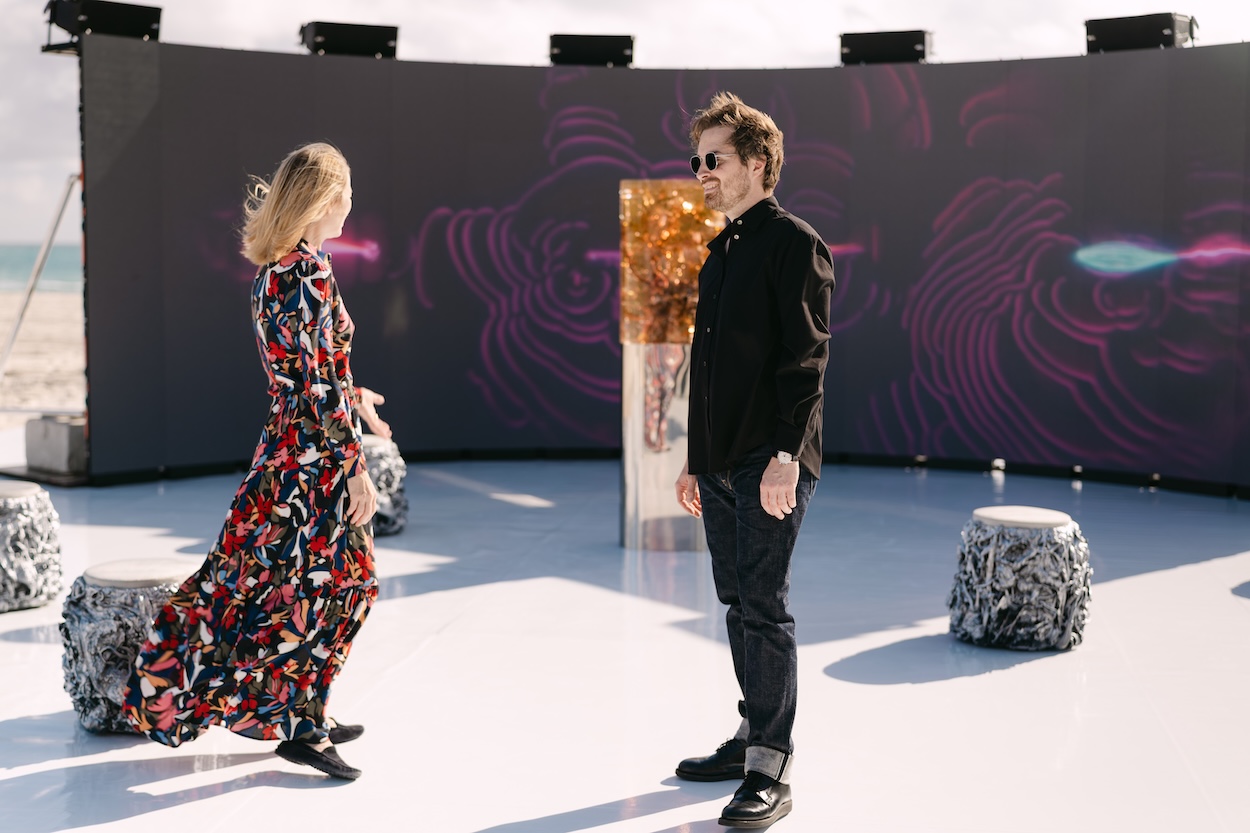
Rusak worked with a sound designer on the narrative. “There are three elements,” he says. “One is the alert system of a plant. Another represents the communication between two plants. The third one is completely speculative about what we call the dreams of the plant.” It evokes feelings, especially in dialogue with the waves of Miami Beach. Rusak said the location was a challenge initially—shifting from the stillness of a laboratory into a social setting that required a competition for attention. Then, he observed, people began to interact with it. Their curiosity furthered the interaction of art and nature.
Courtesy of Maison Perrier-Jouët
…
Axelle de Buffévent, the Global Culture and Creative Director of Maison Perrier-Jouët, looked to the four pillars of Art Nouveau, which is embedded in the history of the maison, when selecting Rusak for this commission. “It has to be inspired by nature,” she tells Surface. “The second pillar is that there are no boundaries between disciplines; Marcin has an amazing way of connecting disciplines. You know, it’s not even erasing the boundaries. He connects them.” The third pillar involved bringing beauty to everyday life.

Courtesy of Maison Perrier-Jouët
…
The final pillar pertains to craft. “Art Nouveau rose at a moment where industrialization was creating misery—a very ugly environment, and the proponents of Art Nouveau were trying to go back to the studio. Marcin has a very interesting way of connecting craft and technology. It’s the craft of tomorrow, in a way.” She adds that she always knew he would be a collaborator. “We keep very close to the people we work with,” she says. “We’re building a family.”

Courtesy of Maison Perrier-Jouët
…
Amidst the bustle of Miami Art Week, Perrier-Jouët hosted a four-course dinner—to celebrate the immersive piece—that was, itself, a work of art. Named the Banquet of Nature, the experience featured the impeccable cuisine of three-Michelin-star chef Pierre Gagnaire (another frequent collaborator of the maison). Rusak’s slender sculptural forms, featuring trapped botanicals, sliced up the table. Amsterdam-based artful culinary innovators Steinbeisser contributed to the playful, powerful engagement. “The idea behind the banquet was to create moments that are not only about the wine and the food, but really about connecting people and sharing ideas,” de Buffévent says. “This is not a work of art in setting alone, but by the way we bring an understanding of what champagne is, where we come from, and the regenerative agriculture that goes alongside our approach. Everything is connected.”

Courtesy of Maison Perrier-Jouët
…
In addition to Plant Pulses and Banquet of Nature, Perrier-Jouët announced their inaugural Design for Nature Award, in collaboration with Design Miami. The winner—pioneering Dutch artist and Haute Couturier Iris van Herpen—has been given creative freedom to produce a work for Design Miami 2026. “Design Miami is a vital platform for the design avant garde—a place to think about how we live and imagine our collective future,” Glenn Adamson, Curatorial Director, Design Miami 2025 shares. “This innovative award is perfectly aligned with that mission, and we are delighted that in its inaugural year, Perrier-Jouët is recognizing Iris van Herpen, a designer who epitomizes the fair’s values, working at the leading edge of material innovation and creative possibility.” Anticipation is already blossoming.