At Roberts Projects, 13 Artists Address L.A.’s “Overlapping Histories”
Participating artists Suchitra Mattai, Jackie Castillo, and Jackie Amézquita provide insight on their contribution to the group exhibition "Back to the Earth."
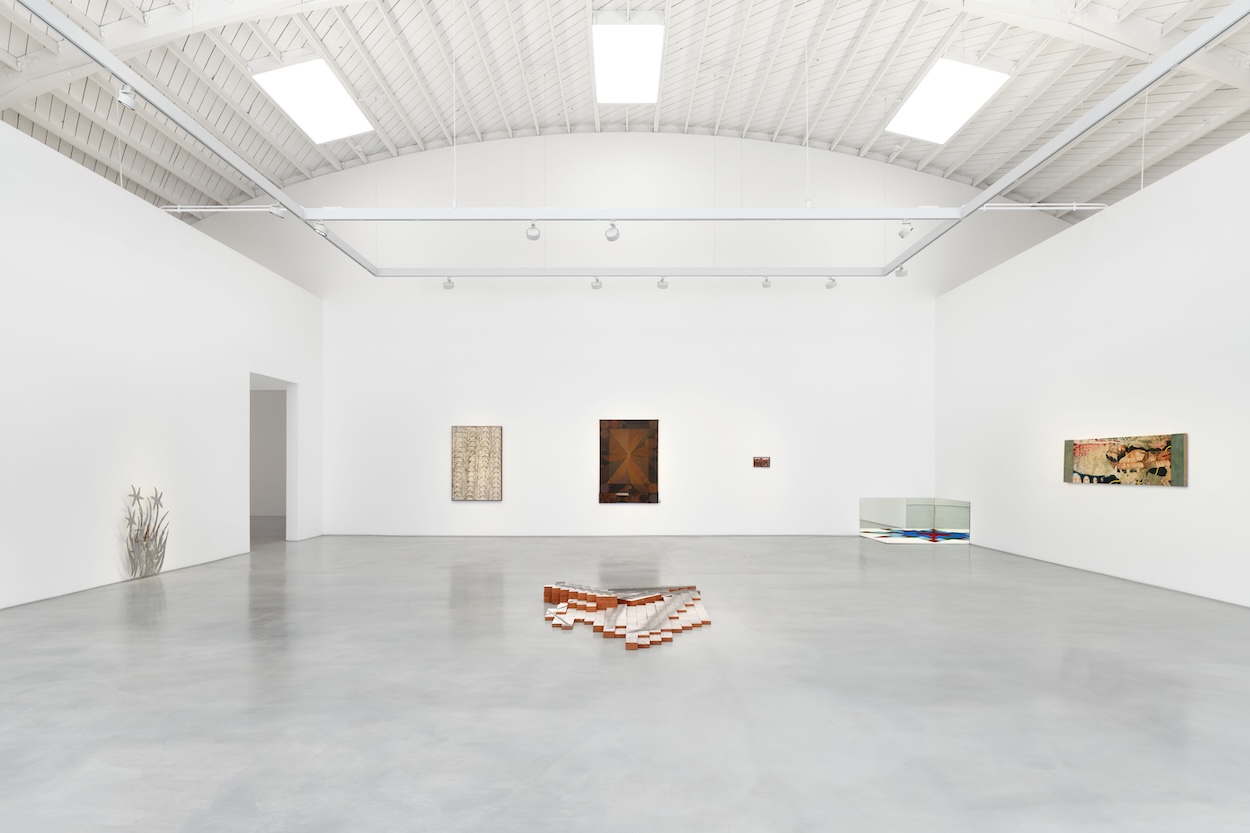
"Back to the Earth" installation view. Courtesy of the artists and Roberts Projects. Credit: Paul Salveson…
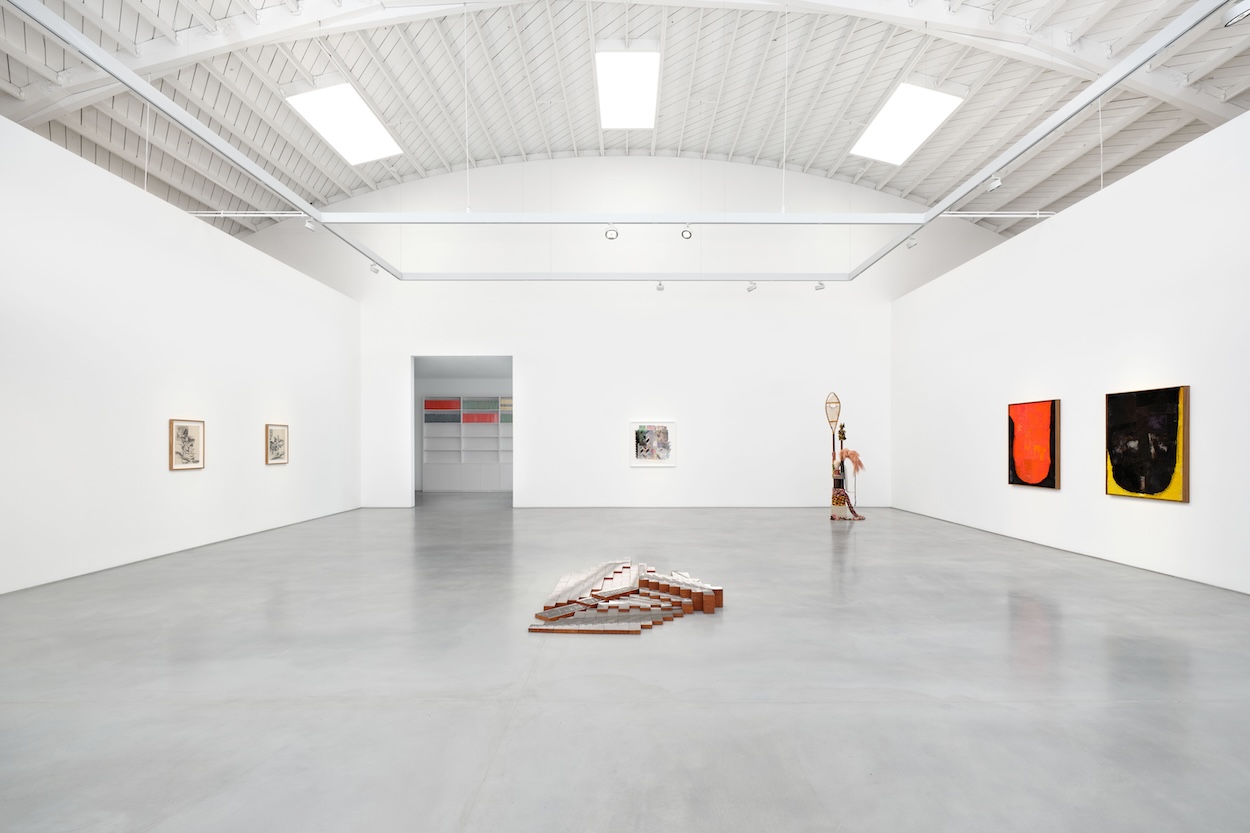
A group exhibition at Roberts Projects in Los Angeles, Back to the Earth, brings together 13 artists whose practices—ranging from painting, drawing, and sculpture—center material connections to land, labor, and memory. The exhibition features works made from soil, rubble, salvaged textiles, and other charged remnants that speak to cycles of extraction, migration, and repair. Rather than treating nature as backdrop or resource, the artists approach it as a living record—something shaped by human presence and capable of holding ancestral knowledge, personal histories, and structural violence.
Some pieces, like Jackie Castillo’s and Suchitra Mattai’s, bear the traces of their origins: earth collected from specific neighborhoods, materials gathered from construction sites, textiles inherited and unspooled. Others, like Jackie Amézquita’s function as quiet interventions—acts of reconstitution that invite slowness or care. Across the show, there’s a shared sense that the land is not just something to depict, but something to listen to, work with, and implicate.
Mattai, Castillo, and Amézquita are three Los Angeles-based artists whose contributions engage the land as both subject and collaborator. Below, they speak to how environments register trauma, how material can become mnemonic, and how working with earth itself can be an act of regeneration.
"Back to the Earth" installation view. Courtesy of the artists and Roberts Projects. Credit: Paul Salveson…
If you were to give a brief artist statement introducing the work you’re showing in this exhibition and what you hope viewers will come to understand about it, what would you say?
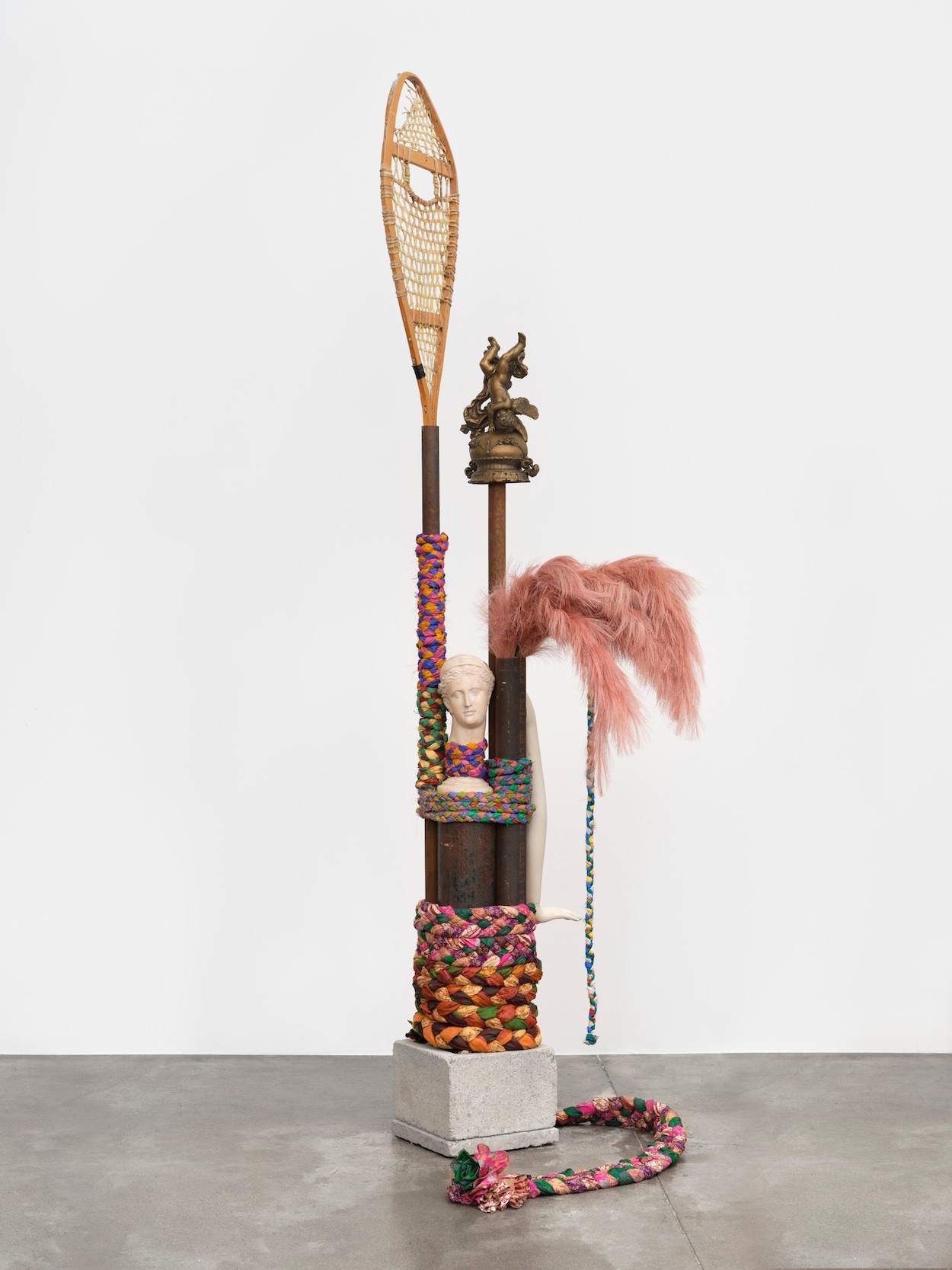
Suchitra Mattai: “lost and found” is an assemblage made of organic materials—eroded metal, silk, feathers, and stone—and inorganic materials like plastic, concrete and polyester that collectively allude to the concept of the axis-mundi. Present in mythologies around the world, the axis-mundi connects earth and cosmos; it is a point at which the sacred and the profane meet and overlap with one another. In this work, objects emerge and retreat within a tiered mountain landscape that references a variety of mythical beings—the tri-murti (three gods) found in Hinduism, the bust of Diana, the Roman goddess of the hunt and cherubs of the Judeo-Christian world, all hinting at a future mythological space for an inclusive secular world.
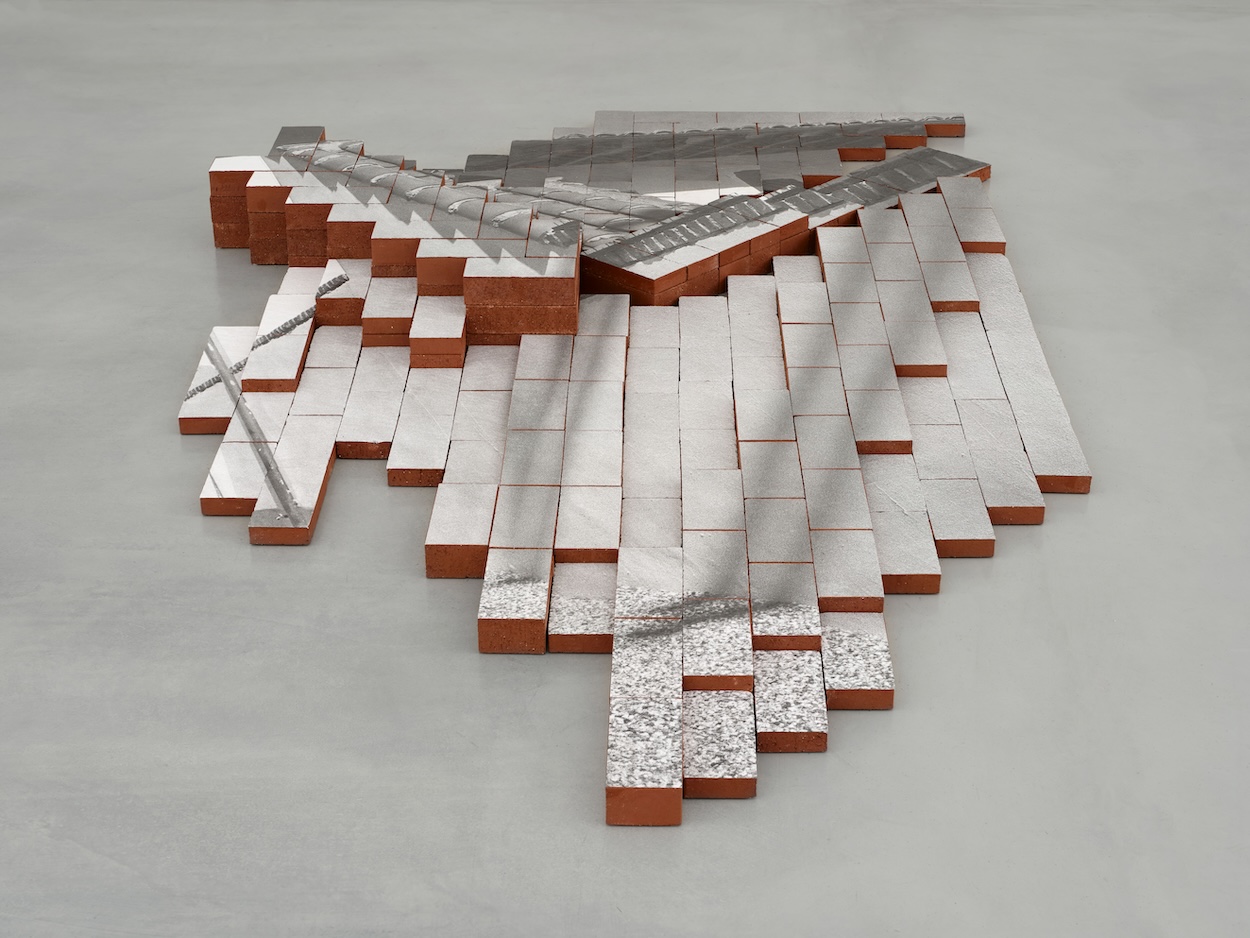
Jackie Castillo: Through the mediums of film photography, sculpture, and installation, my practice considers the relationship between city infrastructure, collective memory, and the isolation and anxiety felt by the working class. I often combine film photographs of Southern California suburban and urban landscapes with architectural remnants to explore the ways in which place, labor, and identity can become fractured, estranged, or made invisible, mirroring the violent shifts of a region plagued by increasing displacement and gentrification.
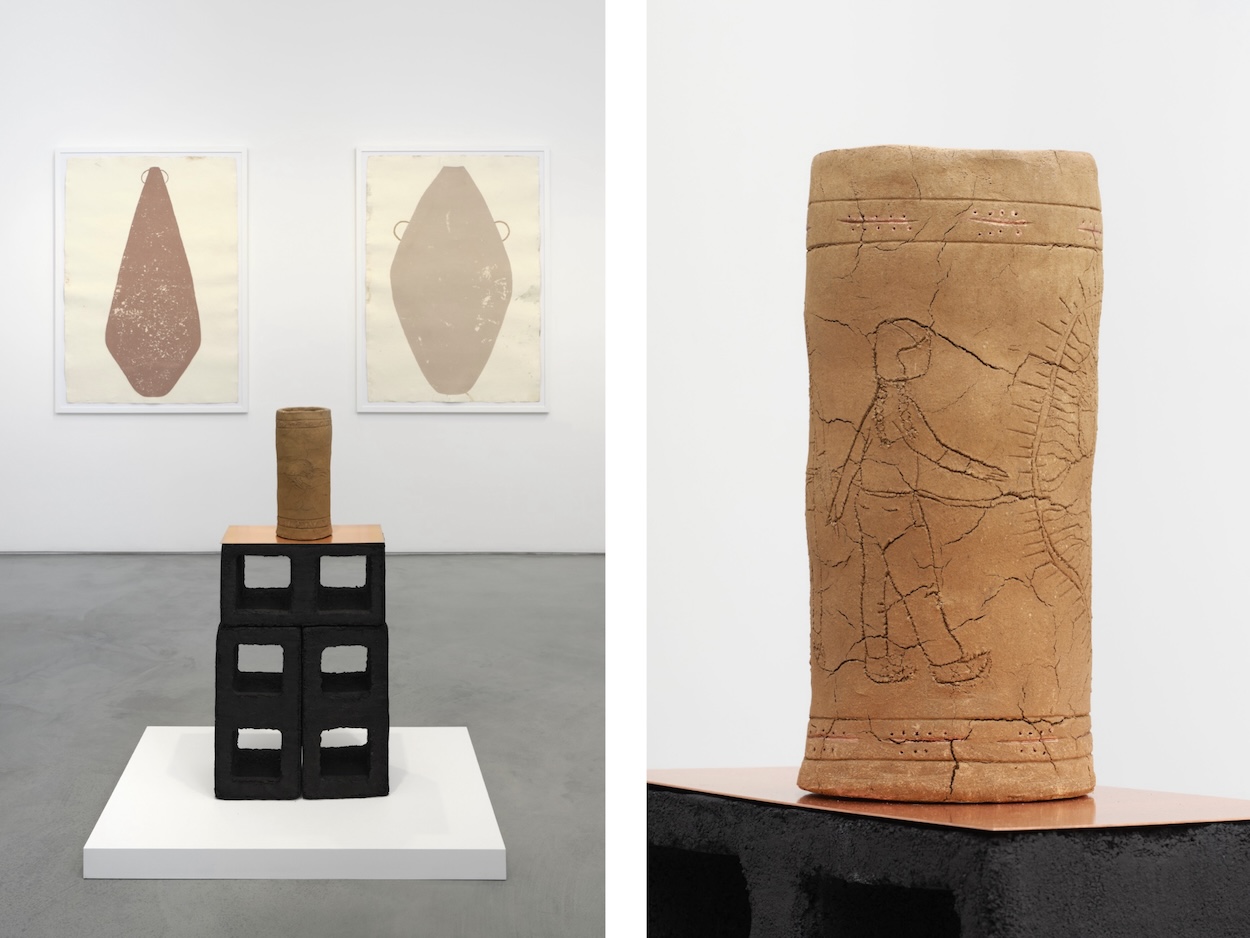
Jackie Amézquita: This new series reflects three of five stages of regeneration—nightfall, first light, and passage—through vessels and pedestals made with charcoal and soil gathered from my neighborhood. The soil holds personal meaning; it is part of the land that supports my daily life, my family, and the community that surrounds me. Each piece is rooted in ancestral memory, drawn from my matrilineal line and inspired by the lives of my great-grandmother, grandmothers, and mother—on both my maternal and paternal sides—whose strength and knowledge continue to guide me. These forms are not just reflections of my own story, but part of a larger, ongoing cycle of renewal—honoring what has been while opening space for futures held in collective memory and shared becoming.
Jackie Amézquita, Lapsos en tránsito (periods in transit). Courtesy of the artist and Roberts Projects. Credit: Paul Salveson…
You are all three based in Los Angeles. What significance does the site-specificity of showing in the city you’re based in hold for you?
SM: The nature of “home” is something that I am always rethinking and exploring. Exhibiting my work in Los Angeles is very special, and being able to use materials from the city in this particular work made it all the more meaningful. The armature of “lost and found” is comprised of discarded building materials from a junkyard that is located next to my old studio. The iron, concrete and stones reference the urban environment while the found objects they are combined with invoke diverse cultural contexts.
JC: It’s a significant aspect of my practice to often exhibit the works that image Southern California in and around their place of origin to more sharply heighten the viewer’s consideration of where they are and their relationship to that place. I create the work for them to enter that experience through both photography and sculptural materials that can resonate widely, from the historical to the personal. Working site-specifically also enables me to engage with how photography’s meaning is not only built on what is shown but also how it was made and who is looking at it under what social, political and economic conditions.
JA: Working and showing in Los Angeles feels deeply layered. This city holds so many overlapping histories—of displacement, survival, migration, and care—and these undercurrents move through my materials and the stories I try to tell. Los Angeles is also my home, the place that continues to hold me, and the place where I gave birth to my daughter. To show this work here, in a moment marked by both personal and collective transformation, is to remain in an intimate relationship with the land and community that shape and sustain me.
Jackie Castillo, Casting. Courtesy of the artist and Roberts Projects. Credit: Paul Salveson…
How does the exhibition’s title, “Back to the Earth,” relate to your work on view—the medium, materials, and exploration?
SM: After reflecting on the title I felt compelled to use materials that were both organic and inorganic. My practice often involves telling stories about my ancestors—indentured laborers from India—through assemblages of found objects combined with fiber-based materials. Most of my materials are human-made and carry references to history, women’s labor and the aftermath of colonialism. The title of the show prompted me to weave minerals and objects “of the earth” into these stories.
JC: Casting, the photographic sculpture I made on the occasion of “Back to the Earth” relates to the overarching themes in the show in less immediately organic ways. Instead, it engages with the built environment as an extension of the natural world, exhibiting how the elements of light, shadow, and architecture become the materials through which land, labor, and colonial violence are revealed and negotiated. The built environment is often reconstituted earth erected into structures that provide shelter, home, safety, but can also reflect domination over land and exploitation of people and their labor to build it and maintain it. My work often straddles these positions.
JA: “Back to the Earth” captures the essence of what I’m exploring in this body of work: a return to the fundamental cycles that connect life, death, memory, and renewal. The charcoal I use is a physical reminder of what remains after something has passed—it holds the weight of history, loss, and erasure. But rather than seeing charcoal only as residue, I treat it as a kind of fertilizer, a fertile ground out of which new growth can emerge. This duality—the past nourishing the future—speaks to a regenerative cycle that is at once deeply personal and collective.
Suchitra Mattai, lost and found. Courtesy of the artist and Roberts Projects. Credit: Paul Salveson…
As it relates to your practice and implementation, what does “symbiosis” mean to you in the context of this exhibition? What form of it does/do your exhibited works explore?
SM: Within the human/earth relationship I understand “symbiosis” to be rather parasitic. My work attempts to center the earth by making it the spiritual core of the sculpture. The earth is spirit and the materials of culture that surround and feed off the core of the sculpture are held steady by the earth itself. The references to the divine, particularly the female divine, are meant to evoke an earthly deity, or even “Mother Nature” herself.
JC: In terms of symbiosis in this work, I think about the ways the architectural styles I chose to replicate, Spanish Revival and Art Deco, are both aesthetic and ornamental choices but also function as layered, historical signs. These styles promoted myths of progress and colonial heritage, creating a Southern California that felt like paradise and was desirable, yet they were and still are built on displacement, class stratification, and the exploitation of land. In the sculpture, what supports these architectures are three distinct bricklaying patterns I used in the work: stretcher bond, herringbone, and stack bond, the inlays of masonry and embodied labor. I would say there is a symbiosis between myth and violence here, where the projection of an idealized image can’t exist without the structural realities and the explorations it conceals.
JA: Symbiosis is woven into the very fabric of my creative process. I work with plant and animal materials as binders—each relying on the other to hold form, texture, and integrity. This interdependence is not just symbolic but fundamental: without the mutual support of these elements, the vessels and pedestals could not exist as they do. The process itself becomes a ritual of collaboration, where materials respond to one another, are transformed through chemical and physical interactions, and come together to create living, evolving forms. Philosophically, this mirrors the broader reality of life—that all beings are interconnected, continuously shaping and sustaining one another. Through these works, I hope to convey how regeneration arises not from isolation, but from the dynamic, reciprocal relationships that bind us to each other and to the earth.
One of the quotes at the center of this exhibition is from the critic and novelist John Berger and reads “Art does not exist in isolation; it grows, transforms and decays alongside the landscapes that nurture it.” Would you like to share any seminal texts, research, or historical material that has informed your perspective on the intersection between, human, environment, and history?
SM: Subaltern studies, which challenged academic fields to look at history through the lens of those who did not hold power, has influenced my work. In particular, scholars like Gayatri Spivak and David Ludden, who I studied with as a graduate student at the University of Pennsylvania, have been a source of inspiration. Likewise, the French scholar Édouard Glissant has expanded my understanding of the relationship between humans, the environment and history in the Caribbean. Thinking about my own ancestors who labored on sugar plantations under British colonial rule and researching this period of history has been integral to my practice, as I regularly research and appropriate etchings made by European colonizers that exotified colonized peoples.
JC: Pierre Bourdieu’s writing made me pay attention to how social space has been constructed as a way of organizing people based on how many different types of resources (money, education, or connections) they have at a specific time. Manifestations of this range from paying attention to the ways in which people hold themselves in space, where they spend time at an event, but also how markets often reflect and reward capital, not just talent, mirroring social space.
From the book The Logic of Practice he writes, “Social space is the structure of the distribution of the various forms of capital at a given moment in time. Agents are distributed within it, in the first dimension, according to the overall volume of capital they possess, and in the second dimension, according to the composition of their capital—i.e., according to the relative weight of the different kinds of capital (economic, cultural, social) within the total volume. It follows that the social world can be represented as a space (with multiple dimensions) constructed on the basis of principles of differentiation or distribution constituted by the different kinds of capital.”
JA: John Berger’s words resonate deeply with how I see art—as something that breathes and evolves in an intimate relationship with the land and its stories. My work is nourished by the oral histories and cosmologies passed down through my maternal line in Guatemala—tales that weave together human lives, ancestral spirits, and the living earth itself. These teachings are alive within me, shaping how I touch materials, honor place, and remember.
Having grown up between Guatemala and Los Angeles, I carry with me the fragile and resilient threads of migration, displacement, and belonging—histories etched into the soil, the wind, and the shifting cityscape. Robin Wall Kimmerer’s Braiding Sweetgrass gave voice to a reciprocity and sacred kinship with the natural world that I have long felt but had struggled to name. Gloria Anzaldúa’s explorations of borders as spaces of transformation mirror my own experience of navigating between worlds—between cultures, times, and bodies.
Together, these influences shape my practice as an act of remembrance and hope—where ancestral knowledge, personal history, and the living landscapes I move through intertwine. Through my work, I seek to honor the cycles of becoming, decay, and renewal that connect us all, inviting a deep listening to the whispers of the earth, the bones of the past, and the dreams of what is yet to come.