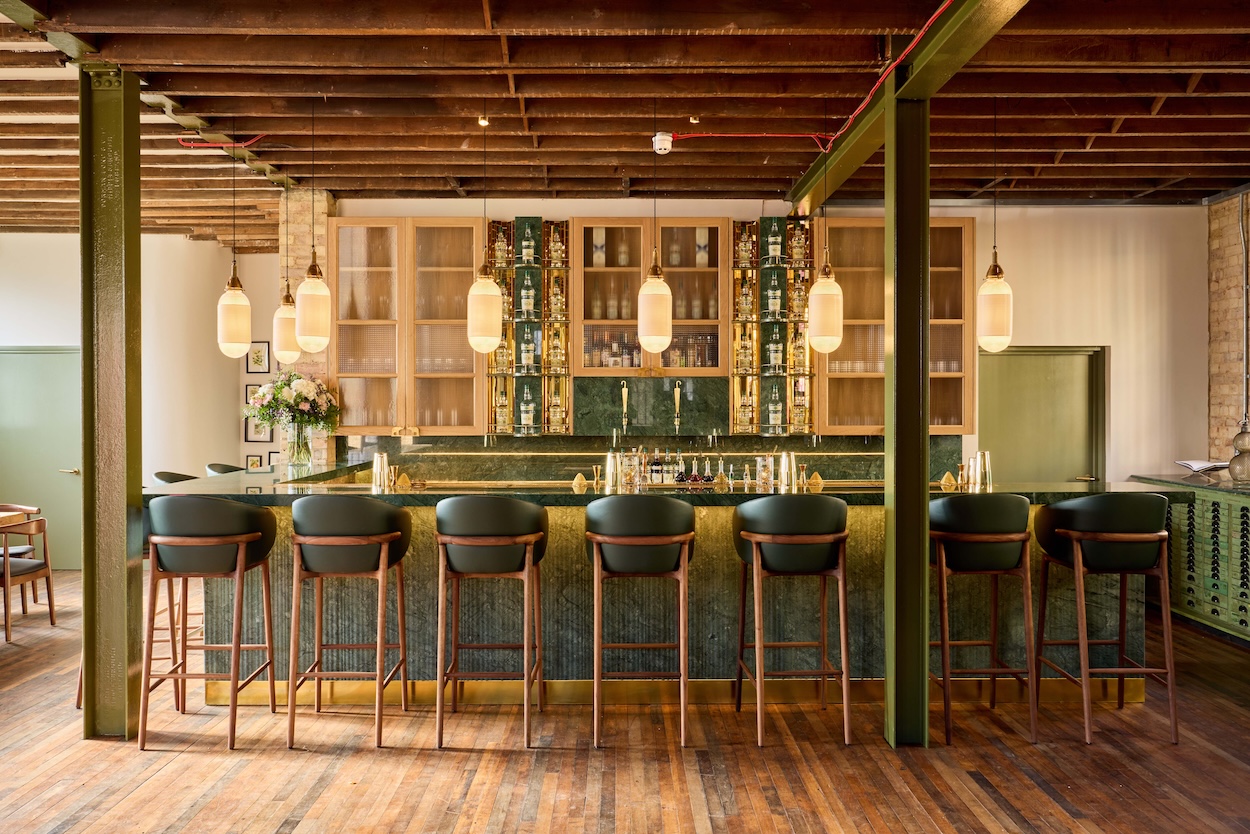
Ten walnut and green leather bar stools line up along the front of a custom butterfly bar composed of fluted green slab marble with brass accents, set atop 200-year-old reclaimed maple floors. This warmly sophisticated array is one of several gathering spaces in a recently opened bar within Thames Distillers, now located in a former bottle factory on Old Kent Road in the London borough of Southwark. The vision of bar design expert Leo Robitschek (of NoMad Hotels and Eleven Madison Park fame) and London-based architecture and interiors firm Transit Studio, the destination was developed for the bar trade community—and as the home of Fords Gin.
For Transit Studio, this was the first translation of a historic structure into a manufacturing space and hospitality outlet. “It’s on Old Kent Road. If you play an old [U.K.] edition of Monopoly, Old Kent Road is the cheapest property you can buy. It’s £60,” Zoe Masterton-Smith, Transit’s founder and principal, tells Surface. “But the developer of The Bottle Factory sees the bigger picture. They’re making this really beautiful campus of extraordinary things. They’ve got a carbon neutral coffee roastery and lots of creatives throughout the space.”
Courtesy of James Riley/Ellipsis Creative Ltd. …
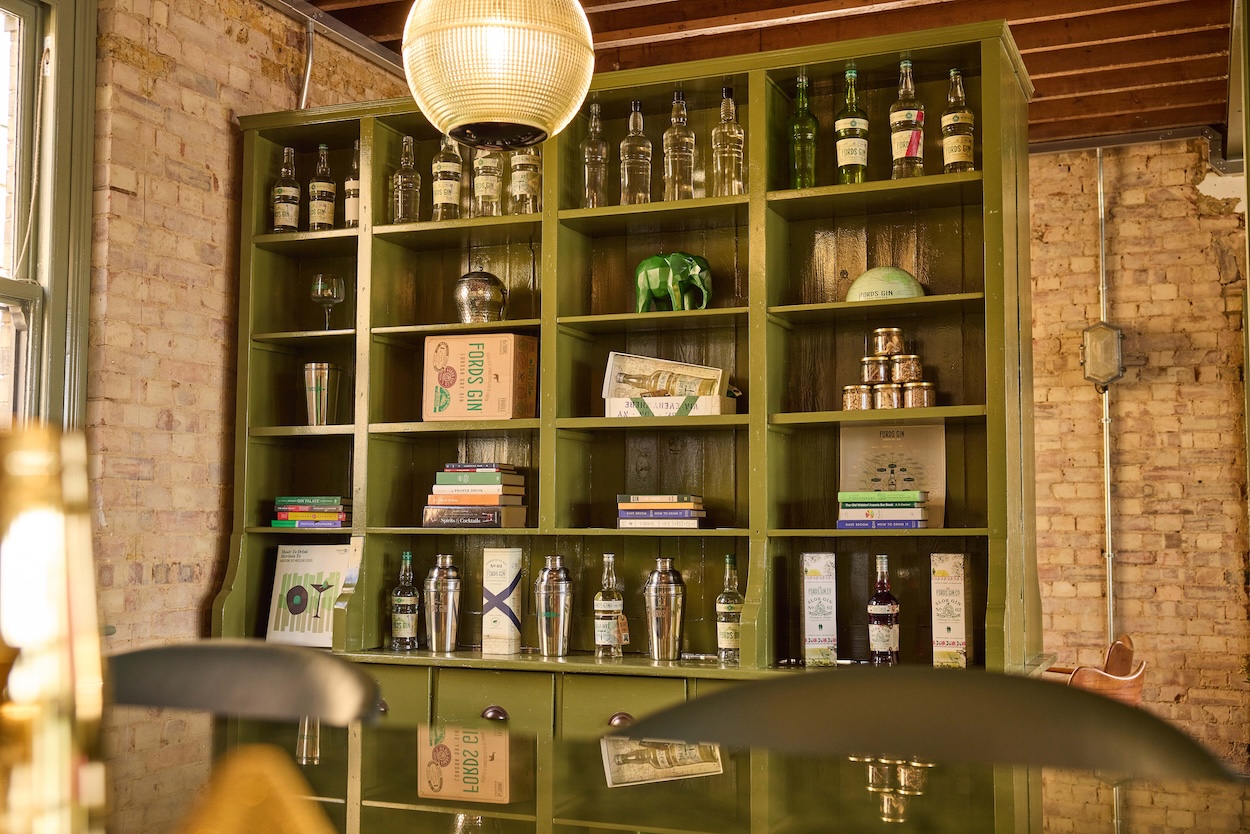
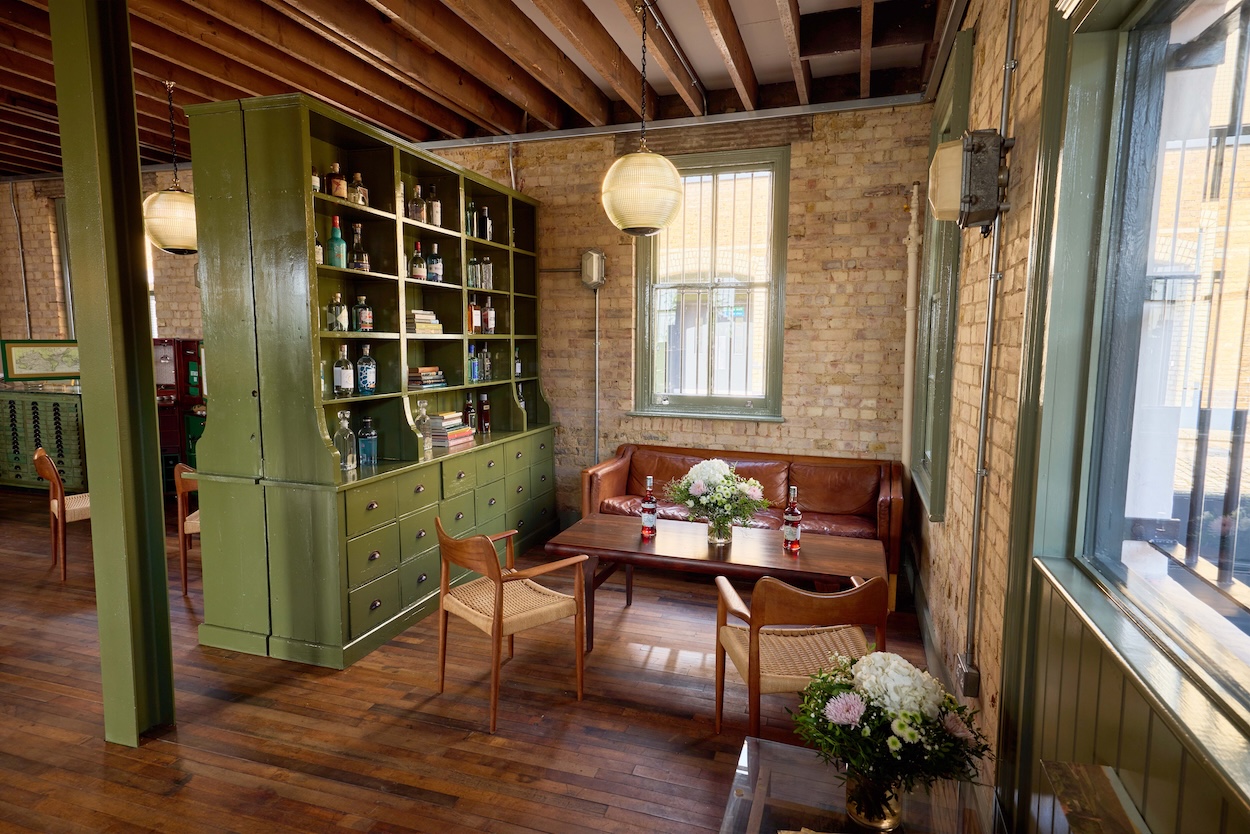
Masterton-Smith coupled a vintage apothecary aesthetic with mid-century furniture, Tage Poulsen sofas, and an 18-seat solid oak table. “Gin-making is highly apothecary-like,” the architect says. “When I went to their original distillery, there were thousands of mini vials and pipettes of all of the tests that they do for each of the batches. It was highly scientific in an experimental way. There was a sense of the botanicals. Using these apothecary references allowed us to tell the story of how gin is made to people who may not be familiar with it.”
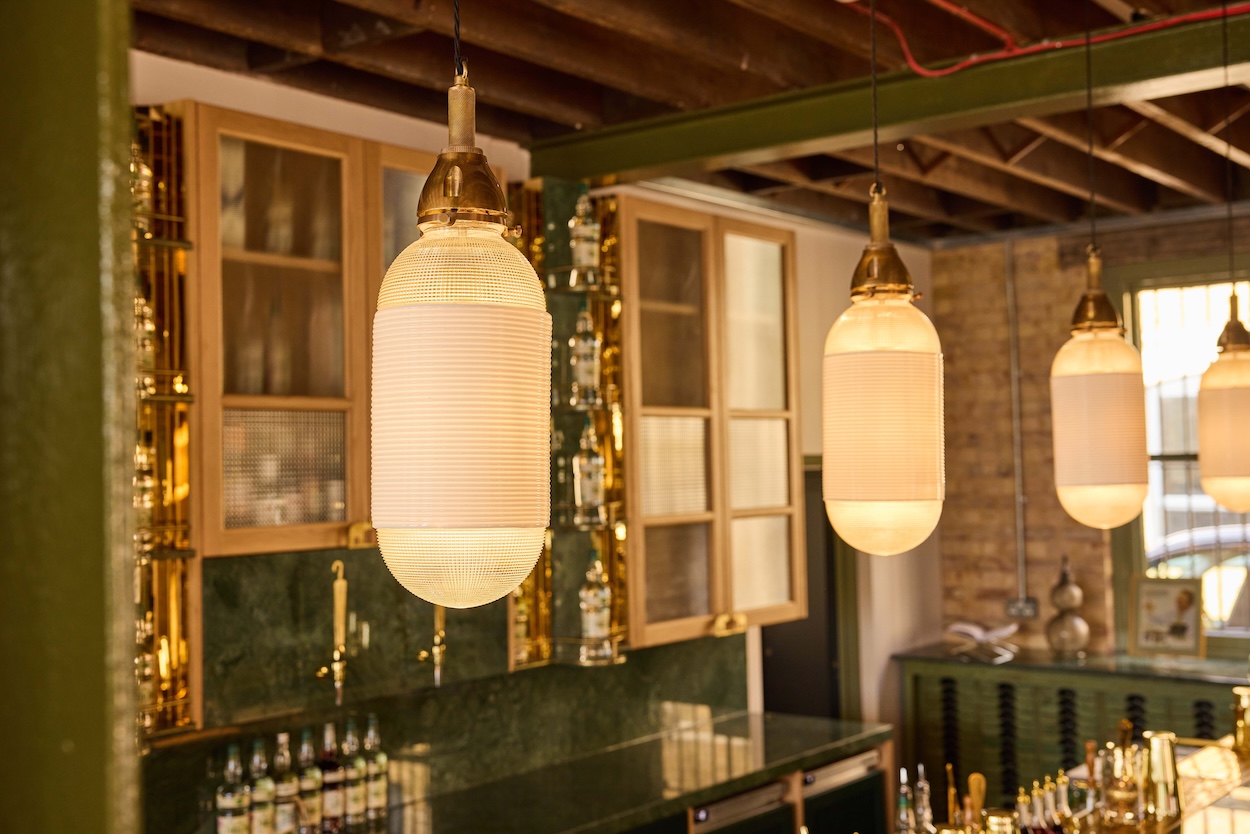
“We found some old stock display counters and cut them up and configured them into a bookcase,” she continues. “The mid-century pieces elevate things, and so do the reclaimed prismatic lights around the perimeter. They are actually from an old coal-fired power station that had been decommissioned. There is a balance of warmth and history and a sense of elevation.”
Courtesy of James Riley/Ellipsis Creative Ltd. …
There is nuance to Masterton-Smith’s approach to a bar led by one spirit. “I think it was listening to what Fords Gin is about, what it does in the market, and where its interest lies,” she says. “The purpose of this was not a tourist brand experience. It is quite a distinctive and high-level engagement with a brand. I think therefore we wanted all the touchpoints to be quite subtle.” This included etching Fords Gin’s elephant iconography into drip trays. On the cocktail taps, she designed custom umbrella handles.
For the bar layout, Robitschek and Masterton-Smith modified the butterfly bar style, wherein two cocktail stations fan out from the central well. “One thing about it being specifically for bar trade is that compared to a commercial bar, of which we’ve done a number,” the architect says, “you’re only really serving cocktails here. There isn’t that kind of allowance for beer fonts and wine glasses. It’s designed to service cocktails and everything’s on hand for that. It’s integrated into the workflow. That’s the way that Leo designed the stations.”
Courtesy of James Riley/Ellipsis Creative Ltd. …
Further, with Fords Gin as the hero product, the visual identity was distilled down. “It’s not like a classic hotel bar where you might have a thousand bottles behind the bar,” Masterton-Smith adds. “This is a focused brand experience in the world of spirits. It wasn’t about having loads of those bottles on display. It was about a singular display, as it were, of whatever spirits they are talking about that day or whatever cocktail they might be making.”
Just beyond the bar are Thames Distillers’ stills. “They are the heart of it all,” Masterton-Smith adds. “Some of the needs were purely practical—about how you store high volume, high proof liquids, in a safe way. It needs to be practical for them, but we still wanted to make it something that felt thoughtfully designed.” The historic Victorian warehouse was very much an empty box when Masterton-Smith set to work. No period details remained within. And now it tells the story of Fords Gin, as well as that of Thames Distillers, which was founded by the U.K.’s oldest gin-making family, who have been distilling in London since 1681.