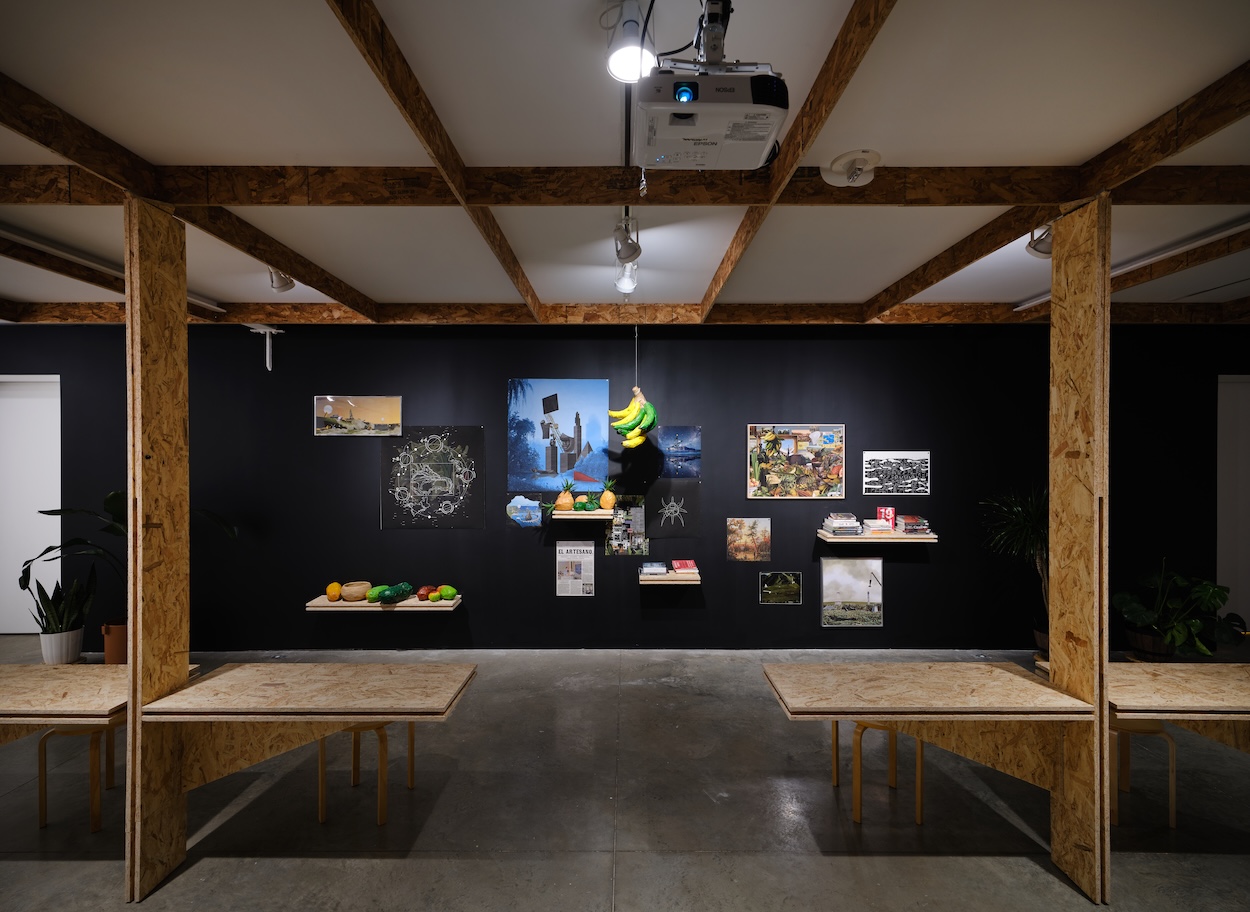
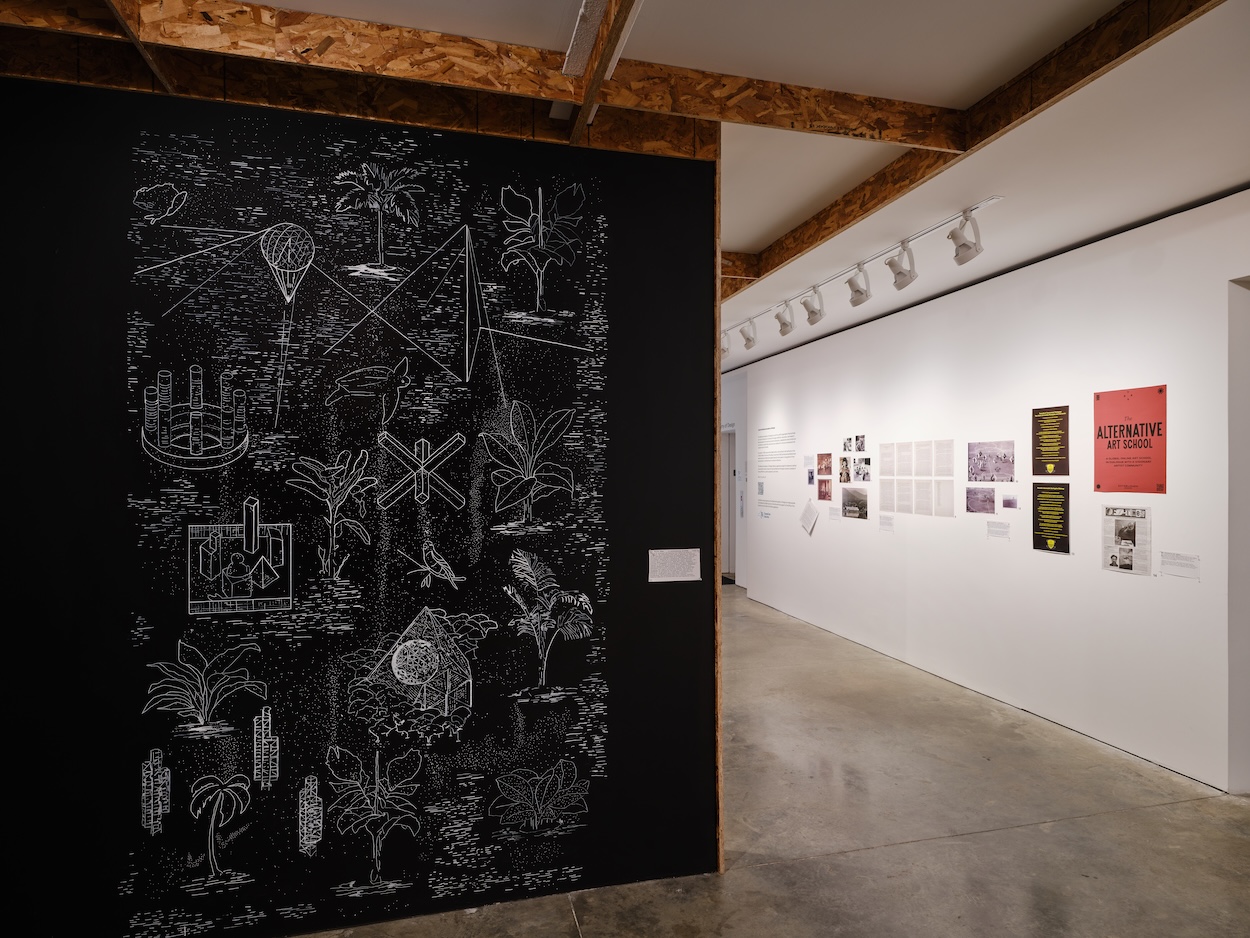
An ever-evolving exhibition, National Academy of Design’s “Future Schools” incorporates an archive, a live performance series, and a curriculum of talks and workshops. Curators Nato Thompson and Natalia Viera Salgado have successfully established a sense of unfolding discovery—and an ongoingness—as they welcome attendees into a warm, lively school-like experience that treats art and design as a vehicle for inspired education. Four new commissions—including a chalkboard drawing by Chloë Bass that references Joseph Beuys’ use of the blackboard—punctuate the dynamic environment.
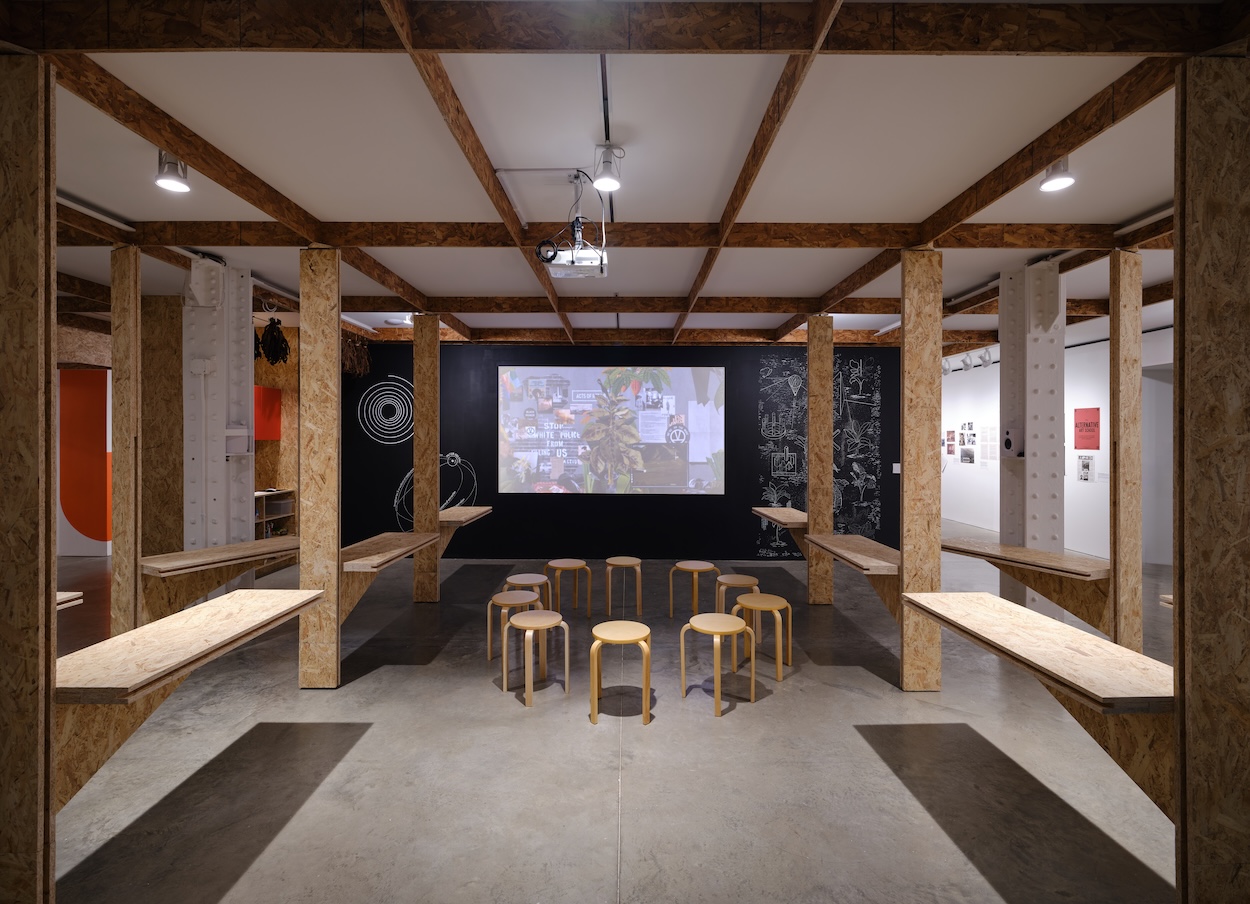
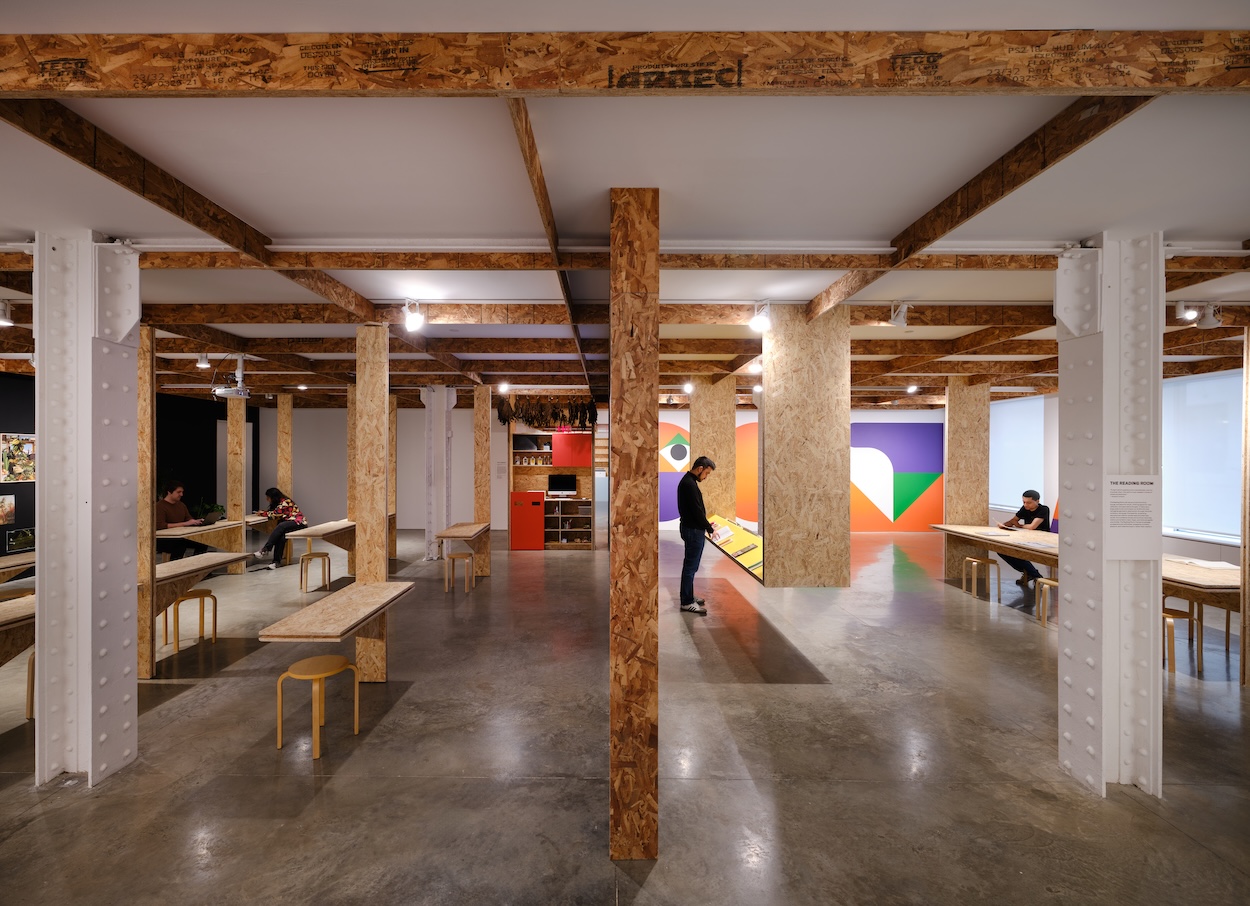
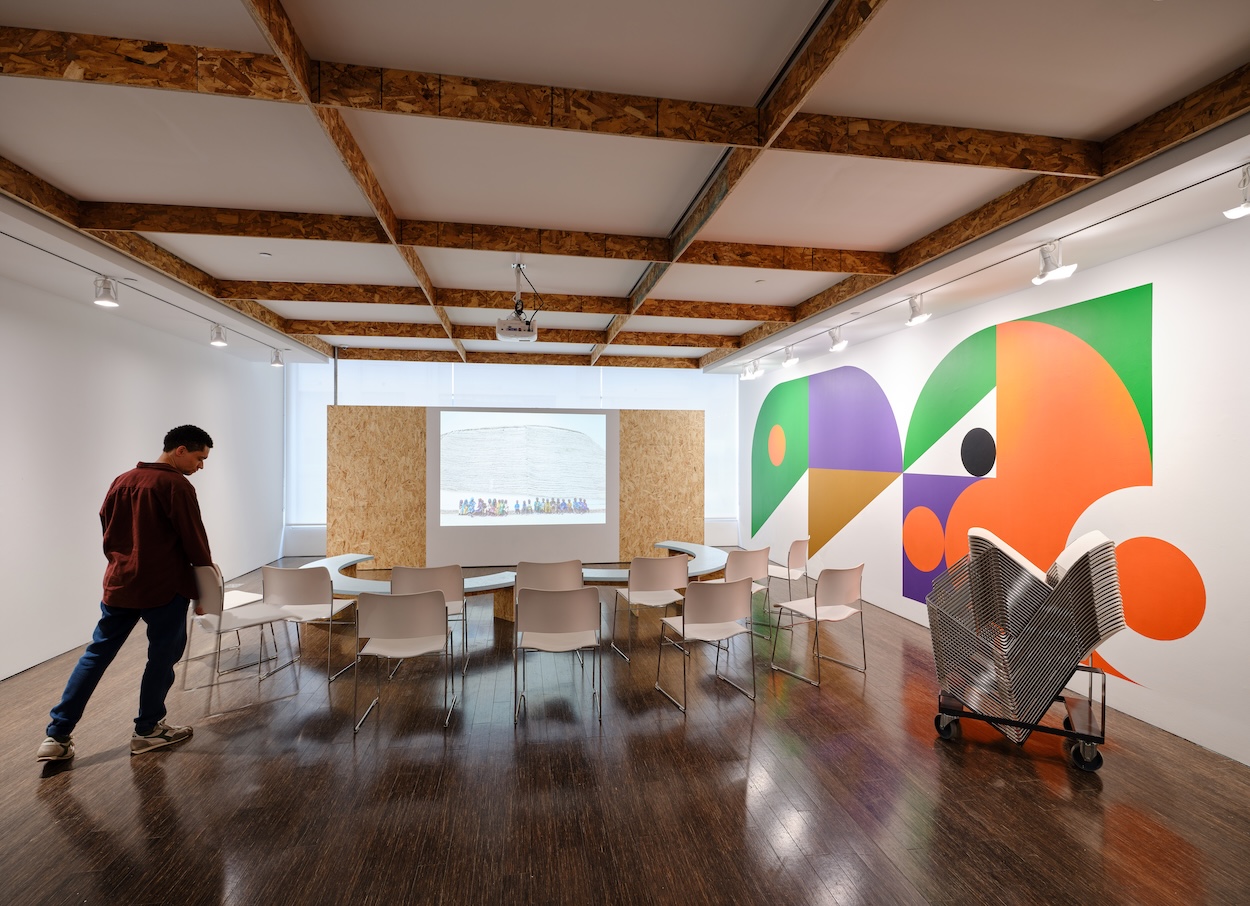
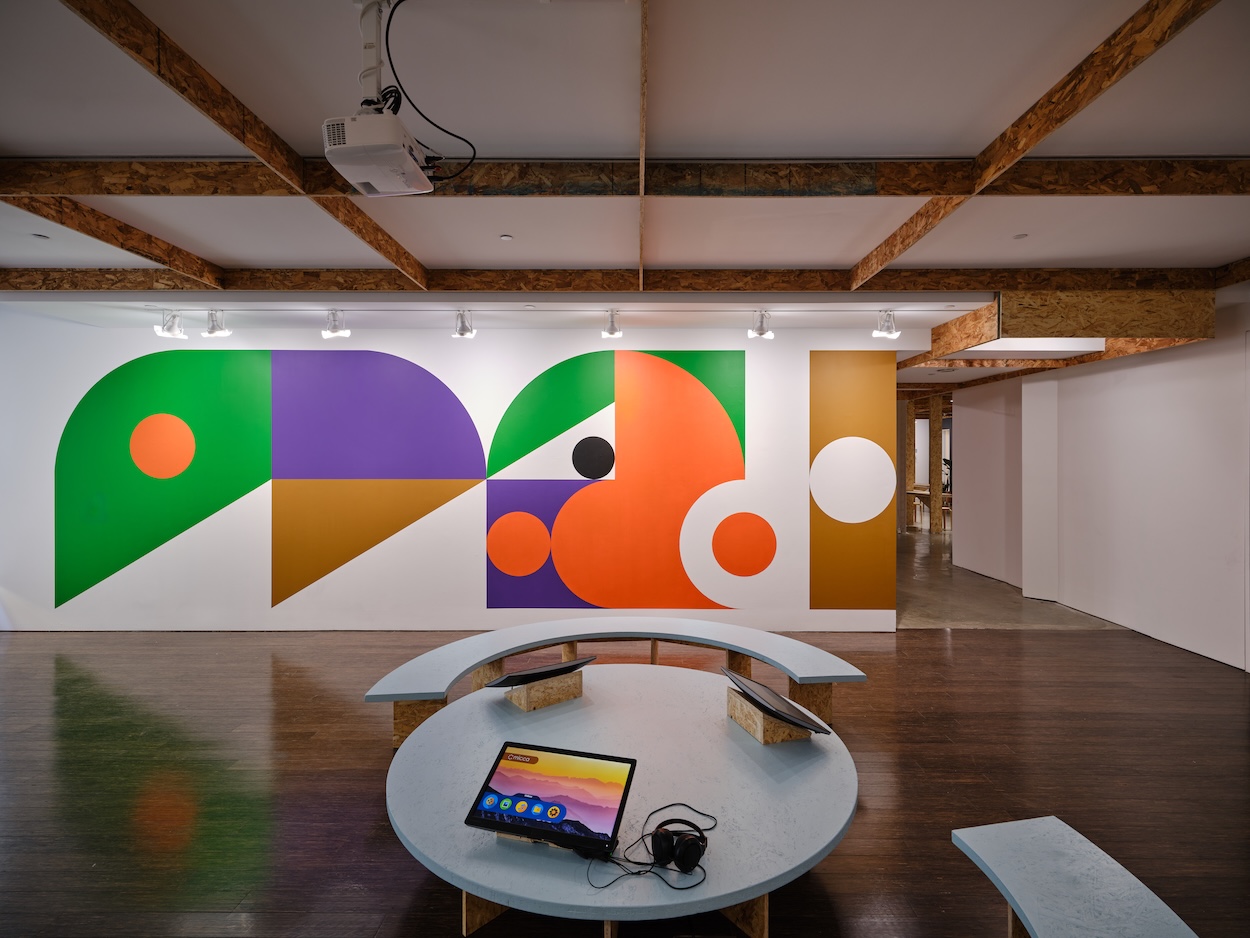
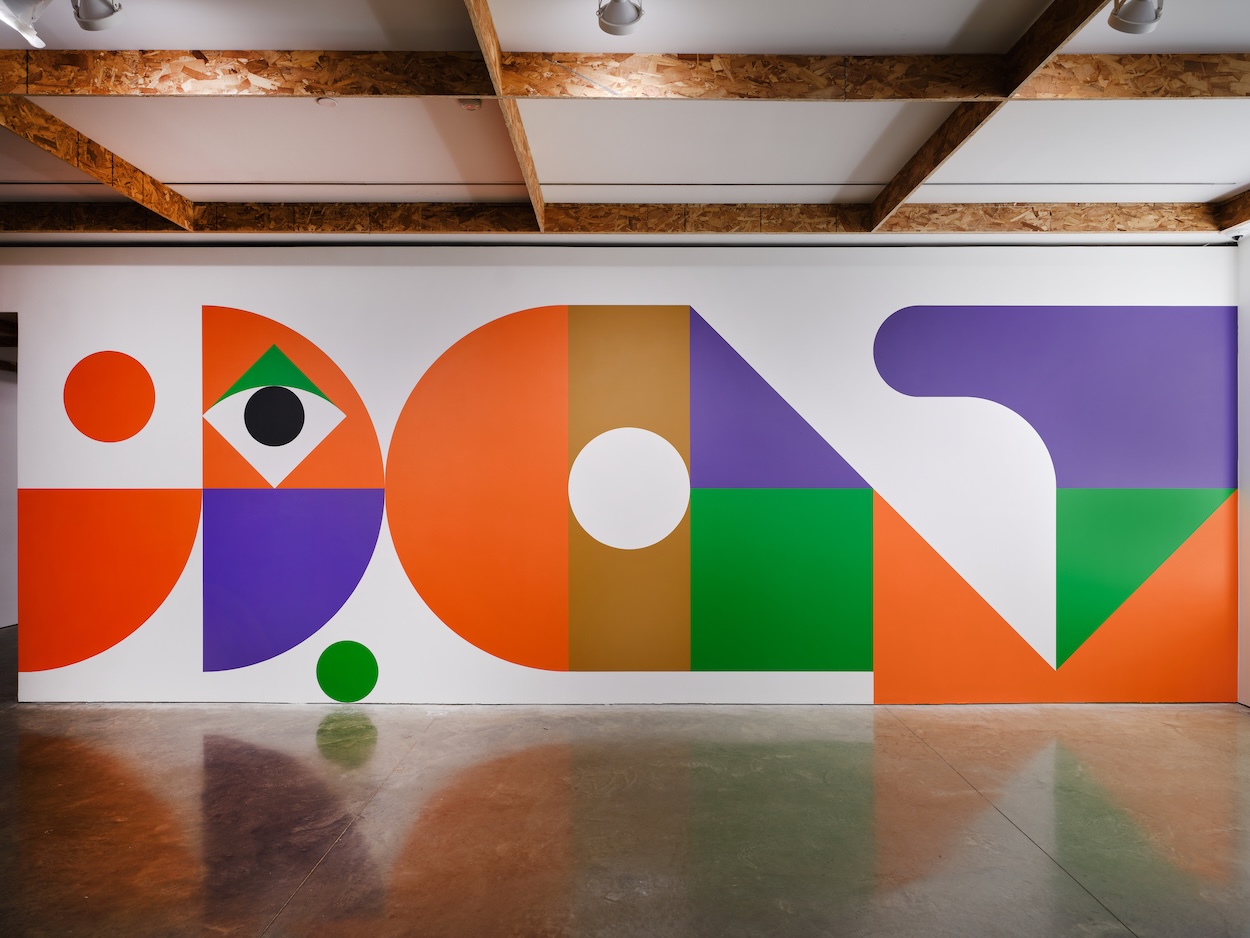
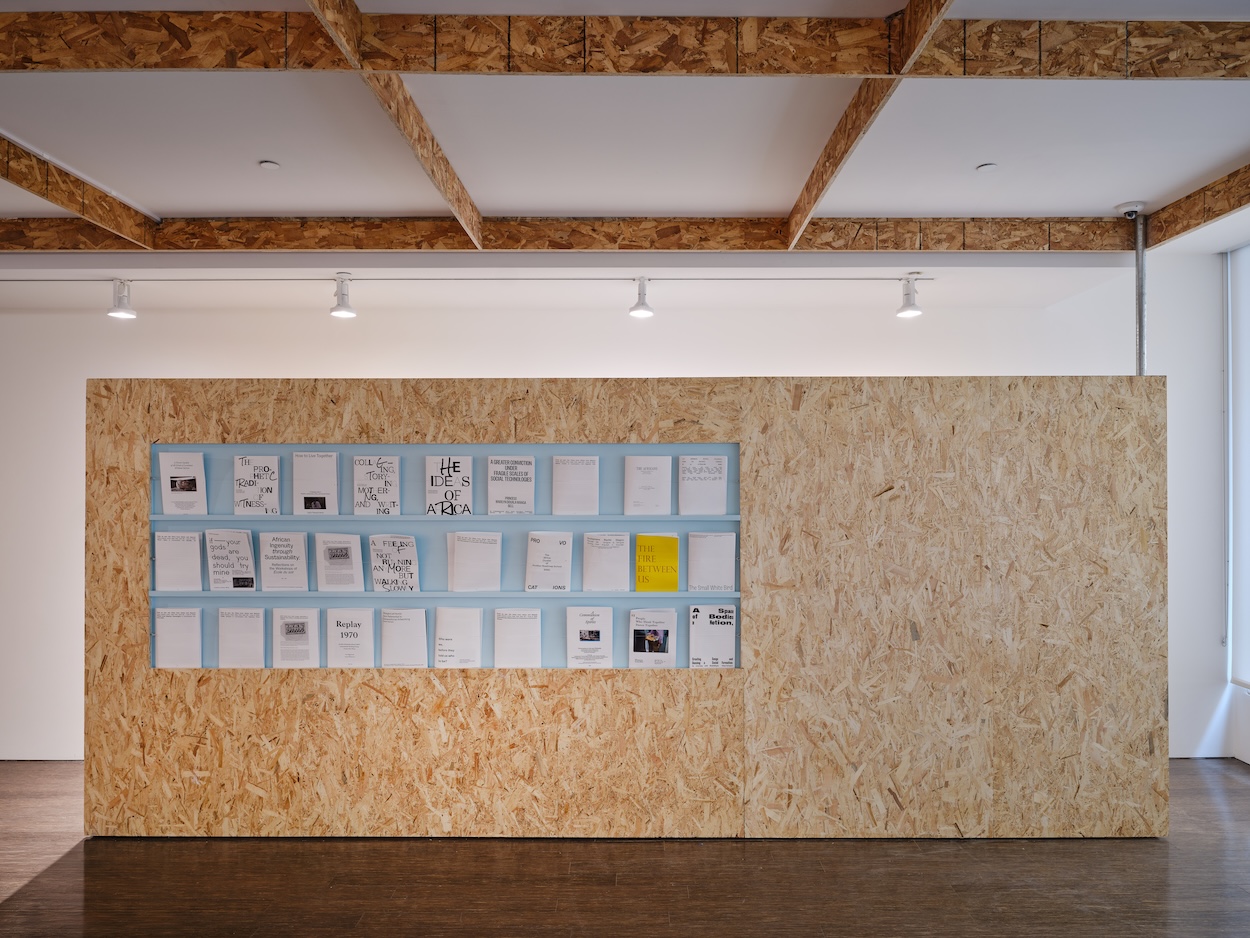
Created in partnership with Büro Koray Duman Architects, the location—519 West 26th Street, 2nd Floor, New York—has transformed into three interconnected rooms. First, the Reading Room acts as a hybrid archive and study space; it features a large-scale mural of geometric abstraction by Argentinian artist Ad Minoliti, Geometrical speculation can be tender queerness. The aptly titled Classroom presents a “school within a school,” and features A Loudreading Academy by WAl Think Tank, an architectural partnership between Cruz García and Nathalie Frankowsky. Finally, the Symposia offers a place to gather and read, complete with films and zines by Christian Nyampeta (and the ability to produce your own).
Thompson and Viera Salgado set out to survey the potential of alternative art education. As such, “Future Schools” will host classes by LAESCUELA___, the Strother School of Radical Attention (SoRA), and the School for Poetic Computation (SFPC) throughout its run. To learn more, we spoke with the curators following the exhibition opening.
Courtesy of Argenis Apolinario…
Can you speak to the balance between what is, in essence, a working classroom, an archive, and a symposium space?
Nato Thompson: What we were trying to do really came from something my son once said to me: “Adults talk about art. Kids do art.” That stayed with me. Art isn’t just something to study. It’s something one does. And art schools, at their best, are less a noun than a verb. They are active, unfolding, and lived.
So we wanted to create an exhibition that was in motion, something process-based rather than fixed. That’s where the balance between classroom, archive, and symposium begins to shift. Instead of separating those modes, we tried to let them exist together as part of an ongoing activity. You’re not just looking at materials from the past, you’re encountering them in the midst of use. You’re not just attending a talk, you might find yourself inside something that feels closer to a class.
We also liked the idea of the exhibition as a kind of three-part stage that unfolds as you move through it. There’s the archive, which holds histories of alternative schools and practices, not as something sealed off, but as something available and active. There’s the classroom or studio space, where learning is happening in real time, where people gather, make, and test ideas. And then there’s the symposium or forum, which brings in conversation, performance, and more public-facing forms of exchange.
But these aren’t fixed zones so much as overlapping conditions. The archive bleeds into the classroom, the classroom into the symposium. You might begin by reading something historical and end up in a live discussion, or come for a program and find yourself drawn into the materials.
At the same time, we wanted to push back on the overly formal nature of so many exhibitions right now. There can be a kind of stiffness to them. We were interested in something more open, something that could be a little messy, even magical. A space where things are still being worked out, where it’s okay for the results to be imperfect, and in fact, that imperfection is part of the point.
Courtesy of Argenis Apolinario…
How did you work with Büro Koray Duman Architects here?
Natalia Viera Salgado: Our collaboration with Koray began at the very earliest stages of design. It was the first time we had taken on a project of this scale, one construction supporting four distinct commissions simultaneously. Central to our proposal was the idea of a “school within a school”: a space that would invite instructors and practitioners to work from the gallery throughout the run of the show, while also hosting artists and architects presenting their commissions.
The idea was also to transform the gallery physically and conceptually into an active pedagogical environment organized around three distinct spaces: a working classroom, a symposium space for public dialogue, and a library and archive tracing the history of alternative schools and experimental pedagogies from the 20th century to the present. To extend the exhibition beyond display, three pedagogical groups were invited to inhabit and activate the space on their own terms: The Strother School of Radical Attention, La Escuela___, and the School for Poetic Computation. Their classes, held throughout the run of Future Schools.
We worked closely with Koray to articulate what each space needed to be, and he translated those needs into the design with real thoughtfulness. The show’s three components—the Library, the Classroom, and the Symposia—each occupy their own gallery and host different commissions by Ad Minoliti, Chloe Bass, Christian Nyampeta, and WAI Think Tank, so the architecture had to hold all of that together coherently.
In early conversations with Nato, there was a shared desire for the space to feel lived in, worn in, used, inhabited. Every detail from the way we’ve decided to hang documents, images, and posters is well thought out and represents the spirit of being in a classroom.
Courtesy of Argenis Apolinario…
Can you walk me through the three commissions here, by Ad Minoliti, Christian Nyampeta, and WAI Think Tank?
NVS: For each section, we invited three different projects that are really thinking about alternative forms of education and collective knowledge. Located in the Library is Ad Minoliti’s work Geometrical Speculation Can Be Tender Queerness, 2026, which uses geometric abstraction as a kind of queer, non-binary methodology. For them, form itself becomes a way of imagining an entirely different world. It draws on queer feminism, animality, childhood, and Latin American modernism to ask whose bodies and experiences get centered in art and culture. They also run real infrastructures around this, like the Feminist School of Painting and Sala Peluche, a trans and anti-racist art space in Buenos Aires, so the work here is very much in dialogue with those ongoing projects.
Located in the Symposium is the work of artist Christian Nyampeta whose practice incorporates film, poetry, and performance, often engaging with pedagogical exercises. His work, Open Curriculum: École du soir or Lessons from École du soir, 2026, unfolds with the urgency and pleasure of a public gathering. Conceived as both a reading room and discursive platform, the gallery invites visitors to produce their own zines while hosting talks, lectures, and performances—operating as an active site of study, conversation, and collective making. At its center is a dossier of zines and films by Nyampeta, presented alongside contributions from his long-term collaborators, Another Roadmap Africa Cluster (ARAC). Visitors are encouraged to read and engage with a wide-ranging repository of literature emerging from and beyond École du soir (Night School)–an initiative that extends the legacy of generations of Black filmmakers who approach cinema as a form of evening school.
WAI Think Tank (Cruz García and Nathalie Frankowski) bring their LOUDREADERS platform into the Classroom with their work A Loudreading Academy, 2026. It’s essentially an alternative trade school modeled by Luisa Capetillo, a Puerto Rican abarca-socialist and feminist labor organizer and cigar factory. It is also a direct response to the failures of Western academia where participants are invited to “loudread,” and share knowledge with others. The installation includes books meant to be read aloud to an audience, so there’s something very activated and communal about it.
Courtesy of Argenis Apolinario…
Similarly, would you speak to the process behind the chalkboard drawing by Chloë Bass?
NT: We knew early on that we wanted to work with the chalkboard as a medium, and to use it in a way that allowed the process to remain visible. The chalkboard carries a very particular set of associations. It brings to mind teaching, thinking in public, and revision. That felt right for an exhibition centered on education.
We were also looking to a lineage of artists who have used the chalkboard in compelling ways, figures like Beuys and Ligon, where it becomes both an aesthetic and a political space. A place where ideas are not fixed, but worked through.
It felt natural to invite Chloë Bass into that framework. What she proposed, which we immediately loved, was that the drawing would unfold over time rather than arrive as a finished image. The work is structured in four chapters, developing across the duration of the exhibition. The first chapter centers on her practice at the piano. It reflects on what it means to practice, how repetition shapes the body and mind, how it brings you into contact with difficulty, with specificity, with time. There is something very grounded in it, almost quiet, but also quite rigorous.
And then the work continues to evolve from there. We do not fully know how it will unfold, and that uncertainty feels important. It is not a static object. It is a living process, one that mirrors the rhythms of learning itself.
Courtesy of Argenis Apolinario…
How have you sought to activate the space through educational—and inspiring—programming? How was this sort of curriculum developed? How did the pieces come together?
NVS: We opened the process through an open call, inviting proposals from groups whose work aligned with the spirit of the exhibition. From those submissions, we selected three organizations, each bringing a distinct pedagogical vision to the space.
The first group to occupy both the classroom and the gallery is the Strother School of Radical Attention (SoRA), SoRA describes itself as an “underground association” of artists, performers, and interventionists. Over the past decade, the school has built a sustained practice around the question of attention, developing what they call Attention Activism—a framework that unfolds across three areas: Study, Organizing, and Sanctuary. Through these guiding principles, collective inquiry cultivates shared practices of attention; coalition-building mobilizes resistance against its extraction; and dedicated spaces sustain the conditions for attentional care, restoration, and flourishing.
The second group, LA ESCUELA___ “the school” is an artist-run platform and expanding network of collaborators devoted to pedagogies from the Global South, with a particular focus on experimental learning and collective making in public spaces. It is a network of collaborators from curators to artists, and educators across Latin America and the Caribbean, and their diasporas. Rooted in the region’s rich traditions of artist-run schools, collectivism, and cooperativism, LA ESCUELA___ offers free workshops, lectures, online laboratories, and street-based, site-specific classrooms. Together, these programs foreground epistemological perspectives from the Global South, challenging dominant Northern frameworks and proposing a fundamental shift in how knowledge is produced, valued, and shared.
The third group, the School for Poetic Computation (SFPC), is a hybrid school, residency, and research collective dedicated to exploring the intersections of code, design, hardware, and theory. At its core, SFPC centers community, critical thinking, and a reimagining of what it means to engage with technology thoughtfully and imaginatively. Its programs serve a vibrant, diverse community of artists, engineers, educators, and organizers, all united by a desire to expand their practice and approach technology as a site of playful experimentation. Embracing creative subversion, the school treats writing code the way others treat creative writing as a tool for expression and hacks the conventions of art-making through computation. The programming calendar itself is taking shape through an ongoing collaboration with our Programs Manager, Frank Dallas, who has been instrumental in weaving together this remarkably diverse range of classes and events. If you are interested in taking a look at our programs you can visit our website.
Courtesy of Argenis Apolinario…
Is there something you hope people pay particular attention to here, whether that’s part of the exhibition or programming?
NT: There are many through lines running through the show. Different forms of knowledge, decolonial perspectives, and varied gendered relationships all sit alongside one another. The project is meant as an enjoyable provocation, but also as a kind of heuristic model. Not something to replicate directly, but something that helps people think through what else might be possible.
We know that different people will encounter the exhibition in different ways. Artists who participate in the classes will have a very different experience than someone who visits once. That layering is intentional. It reflects the fact that learning is uneven, relational, and shaped by time spent.
We also see this as an opportunity for the National Academy of Design, which is itself in an ongoing process of reinvention, to think through its relationship to pedagogy. Not as something inherited, but as something that can be actively reshaped.
For visitors, there is hopefully both inspiration and pleasure. Inspiration in the sense of seeing what alternative models of art and architecture education might look like. And pleasure in something more immediate, the experience of making and thinking together, of being in a space where that is visible and shared.
We are living in a time of failing infrastructure, particularly in the arts. What I hope people notice is that this is not only a reflection on that condition, but an attempt to gesture toward what might come next. There are hints here, but also tools. Ways of imagining how something new could be built.
Courtesy of Argenis Apolinario…
Finally, how does this align with the bicentennial?
NVS: The bicentennial feels like a genuinely meaningful moment to pause and reflect on what the National Academy of Design has stood for and what it might still become. As one of the first art schools in New York, founded in 1825, the Academy made formative contributions to art and architecture education in the United States. That history carries real weight, especially now, at a moment when art schools across the country continue to close their doors, a decision the Academy itself faced in 2017. Future Schools extends that spirit, tracing a vital history of alternative pedagogical practices in art and architecture and examining the relationships between critical theory, spatial politics, and the question of who gets to define knowledge, and for whom. In bringing that inquiry back into these galleries, the exhibition revives something essential about what the Academy was always meant to be: a living institution: one that has endured two centuries precisely because artists and architects have continued to shape its future. At two hundred years old, the Academy is an ideal place to hold that question and to imagine what new forms a school might take: more porous, more collective, more rooted in the communities it serves.