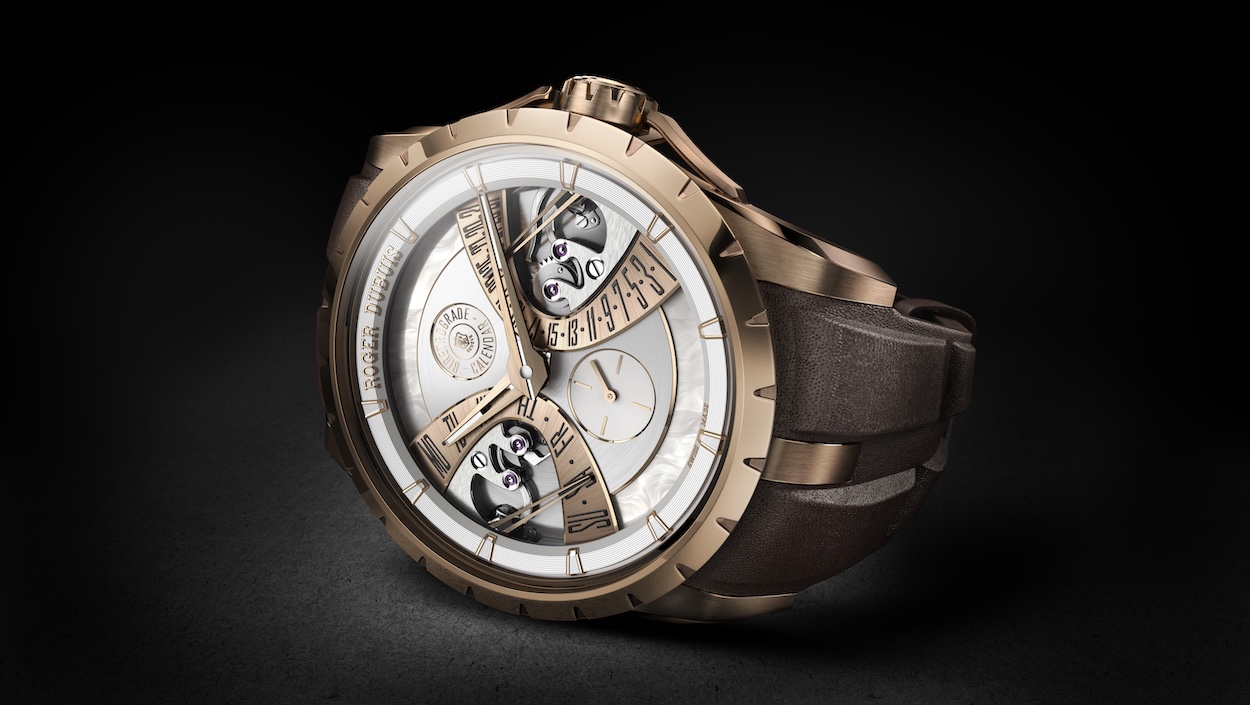
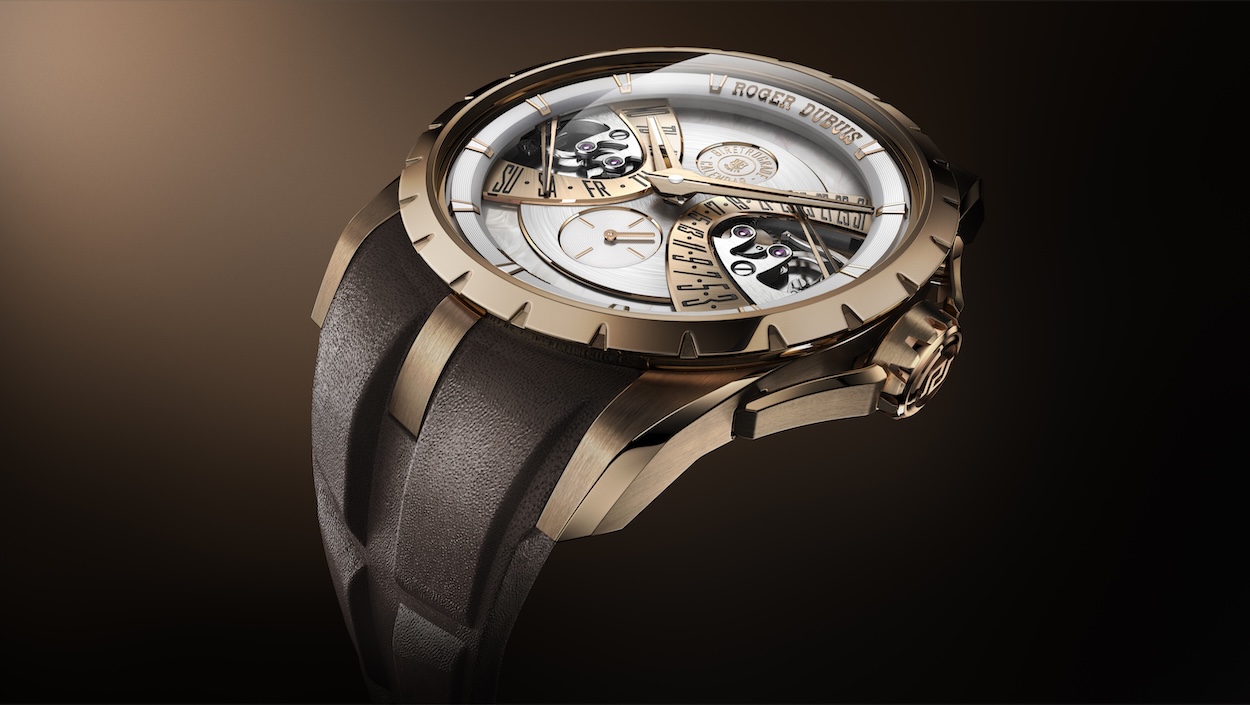
To celebrate its 30th anniversary, haute horlogerie house Roger Dubuis announced the Excalibur Biretrograde Calendar at Watches & Wonders Geneva earlier this year. The Swiss maison, named after its technically and aesthetically experimental co-founder, looked to its first-ever release in 1996 (and an earlier 1989 patent secured by Dubuis) for inspiration. The result is more than a refresh—but a mechanical advancement tucked within harmonious visual language.
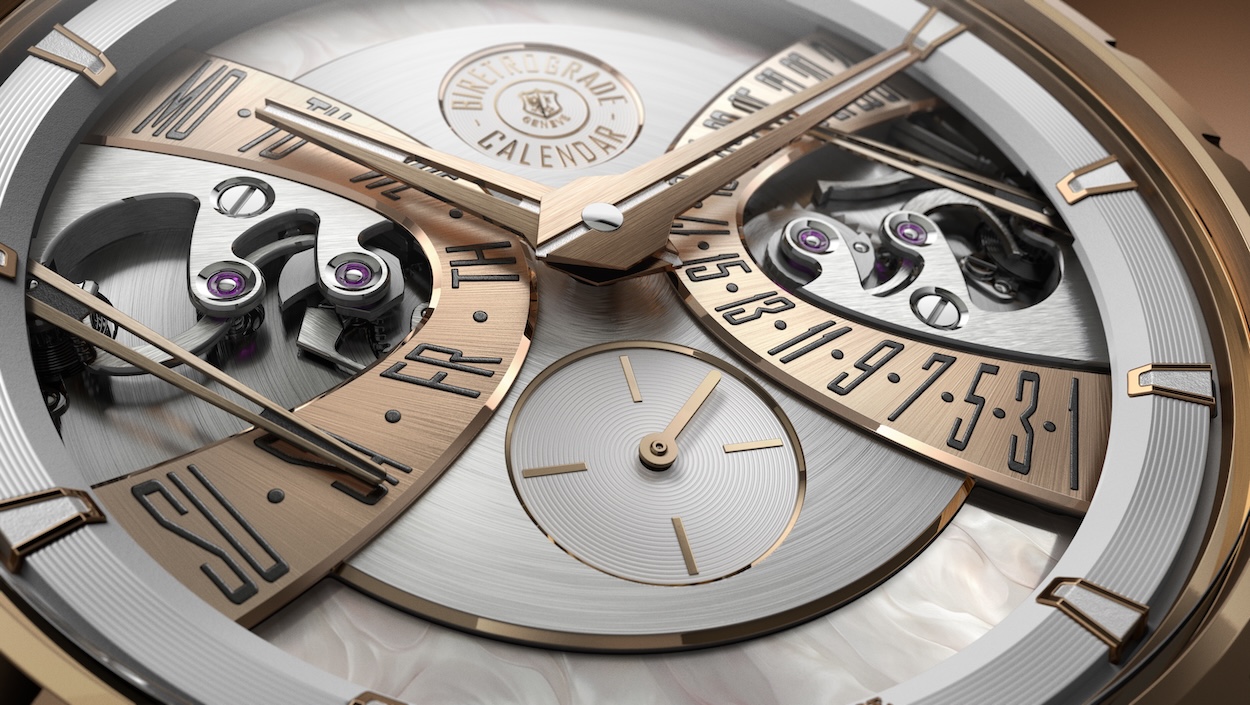
The watch face of the Biretrograde Calendar is easy to decode. In addition to an hour and minute hand traversing the dial, it is defined by symmetrical, vertical crescent-moon indicators—one of which points out the day of the week on the left, while the other notes the date on the right. After the end of the week and month are reached, the respective hand flicks back to the beginning (a feature known as a retrograde calendar).
Courtesy of Roger Dubuis…
Much has changed in the 30 years of watchmaking since Roger Dubuis debuted—and the Biretrograde Calendar reflects this. Three decades ago, dials were primarily designed by graphic designers; today, industrial designers often lead the process. This has led to a transformation from flat dials to watch faces that emphasize layers and volumes. For the Biretrograde Calendar, this architecture is emphasized by variation in materials and finishes.
Pink gold and mother of pearl define the warm visual presentation. “Yet the rest is not merely white,” a member of the product team at Roger Dubuis shares with Surface. “We use different finishes. We have beveled angles on two segments, and also on the ring. We have circular, brushed finishes, too. This is important for us because in this way we were able to bring this watch into the future.” A closer inspection reveals the various ways each component has been aesthetically accented.
Courtesy of Roger Dubuis…
In-house developed calibers (the internal component that powers the watch) are integral to Roger Dubuis, and, as such, skeletonized models (which expose the mechanism inside by removing parts of the dial) have been a frequent way to reveal the maison’s technical developments. Here, however, Roger Dubuis has stepped away from this common attribute in its repertoire—and uses texture to express nuance.
“We had a lot of iteration in terms of prototyping,” shared the Roger Dubuis product team. “This was to find a balance between heritage and the future, and specifics of the warm colors. We also worked on fonts. When we began, everything was serif. There were a lot of round curves. We knew that it was part of our identity and that serif needed to remain—but we straightened our numerals. We did something with serif that is very modern.”
Courtesy of Roger Dubuis…
In Geneva this year, Roger Dubuis also announced the Excalibur Grande Complication—a spectacular sibling to the Biretrograde Calendar, limited to only eight pieces total. A grand complication means that a wristwatch contains at least three additional functions (also known as complications). Though it looks similar to the Biretrograde Calendar, the Grande Complication couples a perpetual calendar feature with a flying tourbillon, and a minute repeater (a chime).
“Those two were specifically designed for the 30th anniversary celebration,” the product team adds. “We had to have the same look and feel, but at the same time make them different enough that someone who doesn’t know anything about watchmaking can understand that these are two very different timepieces.” In many ways, the watchmaking team gave even more life to the visual codes of the Grande Complication.
For the next 30 years, the maison intends to focus on expression—and maintaining the Poinçon de Genève (Geneva seal) certification. This acknowledgment, which is specifically for mechanical timepieces produced in the Canton of Geneva, considers both technical excellence and decorative techniques. It makes Roger Dubuis an apt fit for the honor.