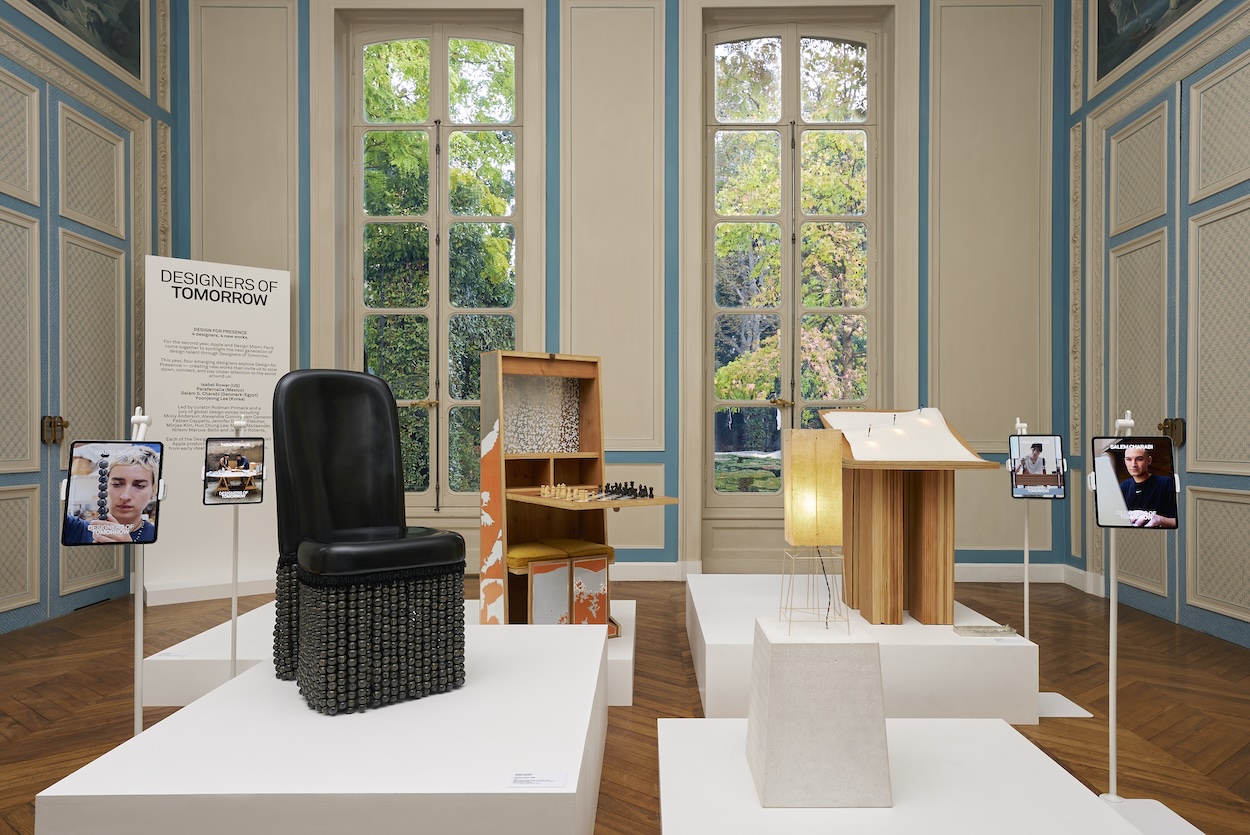
Within the fourth edition of Design Miami Paris, hosted through the opulent halls of L’Hôtel de Maisons, Apple installed its second “Designers of Tomorrow” exhibition. Themed around the concept of presence, the collectible design exhibit features four works by emerging international talent: Egyptian Danish architect Salem S. Charabi, Brooklyn-based designer Isabel Rower, Seoul-based designer Yoonjeong Lee, and Monterrey and Mexico City-based practice Parafernalia (led by Genki Matsumura and Sebastián Zorrilla).
Together, the contributions forge a study on focus and narrative intentionality. This is thanks to the vision of Rodman Primack, the program’s curator and former longtime creative director of Design Miami. Primack, co-founder of AGO Projects, drew the theme from the simple, honest assessment that many of our lives have become so busy. “The process was not without a lot of discussion,” he said during an advanced preview of the exhibition, “but it was fairly easy to identify these four designers and give them this platform.”
Courtesy of Élodie Croquet…
Indeed, the magnificence of the curation pertains to a multitude of factors—the depth and diversity of the talent involved, the strength and originality of all four pieces, and the work in the greater context of both the venue and Design Miami itself. “All four designers have come up with different ways of creating that moment of pause, that moment of presence,” he adds. “The four different practices really show us various ways of approaching design and yet they all have a through line of craft and hand-making.”
For Charabi, this manifested as a work titled The Emergence of Light, a fixture composed of a banana paper lantern set atop a geometric palm frond structure and a grooved limestone base. “I identified 12 different fibers across Egypt—all you need to make paper is fiber and cellulose,” he tells Surface. “We applied paper-making traditions to local fiber.”
Rower’s Padded Chair 1860 references 18th- and 19th-century papier-mâché furniture, including a historic chair she saw at the Musée des Arts Décoratifs in Paris. Rower engineered an iteration where the back and the seat do not touch—and applied clear quartz glaze to paper pulp composite for a high-gloss finish, which she then complemented with 1,500 handmade ceramic beads.
Courtesy of Élodie Croquet…
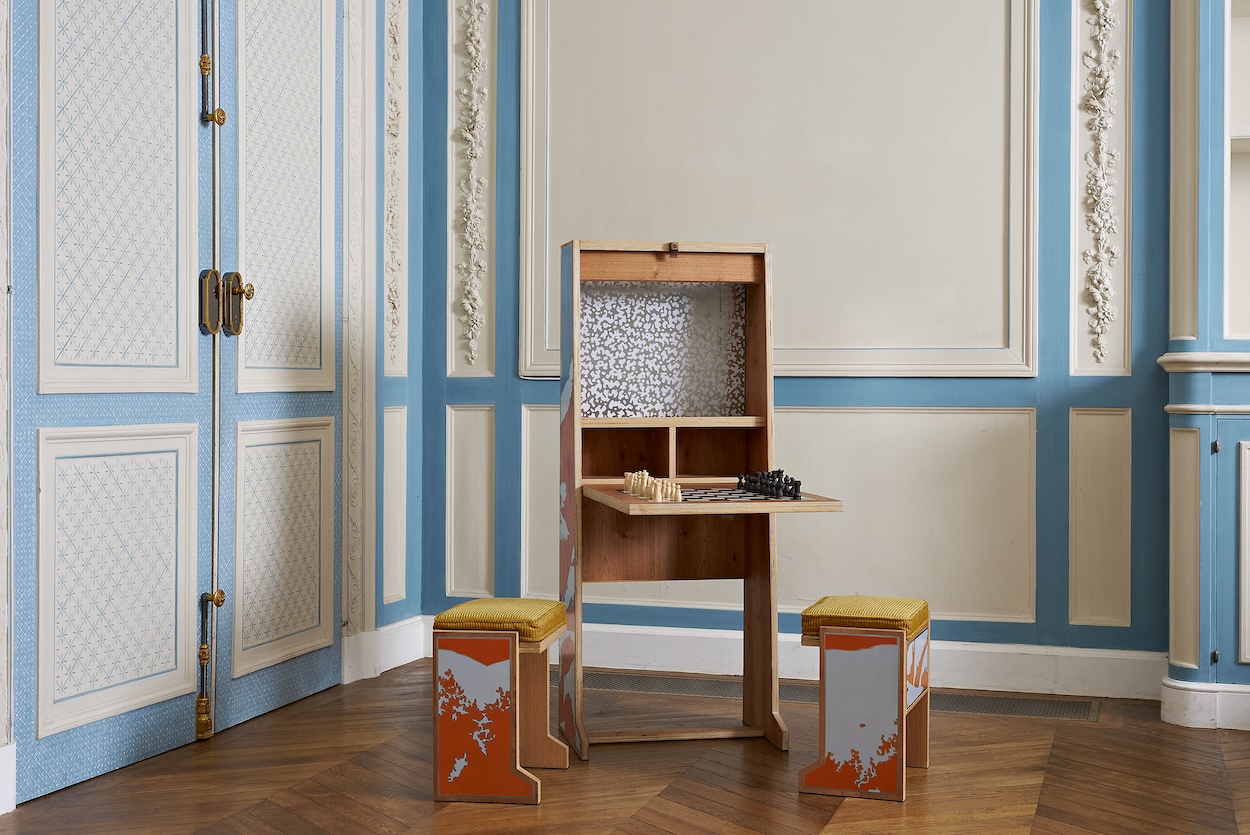
Together, Genki Matsumura and Sebastián Zorrilla devised the MonoAmbiente 1, a furniture piece complete with a chess station and two stools. When the cabinet-like work is closed, its acid-etched stainless steel surfaces depict a rock-formation landscape. Each designer also hand-produced a set of chess pieces. Regarding the form, Matsumura tells Surface, “We were drawn to furniture that is made for really niche purposes. We started with that. We were thinking about presence in many dimensions. Even they we have focused on the way you feel when you’re sitting and talking with someone else, when you close this it completes the landscape and the materiality invites you to look in and inspect how it’s made.”
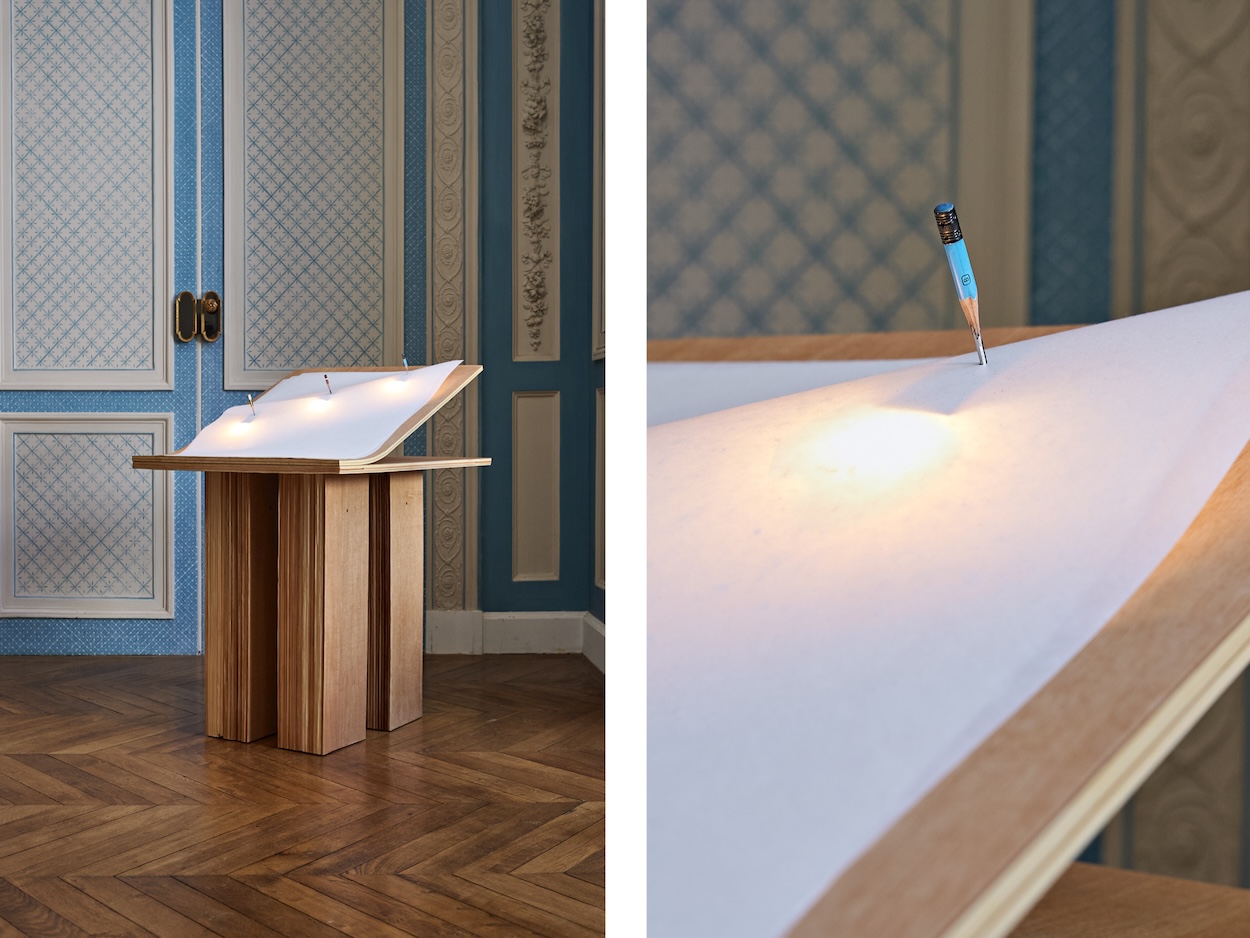
Perhaps the most encompassing, conceptual inclusion, Lee’s New Form sets three “pencil nails” (wherein she has replaced graphite with a metal nail) into 5,000 thin sheets of veneer that the designer hand-layered. The result is a wooden table with an integrated lamp, where sheets of paper act as a shade over a series of bulbs and gently diffuse the light. The pencil nails are a metaphor, acknowledging that as you hone an idea you continue to sharpen a pencil.
“I am used to working with ‘pencil nails’ and paper. For the form here, the angle is very important. I could have just used a pencil in a desk but I didn’t feel that it would highlight my work. It was too simple,” Lee tells us. Its shape affirms something quite unique: New Form exists as both a piece of design but crosses the threshold into conceptual art, as well.