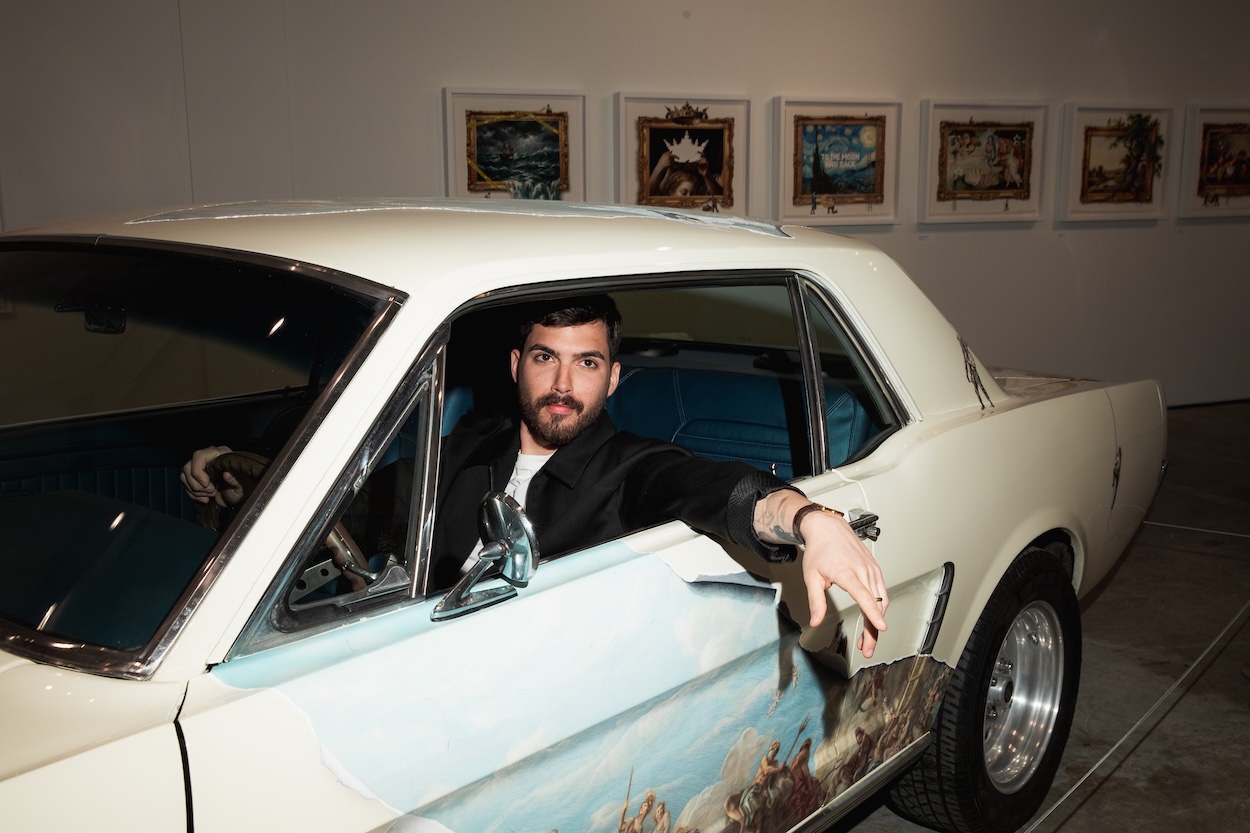
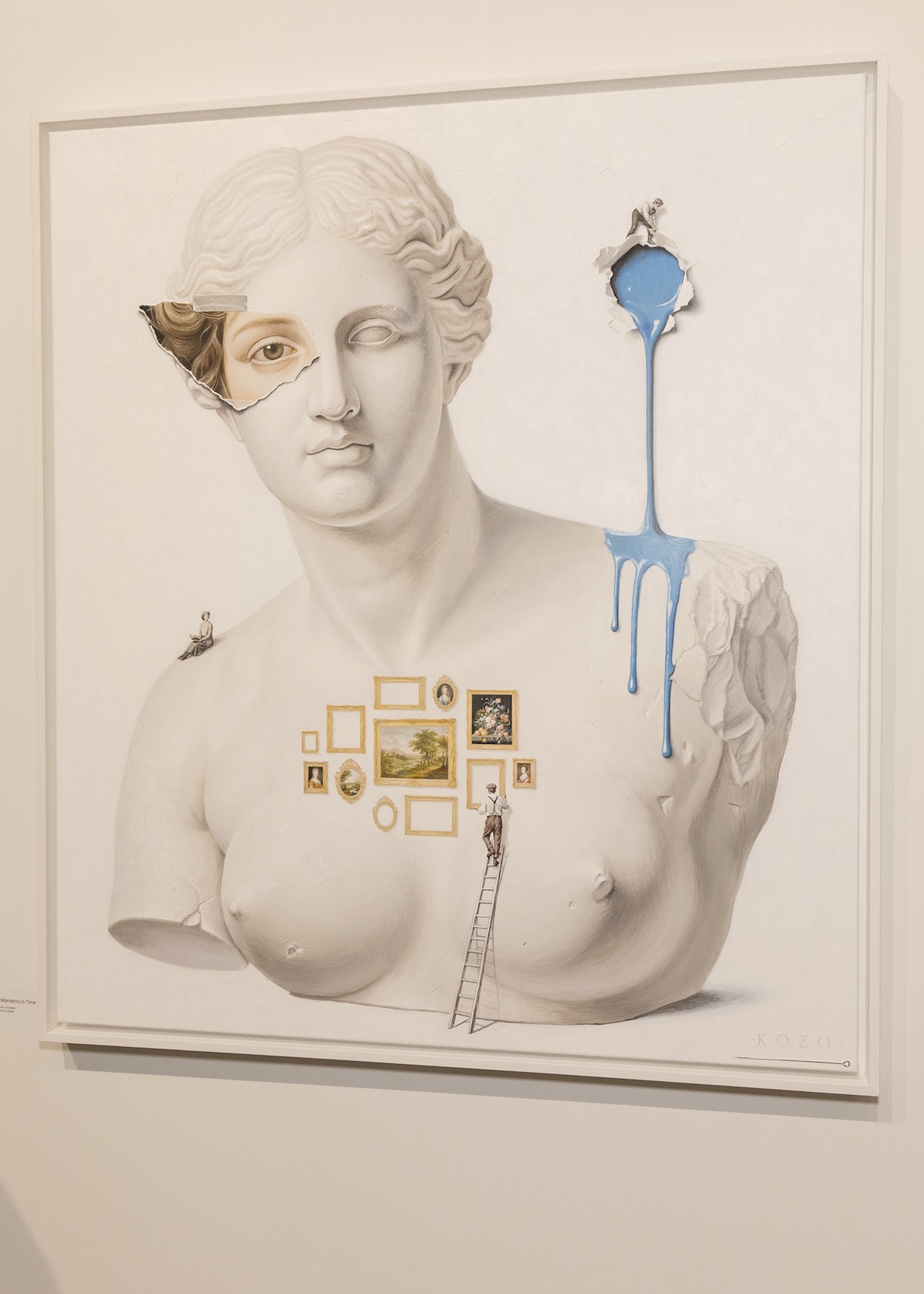
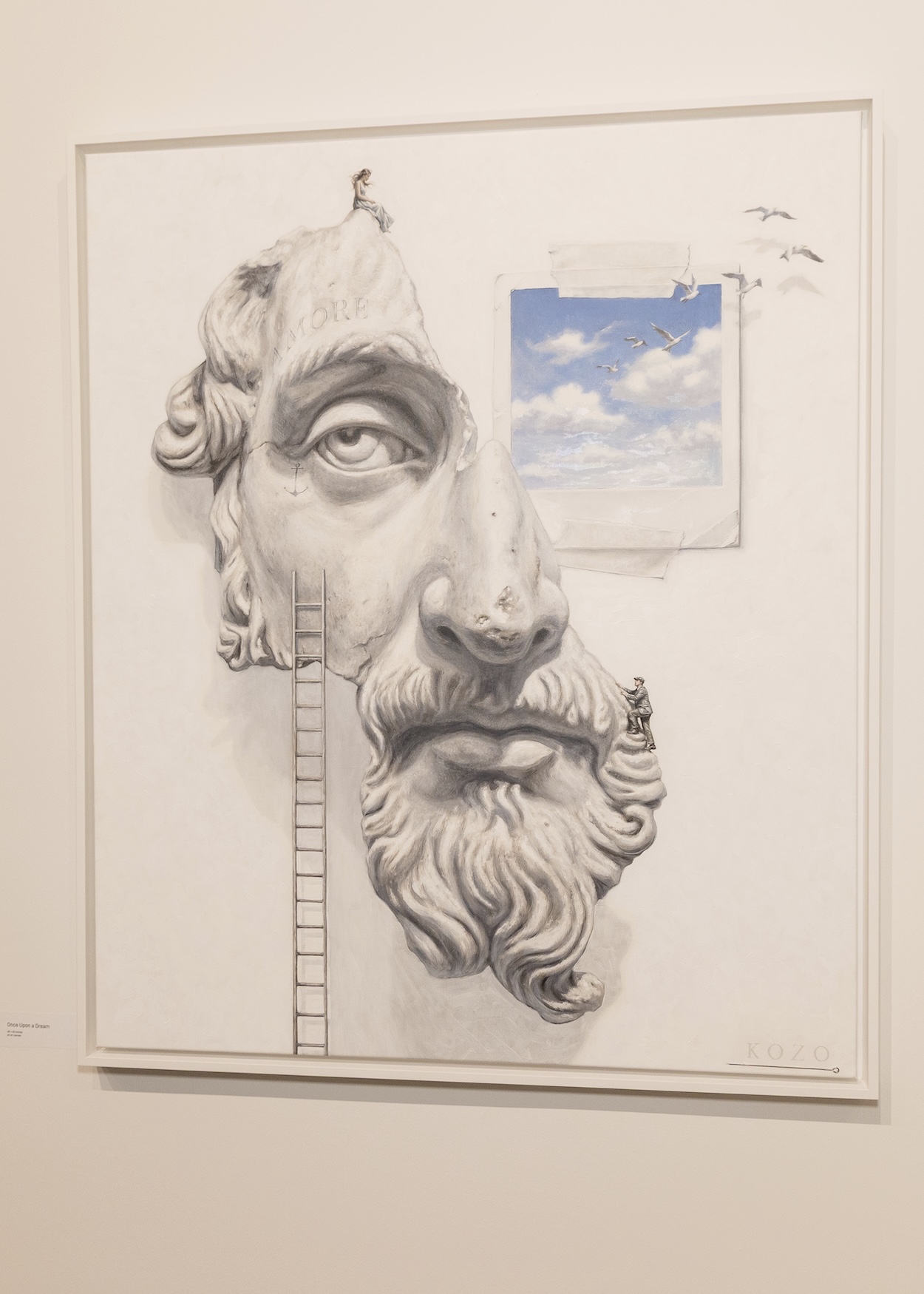
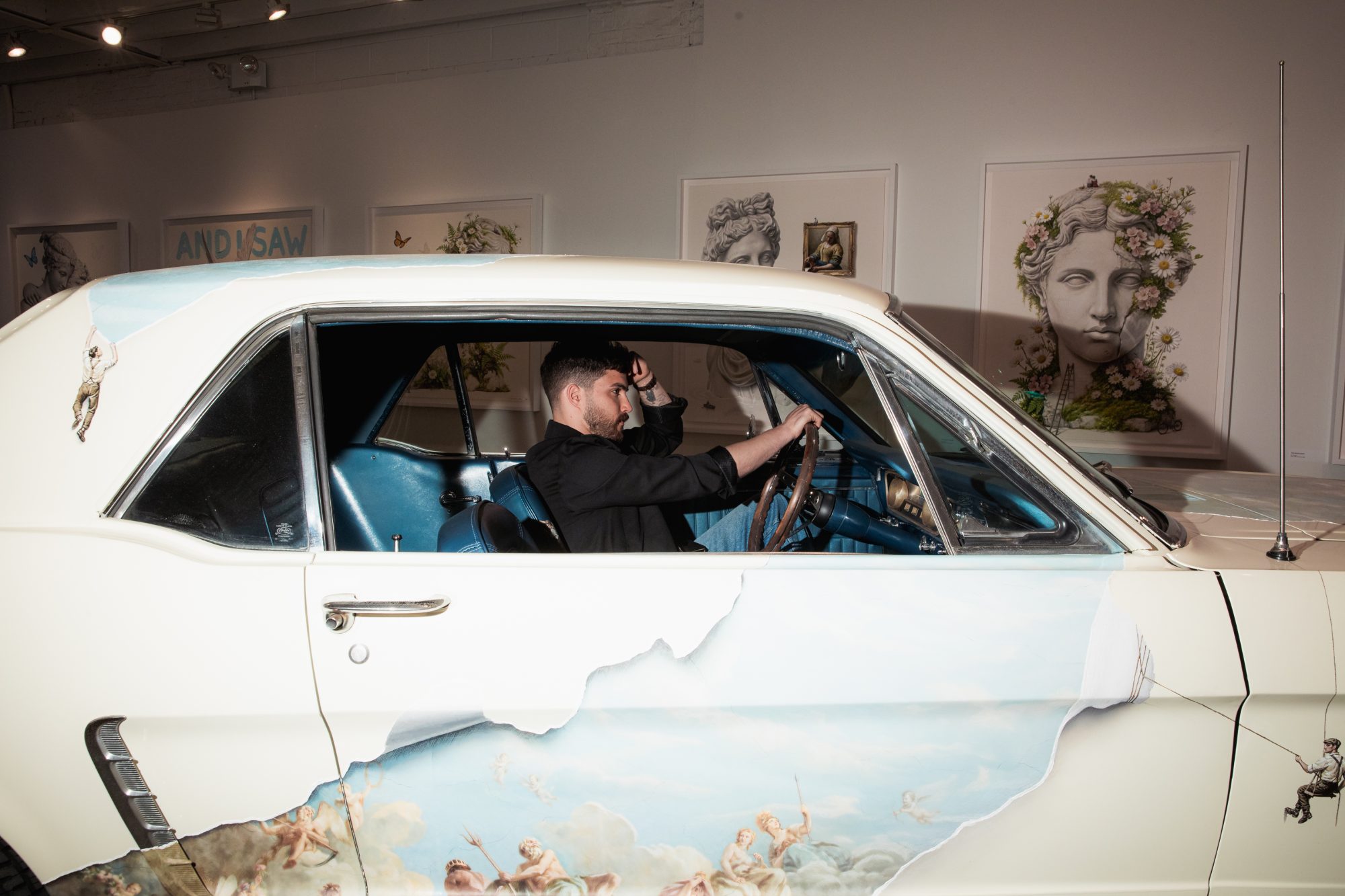
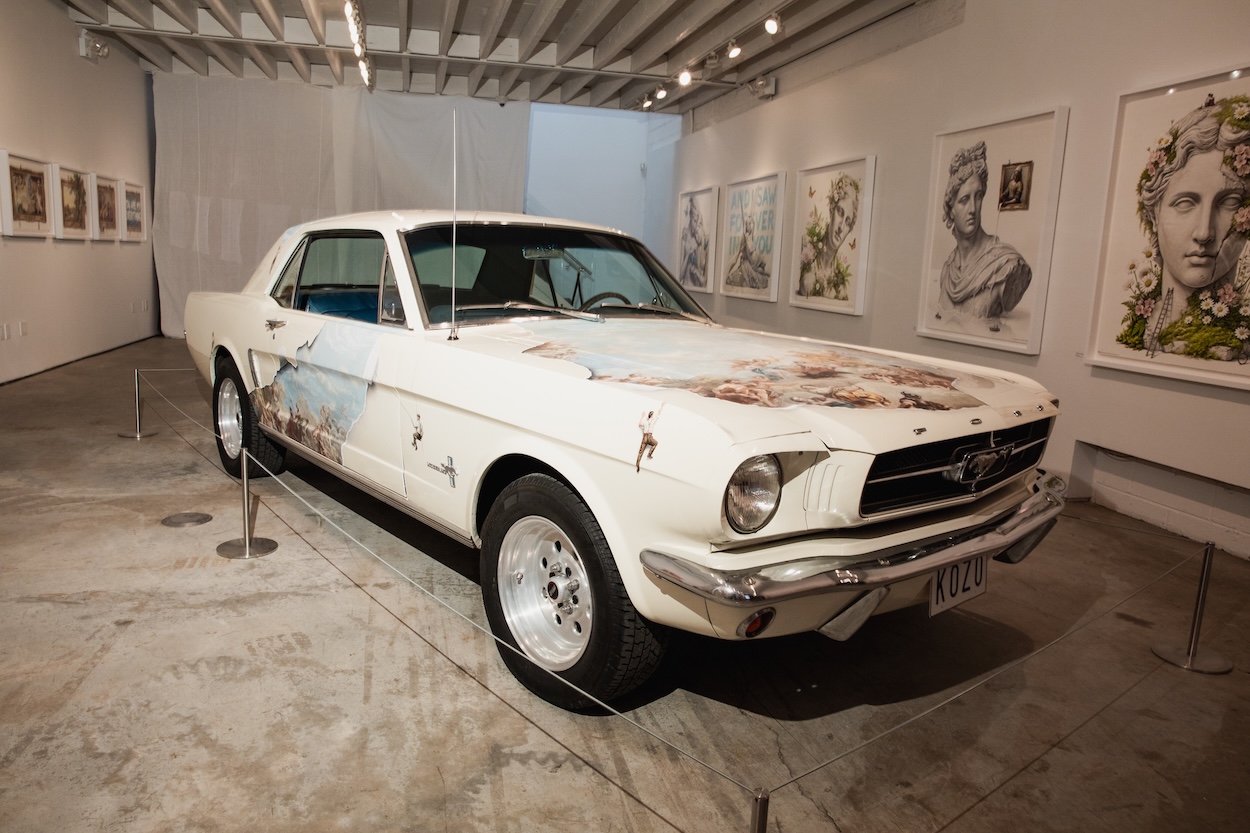
One monumental 1965 Ford Mustang, adorned with more than 500 hours’ worth of hand-painted (and tattooed) art, greets visitors to Free Parking, the garage-like experiential gallery space from collector and curator Larry Warsh’s Cart Department. The vehicle acts as both canvas and mission statement for the New York–based fine artist Kozo, who accented the surrounding walls with his large-scale paintings and drawings. Within, Kozo masterfully invokes art historical imagery, toys with perspective and scale, and upends surrealistic expectation. Altogether, the exhibition, titled “Permanent Impermanence,” edifies, inspires, and builds synapses between art forms.
Here, amidst a celebratory opening night dinner presented by Hexclad, with culinary curation from chef Rōze Traore, Surface spoke to Kozo as guests—including Futura, Mickalene Thomas, Quil Lemons, and Gabriella Khalil—engaged with his works.
Let’s begin with your development as an artist from the skin as canvas to large-scale painted works. Where did you begin? And when was the moment you began to expand your repertoire?
I started tattooing when I was around 16. I used to post on Facebook, designs and things I was interested in tattooing and, basically, tattoo for free for a year, just whoever wanted to come in—friends, people I met in the skateboarding world. I would basically tattoo them on my bed. I think I was using a tattoo machine I bought from eBay, and back then it was really tricky, learning how to tattoo in general because you had to be an apprentice at a shop. I was too young to do that, so I had to figure it out. But slowly I built a portfolio, and I got into a tattoo shop and developed my visual language.
When I was 20, 21, I really got into more of the hyper-realistic, micro-color realism that I’m known for today. I was trying to bring my knowledge in academic-style painting into the tattoo world. I thought that the small designs allowed me to play more because people were willing to experiment and do more interesting things, given the fact that it’s not too big and it’s not going to take too much space on their body. The commitment is not as crazy as, you know, a sleeve. It allowed me to explore and create interesting designs, and this is where the style of classical art and juxtaposition with modern culture came about.
When did you move to New York? And how did that contribute?
Bang Bang reached out and offered to work with me on an artist visa, an O-1 visa. That was 2019–2020. We worked on the visa together and then I started working with him, which for me, you know, working with these artists was a big deal. At some point, I realized that I can use my machine to work not only on skin, but different surfaces like leather, canvases, and paper. And I just realized that for me to fulfill my full potential it means to be a multidisciplinary artist.
Around 2021–2022, I started expanding into the fine art space. And I collaborated with a local gallery in New York called DTR with a body of work that juxtaposed classical mythologies and tattoo ink and tattoo symbols that brought my life story and my clients’ stories onto the canvas. From there I kept expanding, kept trying different things, and opened up my own studio in Brooklyn, where I currently work. From there, I landed a collaboration with Maison Margiela in 2024 during Art Basel Miami, where I tattooed some bags and Tabi boots, sneakers, and sunglasses.
Do you remember what the first tattoo you gave was?
I think the first tattoo I gave was at the bottom of my friend’s foot, because, actually, tattoos disappear after a few months in this area because of the way the skin is. I think it was a Pokéball from Pokémon. I didn’t know how deep I should go with the needle, so I went as deep as I could. I think I probably tattooed his bone that day.
Can you please speak to the development of your style—the way you weave together surrealism and stunning depictions of classical art and sculpture?
I think my style is inspired by my experience in life and basically the things I believe in as a person. My style explores the contrast between the temporary life of human beings and the timeless grandeur of works of art that are bigger than life. And despite the human scale versus these monuments, they’re able to leave an impact through collaboration, persistence, courage, and hard work—and love. And for me, as an immigrant, it also means a lot moving to New York and taking that step, you know, kissing my mom goodbye, my parents, and creating the life that I always dreamed of—being an artist.
What are the origins of this show—both the partnership with Larry Warsh and the body of work within?
I got a call that Larry might be very interested in visiting my studio in Brooklyn. I got super-excited and obviously nervous. Larry’s a big art collector and very known in the art world, and, for me, having him in my studio would be a great honor. Larry came into my studio and it was really exciting to see the work. He even called his daughter and FaceTimed her and showed her the work, which was a good sign. From there, Larry proposed a solo show at 16 Morgan Street, where I’d be designing, tattooing, and painting a car.
That opportunity really helped me push me further and allowed me to progress as an artist, because I’ve never painted on a car, and I had to figure out how to transform my visual language as a painter and a tattoo artist into a moving vessel.
Can now you speak to the car? How did you select the specific vehicle—and how did you determine what you would do ?
We started looking for the perfect car for this project, and we landed on the ’65 white Ford Mustang. For me, this car is a symbol of Americana, and it’s an homage to my life in New York and making it happen as an artist in New York City and in the U.S. I felt like the white color worked perfectly with my body of work, which has a lot of white negative space and white frames. For me, it was a perfect fit.
I had a lot of ideas for the car, but I had a one concept that I thought would be great: to create some sort of effect to show how culture is basically layered, and how culture and art doesn’t come from nothing, it comes from, basically, years and years of artists and designers and people expressing themselves. That creates some sort of an ever-evolving dialogue.
For the design, I was thinking of creating a trompe-l’œil, almost like an illusion, to show something historical, with grandeur—something epic underneath the structure of the car. For me, the Apotheosis of Hercules, which is painted on the ceiling of the Versailles Palace, was the perfect example of master craftsmanship and the most epic man-made creation, by François Lemoyne, who is an artist that I adore. It was also important to show how the day-to-day workers, the people who are the craftsmen and humans, interact with that concept and how, in a way, they are in charge of making that work of art come to life. Despite their size in comparison to the car or maybe the artwork, through collaboration and hard work, they’re able to make an impact and make this dream come to life.
Tell us a bit about the way the more than 500 hours translated into a complete vision with a car as a canvas.
I slowly and carefully started painting the car, angel after angel, and added the sky and the clouds, and slowly built this composition on the car. I think the most exciting part was the fact that I actually tattooed the leather seats. I was kind of thinking, how can I introduce my world as a tattoo artist into this design? For me, the leather seats were a good opportunity to bring my skill as a tattoo artist into this creation. I actually spent a few days with my tattoo machine making this vision come to life, where I tattooed two figures climbing the leather seats, so it kind of communicated with the design that I painted on the car itself.