As executive director of the Michelangelo Foundation, Alberto Cavalli oversees Homo Faber, the biennial exhibition of contemporary craftsmanship that takes over the island of San Giorgio Maggiore in Venice. For this year’s edition (running September 1–30), the artistic direction belongs to Es Devlin. Every prior edition arrived under a frame of its own—Luca Guadagnino’s cinema, Stefano Boeri’s architecture, India Mahdavi’s color, Robert Wilson’s theater. Devlin’s is light.
“It was not so much an instruction as an invitation,” Cavalli tells Surface. “Es Devlin’s practice is intimately connected to light, which she uses as a material with which to craft installations, exhibitions, and experiences. We knew, when we started to discuss her participation, that light would be integral to her vision, and to us it seemed the perfect way to present everything we wanted to show and say. Light is so deeply entwined with craftsmanship: it fuels the growth of natural materials such as willow and wood; it interacts with color and illuminates translucency; and on a fundamental level it allows humans to exist and to use their hands to create.”
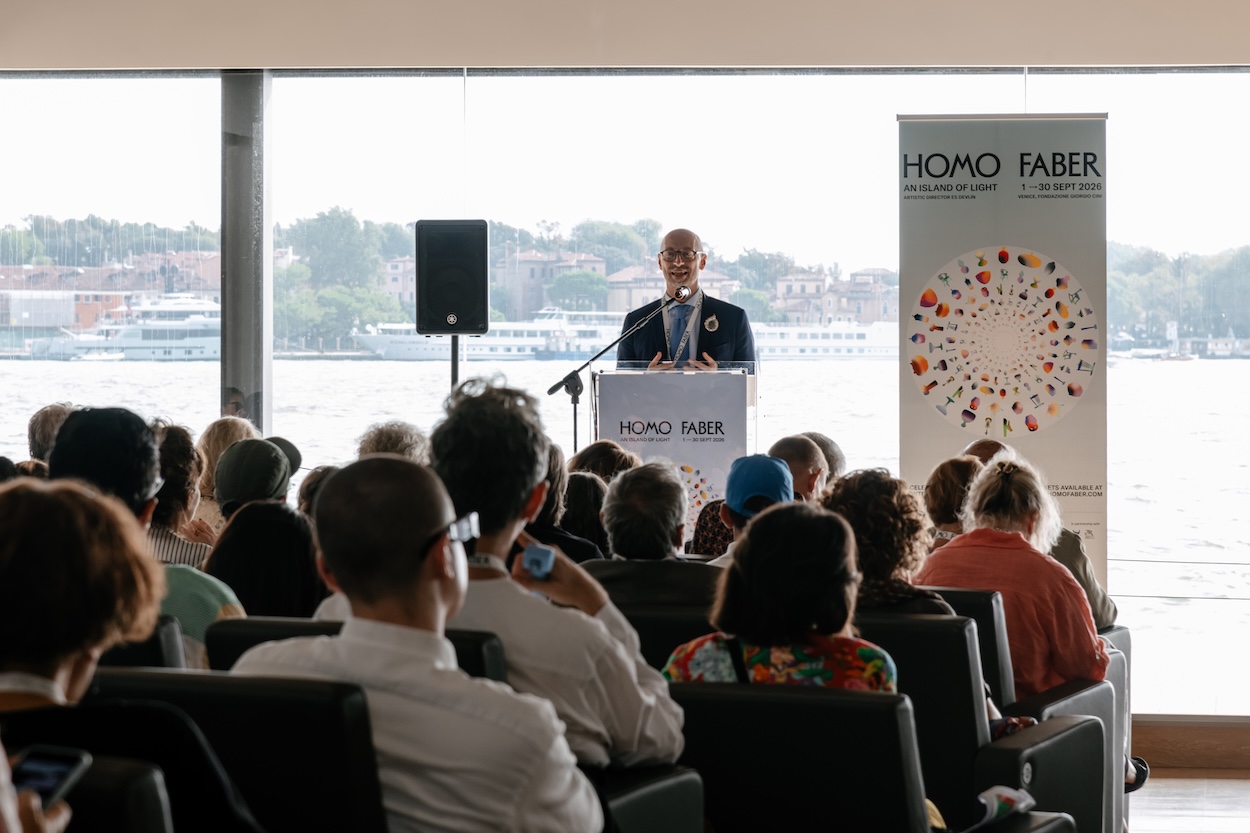
Opening press conference Homo Faber 2026 Speaker: Alberto Cavalli…
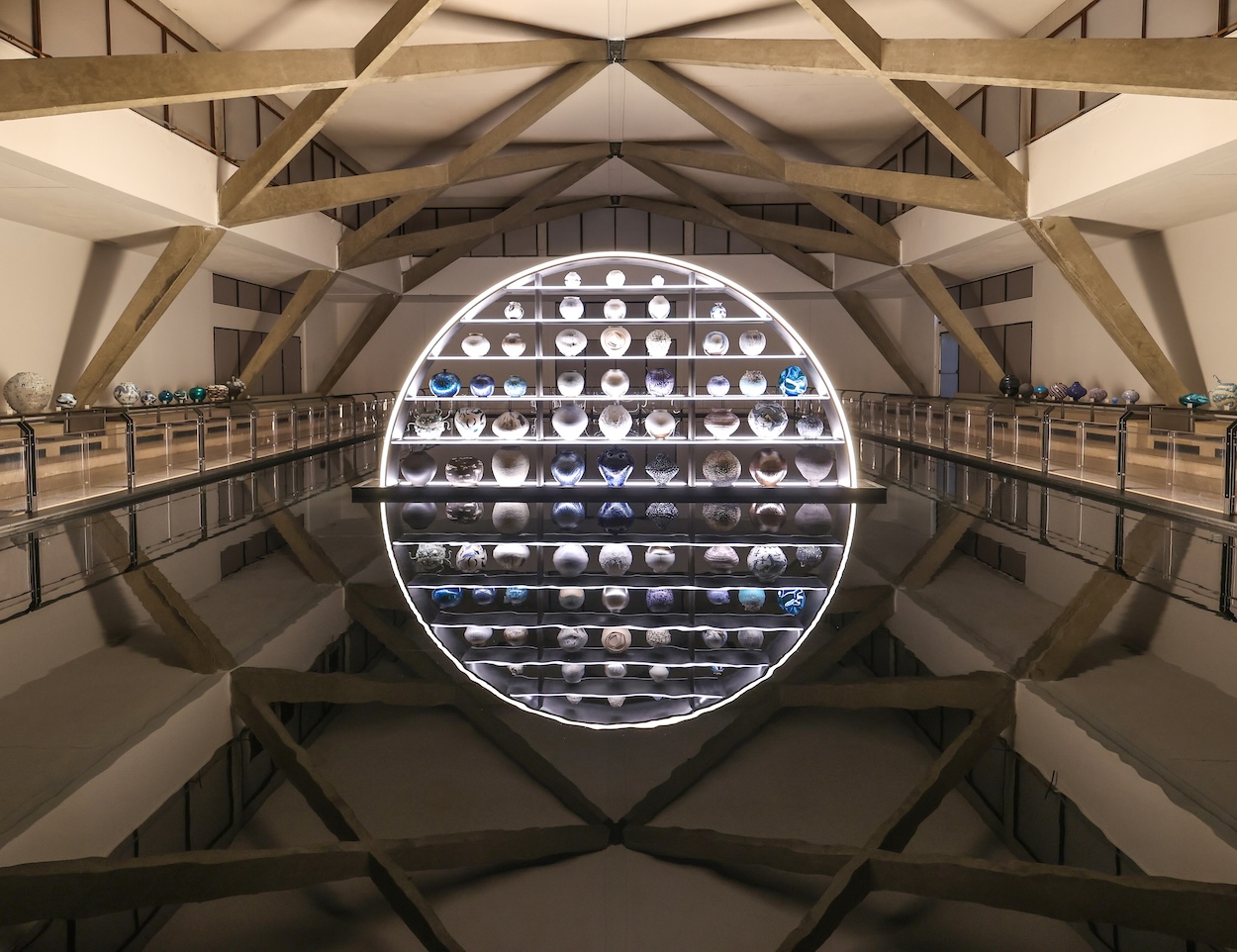
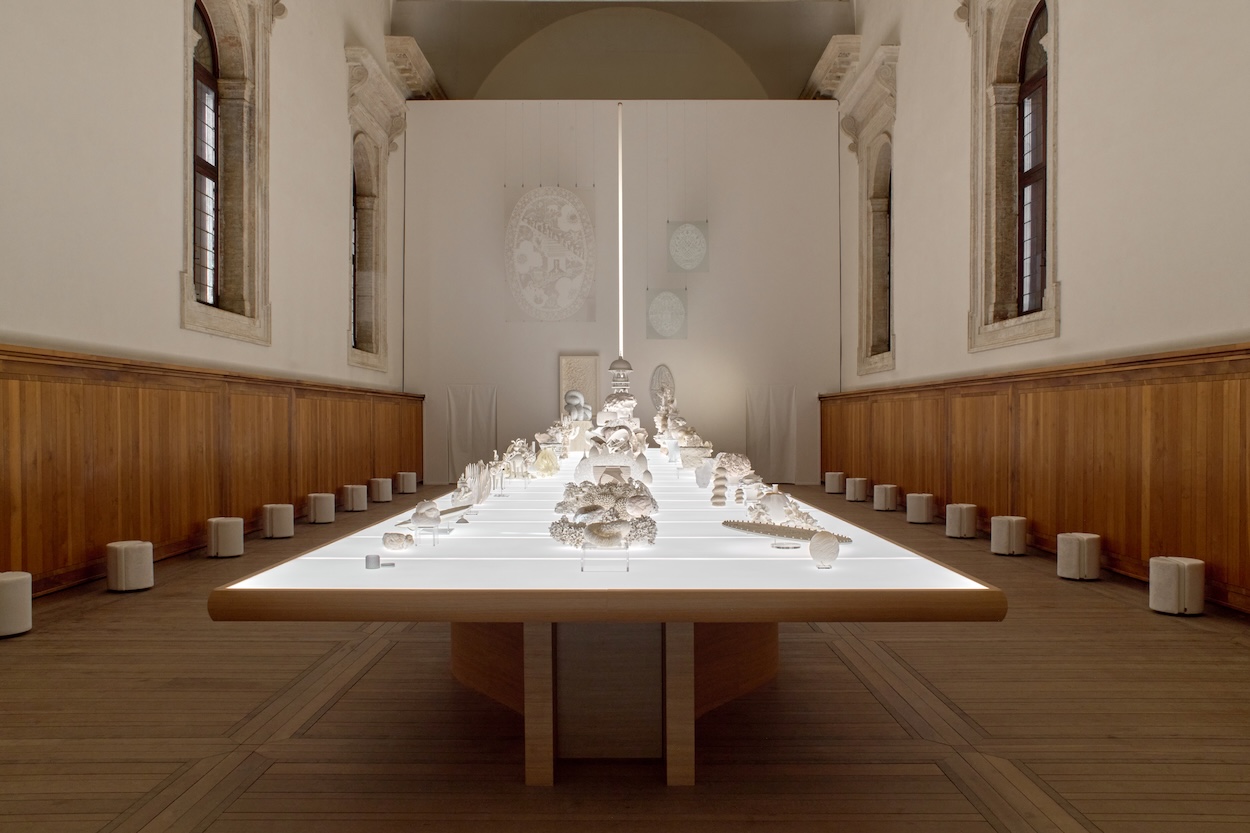
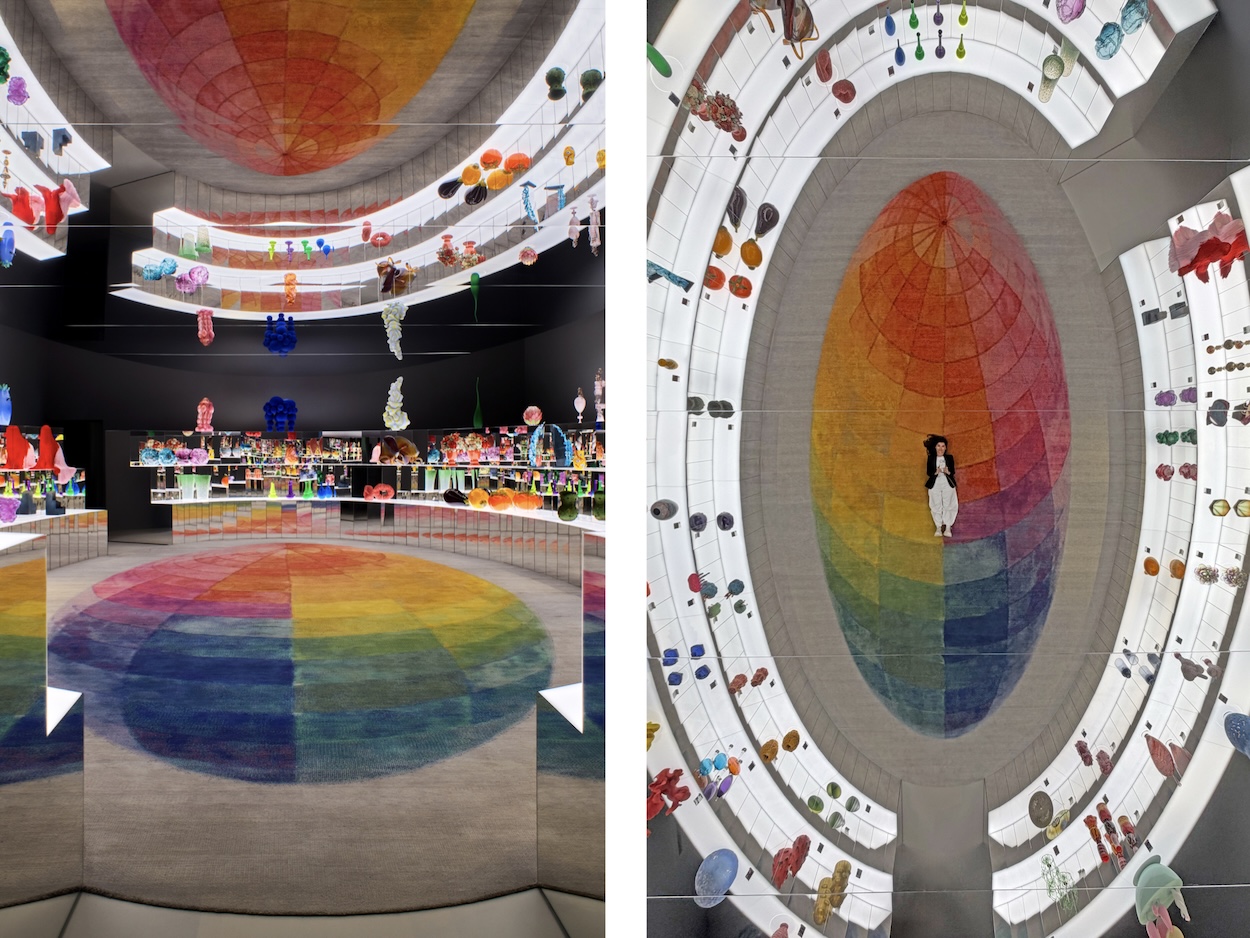
Devlin has built fifteen rooms across the site. Moon jars sit lit in a drained 1960s swimming pool; a hundred objects are reduced to silhouettes thrown on a wall. The rooms were written first, the objects found for them. “The sourcing team worked in close connection with the artistic direction, to find the most suitable ‘protagonists’ for each of the 15 pièces imagined by Es Devlin,” he says. “They all decided to speak in poetry, rather than in prose, because the poetic word is powerful and concise, like light.”
Seven hundred objects and some five hundred artisans made the cut. “We have a rigorous process for selecting the objects for the exhibition, based on criteria that include originality, diversity, authenticity, and talent,” Cavalli says. “Homo Faber 2026 is our most ambitious edition yet, and we worked hard to include craft artists from a wide range of countries and of a variety of ages, cultures, expertise, and creative styles, with careful attention paid to gender balance.” The foundation’s database holds more than 20,000 names. “So of course making a final selection is extremely difficult!”
For 2026, artisans work live in three of the main rooms, and An Atelier Alive rebuilds a functioning studio inside the exhibition. The line between demonstration and performance is one Cavalli has been walking since the first edition. “Live demonstrations are integral to the ethos of the exhibition, offering visitors a rare chance to really get up close to craftsmanship and see a maker in the act of making: the techniques, the tools, the way the hands manipulate materials,” he says.
“We work closely with the masters beforehand to ensure they have a comfortable working space that echoes their workshop environment. We limit visitor numbers into those spaces to prevent overcrowding and generate a calm, harmonious atmosphere,” Cavalli says. “Making is often a solo activity and they welcome the chance to interact with enthusiastic members of the public who are inspired by their work—and may, we hope, become their customers.”
Craft has been absorbed into luxury’s story about itself; every maison now has a film about hands. Cavalli has a short answer for what Homo Faber refuses to do. “Use craft as a make-up,” he says. “Craftsmanship and creative vision constitute the rare earths of luxury, which make it possible to trigger all the alchemical, constructive and communicative reactions of products that carry within themselves the precious seed of permanence, repairability and care.” “The adjective ‘artisanal’ is used with a certain ease to give a patina of value to objects that are actually very industrial. True luxury cannot be reduced to a complacent aesthetic coating: on the contrary, it is a production discipline that feeds on the manual dexterity of master craftsmen and magnifies their ability to be not executors, but interpreters.”
He answers the artificial intelligence question—the one everyone in design is fielding this year—the same way. “We have to accept that A.I. is here to stay, and that it will be part of our lives, in some form or other, whether we like it or not,” Cavalli says. “However, we feel strongly that it should never be used to replace human skills, human ideas, human talent.” Authenticity is one of the foundation’s judging criteria, and he defines it narrowly. “A work must have a binding and essential connection with its author: its artistic and economic value must derive from the skill of the person who produced it, and its existence must be fundamentally connected to the context and experiences of its maker.”
In May, the foundation launched the American edition of Homo Faber Guide with 213 artisans, and 71 of them are in Venice: Ibrahim Said transposing Fatimid water filters onto the outside of a jug in North Carolina, Dina Nur Satti burnishing Nubian forms in Ridgewood, Jane Yang-D’Haene coiling moon jars in New York. Diaspora is doing enormous work in the American selection. Asked what he had to unlearn to look at American craft properly, Cavalli answers with what he found. “The great audacity of trying their hands at materials in an innovative, sometimes provocative, always courageous way,” he says. “Original, pioneering, delicate but strong. A sense of wilderness emerges at times, tempered by a great dexterity.”
The exhibition closes at the end of September, but the foundation’s mission runs past it: craft as a profession people can live on. Cavalli measures that in what happens to those artisans on the first of October. “Our imperative is to create a virtuous circle,” he says. Every artisan shown at Homo Faber is profiled on the Guide, which since 2020 has become a sourcing tool for creative directors, interior designers, and brand teams. This year adds Homo Faber Finds, an advisory service pairing patrons with the right makers for a project, alongside Homo Faber Capsule, a themed exhibition series, and the Homo Faber Fellowship, an annual sponsored training program for duos of master artisans and emerging talents. “This virtuous circle is key to Homo Faber, helping to create long-term benefit for every artisan in our community,” says Cavalli.
Cavalli has clear hopes for attendee takeaways. “That there is a bright future for craft. That it is possible to earn a living from human skill. That there is an audience and a market for craft in today’s world and they do not have to abandon their passion out of fear or disillusionment,” he says. “We do not want to sugarcoat life as an artisan: it is not easy; there are many challenges. The aim of Homo Faber is to address those challenges and make it a little easier for craft artists with talent and skill to build and sustain thriving businesses. Not easier to make—the act of creating will always offer its greatest rewards through overcoming difficulty—but easier to earn a living as a craft artist and benefit from the joy and personal satisfaction that brings. In our view, that’s needed now more than ever.”