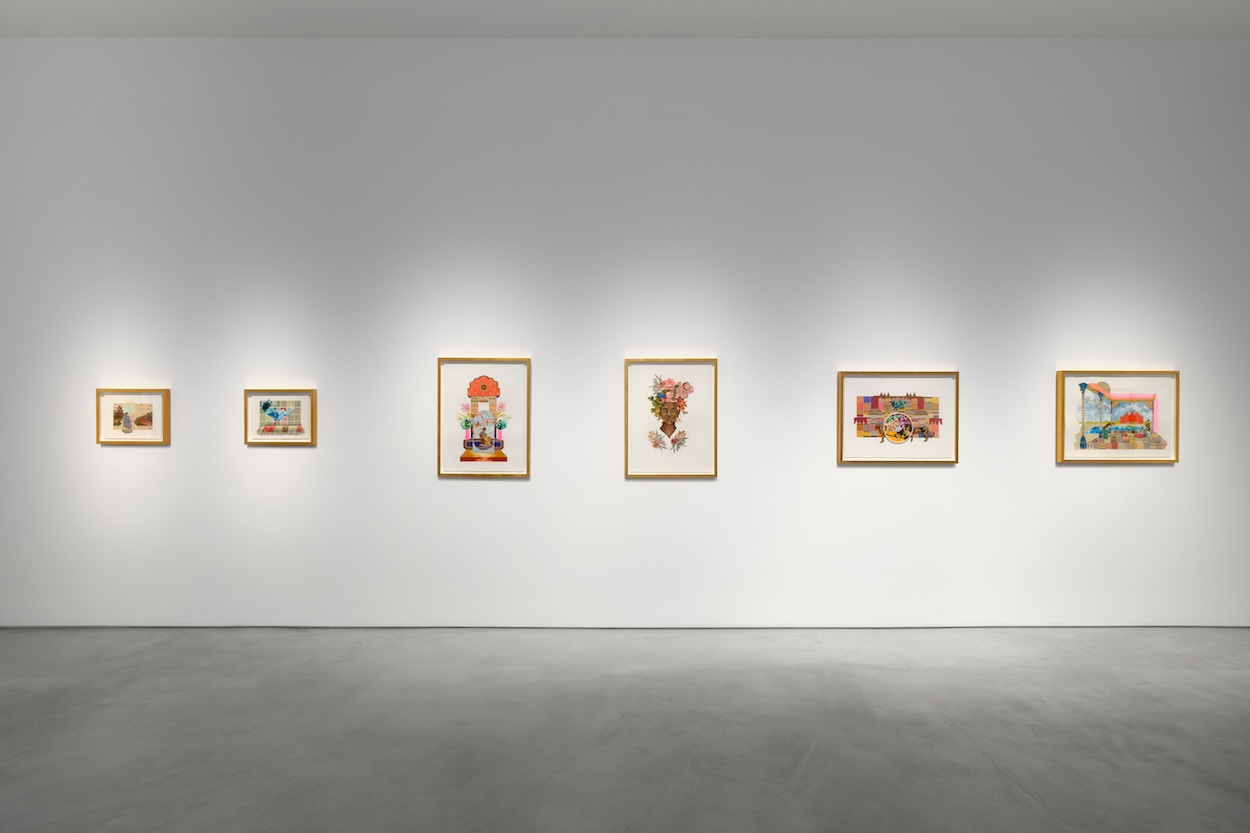
This season at Roberts Projects, two solo exhibitions trace two artists’ distinct approaches to translating lived experience into form. In fables, guineps, and the sweetness of unknowing, Suchitra Mattai shifts from her previous large-scale, installation-driven work to a more intimate practice of collage and painting. Incorporating historic book pages, craft materials, and moral tales, she reconceives the fable as a cross-cultural language, weaving together nature, folklore, and shared human narratives. Her process, equal parts research and intuition, negotiates a dialogue between image and idea, producing work that is at once personal and universally resonant.
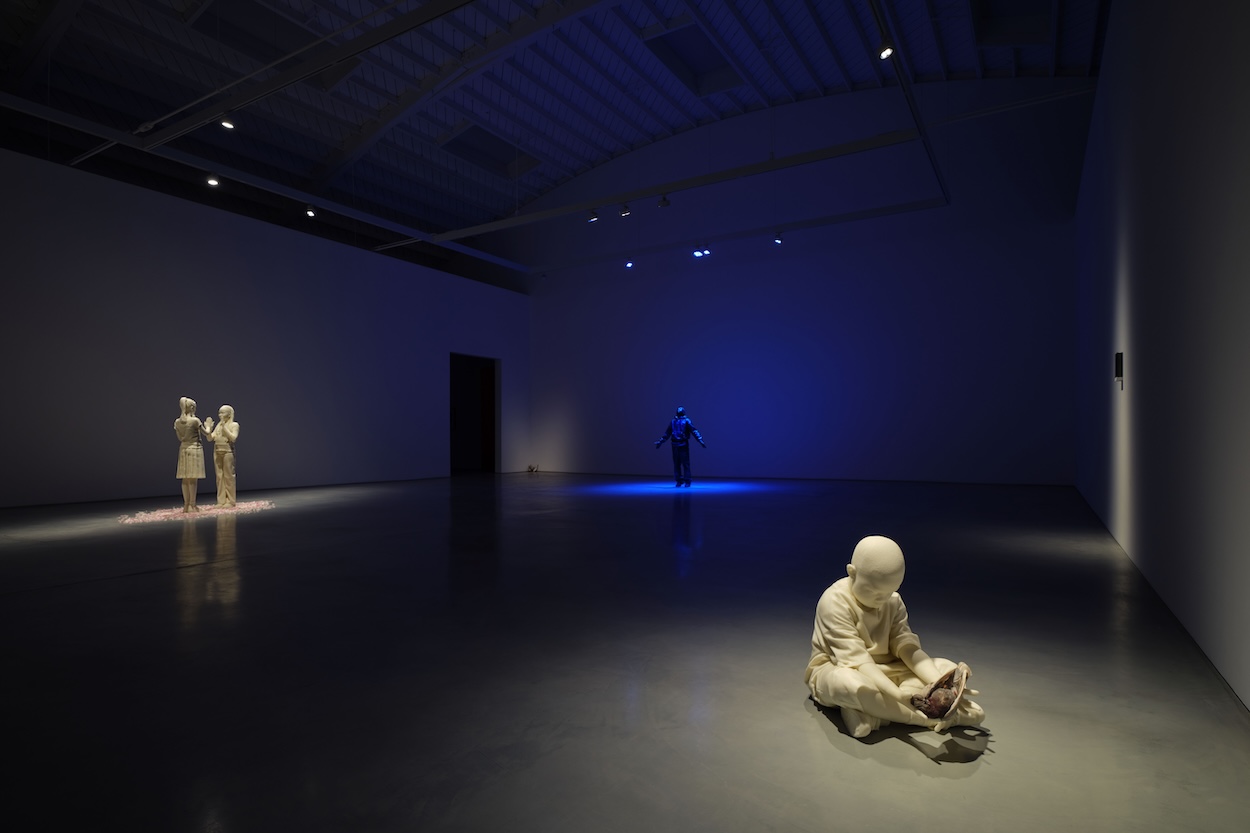
In the adjacent gallery, Esmaa Mohamoud What Does Webster’s Say About Soul? offers a study in restraint. Her first solo exhibition with Roberts Projects employs negative space and precise spatial composition to explore memory, mourning, and spiritual passage. Drawing on poetry and music, from Gil Scott-Heron to Dorothy Moore, Mohamoud constructs a conversation between material and absence, body and spirit. Each sculpture functions as a distinct memory, its quiet intensity amplified by the surrounding void.
Surface spoke with Mattai and Mohamoud about their concurrent exhibitions, and their common ground.
Suchitra Mattai, "fables, guineps, and the sweetness of unknowing." Credit: Paul Saulveson. Courtesy of Roberts Projects …
Surface: This has been a major year of exhibitions for you, congratulations! Having exhibited as much as you have recently, tell us about how you approached selecting the focus and theme of this body of work.
Suchitra Mattai: I have been making collages for many years, but have never shown them in an independent exhibition. After coming out of some large-scale installation-heavy exhibitions, I was happy to turn to developing a quiet solo. Painting has always been at the heart of my practice and these collages combine historic book pages, craft materials, and painting. In our tumultuous new world, I felt that fables, as moral tales, were the right fit. I wanted the ideas to be accessible, and fables often embody cross-cultural ideas that are rooted in our shared natural environment with anthropomorphic flora and fauna.
How does its format as a solo exhibition versus a group show inform the themes you’re able to explore through these works?
SM: I make very intuitively. My research sets the stage, but the work is made through a call and response process. A solo inspires a kind of freedom. Without boundaries, the challenge is to make a number of works that share a collective core. This is what I sought to do with “fables, guineps, and the sweetness of unknowing.” In a group exhibition, sometimes the conceptual framework is set by the curator. I embrace that process as well, but it is more challenging for me because there are set boundaries. However, it is a beautiful experience to share space with other artists and to combine energies in a singular space.
The role that the literary form of fables play in this show is delightfully unexpected. Can you tell us about how other mediums beyond visual art—such as, in this case, the fable—inform your practice?
SM: My family life is a huge influence. I live with my husband, a philosophy professor and film maker, and our two inquisitive sons. We watch countless movies, travel as much as possible, chat about politics, and banter about ideas and possibilities all day long. My sons make music, design games, and dream. It’s a veritable hippie commune! When I asked to move to LA from Denver three and a half years ago, everyone was on board for the adventure. They inspire me.
I am interested in folklore, mythology, historic religious traditions, architecture, poetry, music, etc. I spent many years researching South Asian artistic traditions and colonialism on the subcontinent and in the Caribbean. (I am from a former British colony, Guyana.) I grew up mostly in environments where I was an outsider, so developing a reliance on an interior life has been essential. Mental illness has also contributed to my life as an outsider. I take refuge in my family, making, and research.
Esmaa Mohamoud, "What Does Webster’s Say About Soul?" Credit: Paul Saulveson. Courtesy of Roberts Projects …
Surface: This is your first solo exhibition with Roberts Projects. Tell us about how you and the gallery worked together to select the sculptures on view.
Esmaa Mohamoud: In the early stages of imagining this show, there were a few iterations we considered before landing on the show we currently have. Throughout the process, the gallery has been extremely supportive of my ideas and has allowed me the space and time to create without limitation. This was an ambitious show to mount, and I am thankful to have collaborated on this exhibition with Roberts Projects.
I normally approach creating an exhibition by heavily editing works down to distill and tighten concepts in the show. What Does Webster’s Say About Soul? was no different to this process. Throughout the 8 months of production, there were roughly 3-4 works that didn’t make it to production—despite being included in early planning—as they weren’t as cohesive to the larger narrative of the current exhibition. I still have strong confidence in the works that didn’t make the cut and hope they will go on to be a part of future exhibitions.
It was imperative that the show wasn’t overfilled, in fact, I was relying on the negative space to further emphasize the feeling of mourning, grief and loss.
One of the most striking aspects of this show is its use of negative space. It feels like there was a very deliberate usage of negative space. How did you arrive at that decision and what was your intention/vision for how it would impact viewers’ experience of the works?
EM: I utilized sketch up to play with the composition of the space in the early stages of mapping out the exhibition. It became a helpful tool in understanding how I could manipulate negative space to enhance the exhibition and viewer experience. I wanted it to feel as though the sculptures were all isolated memories that that coexist together to create a larger conversation about death, decay, soul, and spirit.
An important consideration for me as a sculptor when making, is to continue to question the body’s relationship to objects and space. I often think about negative space as an object itself, despite its intangibility. While the negative space in the show overemphasized quite moments and isolated these memories and stories, it also created an impalpable environment using empty space and lighting. This is meant to reflect the notion of the “in between” space—a transitional concept that exists between life, death and beyond involving the body and spirit.
We were intrigued to see that Gil Scott-Heron’s Comment #1 (1970), informed the title of the exhibition. Tell us about how other mediums beyond visual art—such as, in this case, poetry—inform your practice.
EM: My practice starts with research, often focusing on film, music, and literature. Over the last 10 years or so, I have been accumulating research and information on a digital hard drive. Some of the information I have complied over time doesn’t even become applicable or relevant to an artwork that I create until many years later.
My greatest source of inspiration is music and poetry. Two of the large-scale sculptures in What Does Webster’s Say About Soul? are titled after songs that have had a profound impact on me as a Black woman. For example, the title and emotional texture of my sculpture I Can’t Forget You (My Whole World Turns Blue) is informed by Dorothy Moore’s 1968 song Misty Blue. Though originally a lament of lost romantic love, I interpreted it as the voice of a mother grappling with enduring grief, which strongly influenced the decisions I made with the sculpture and how it should be displayed.
Esmaa Mohamoud, "What Does Webster’s Say About Soul?" Credit: Paul Saulveson. Courtesy of Roberts Projects …