798, No. 4 Jiuxianqiao Lu
Beijing
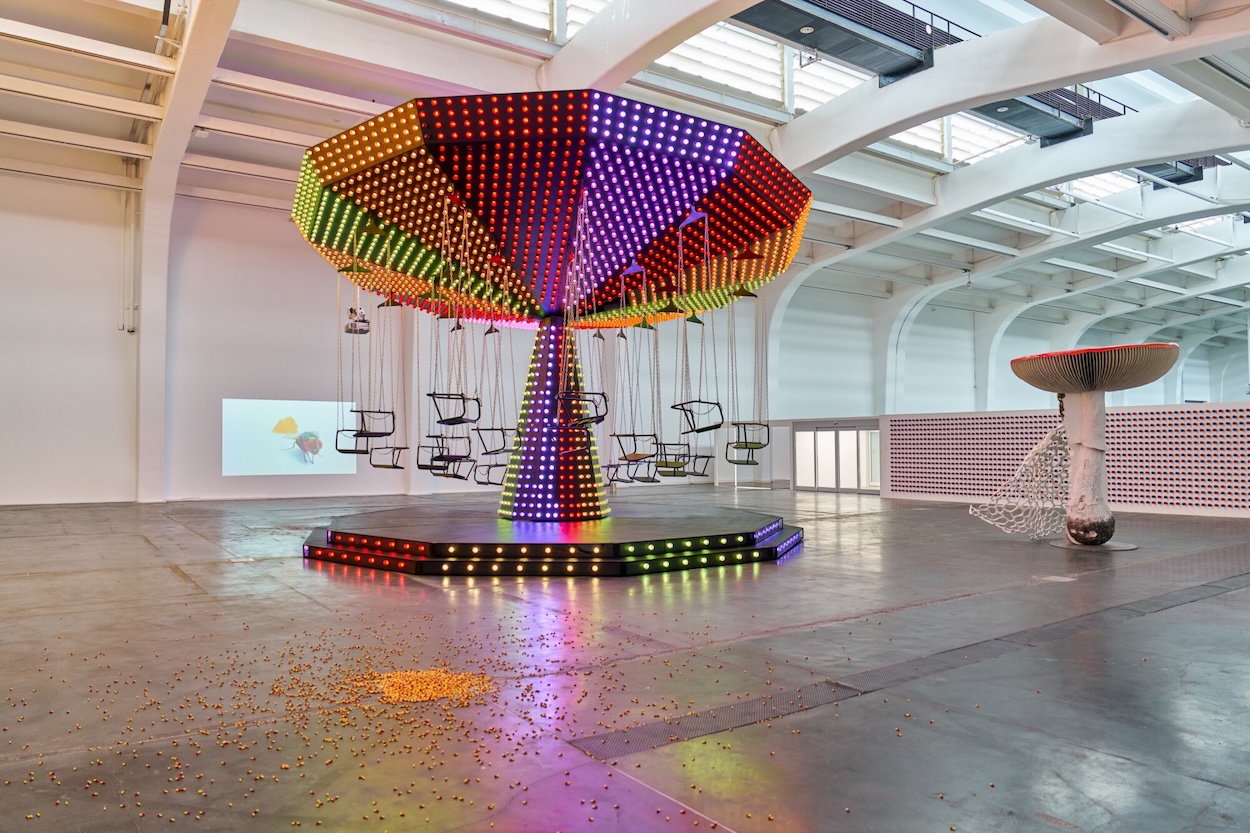
Beijing’s UCCA Center for Contemporary Art presents Carsten Höller’s first institutional solo exhibition in China, “Two,” an experiential “Laboratory of Doubt” that divides the museum into parallel color and black-and-white environments and turns visitors into participants. Curated by Philip Tinari with Jiashu Zou, the exhibition brings together landmark installations and new works created for UCCA Beijing, including Sliding Doors Square (2026), a disorienting corridor of mirrored automatic doors; twin Pill Clocks (2026), which dispense pills containing an “undisclosed substance” every three seconds; and two slowly rotating Tilted Carousels (2026), which carry visitors in opposite directions. Elsewhere, Höller enlarges a die into the climbable marble Dice (Chinese Marble) (2026), tracks visitors with responsive spotlights in Beijing Dots (2026), and deploys transparent doors in Sluice (2026, with Valia Fetisov) to trap participants until they remain motionless for 30 seconds.
Two roaming robotic beds can be booked for overnight stays, tracing sleepers’ paths as drawings across the floor, while flashing bulbs and rhythmic stereo sound in two versions of Light Wall seek to synchronize brain waves and produce perceptual effects. Mushrooms recur at radically different scales, from the rapidly rotating Spinning Amanita sculptures to Giant Triple Mushroom (2024), an enlarged hybrid of three species, while Smell of My Mother and Smell of My Father (2017) disperse recreated versions of Höller’s parents’ scents beneath a bench. Across mirrored surfaces, marble, neon, light, sound, scent, moving machinery, and participatory architecture, Höller uses doubling and sensory disruption to make certainty itself feel unstable.