Inside Samuel Alexander Forest's "A Bag of Tricks"
The New York-based artist opens up about performance as a form of drawing, drawing as a form of performance, and the question that anchors the show: what remains once the act is over?
Most magicians arrive with a bag of tricks, but no one ever asks what happens to the bag once the tricks are done. That question sits at the center of “A Bag of Tricks,” Samuel Alexander Forest’s new solo exhibition at Ortega y Gasset Projects in Brooklyn, on view through August 16.
Across graphite drawings, kinetic sculptures, and a series of live music performances, Forest borrows the visual language of the circus and the stage to ask a question about identity itself: what remains of a self once the performance of it is over. It’s a fitting extension of his broader practice, which has long found meaning in overlooked, ordinary objects.
Courtesy of Samuel Alexander Forest.…
“A Bag of Tricks” marks a departure from your usual practice of making drawing-sculpture replicas of overlooked everyday objects. What drew you toward the language of theater and the circus for this show and how did that shift change the way that you worked?
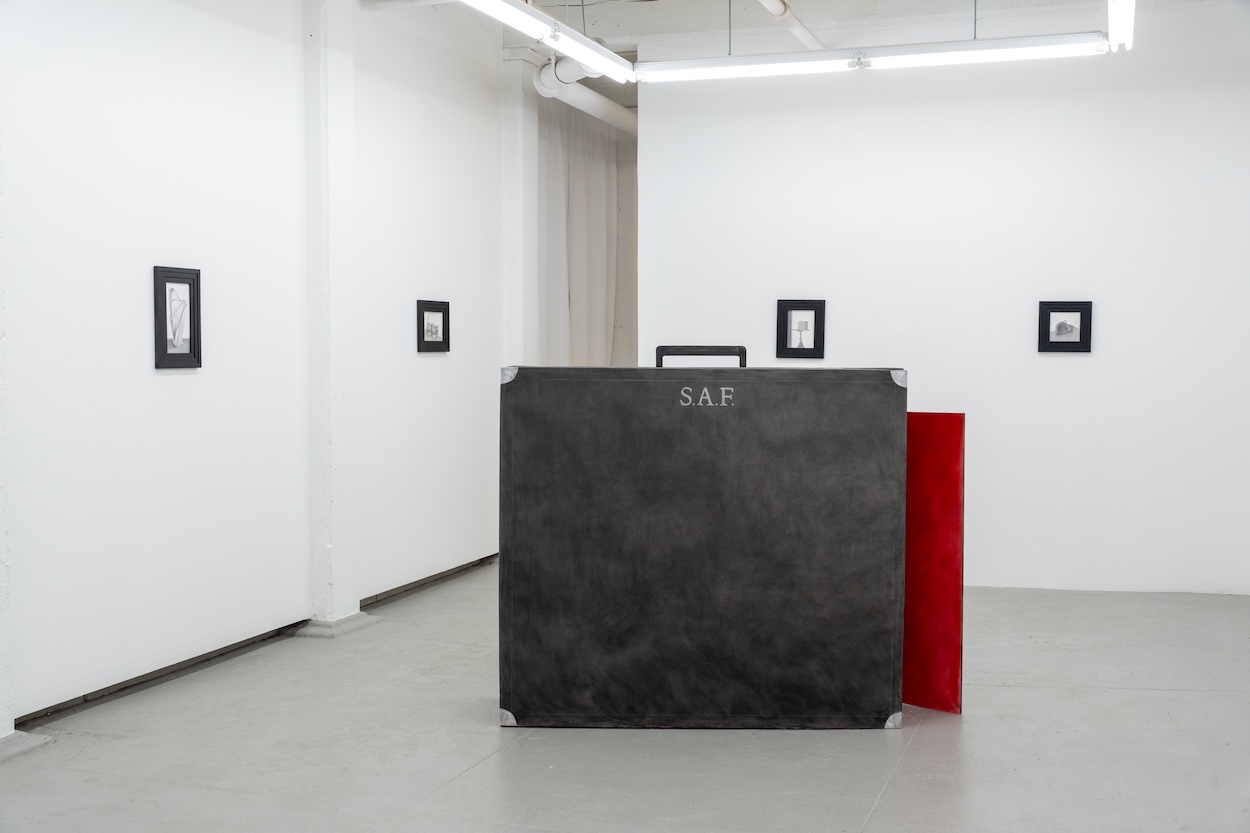
The idea for this body of work started after having performed a curated set of songs at the closing reception of my previous shows, wanting to offer more to people who’ve made it to see the work. They turned out to be really well-received and provided people with a reason to stay longer and another entry point into my drawings and sculptures as the songs revolved around them. I said to myself then that for my next show, I would want the performance aspect to fully be embedded in the work. Thus the idea for the central sculpture in this show, the oversized briefcase that holds my instruments and turns into a stage, came to be. With this kind of meta layer of performance about performance, theater and the circus seemed like the perfect set-up to build around.
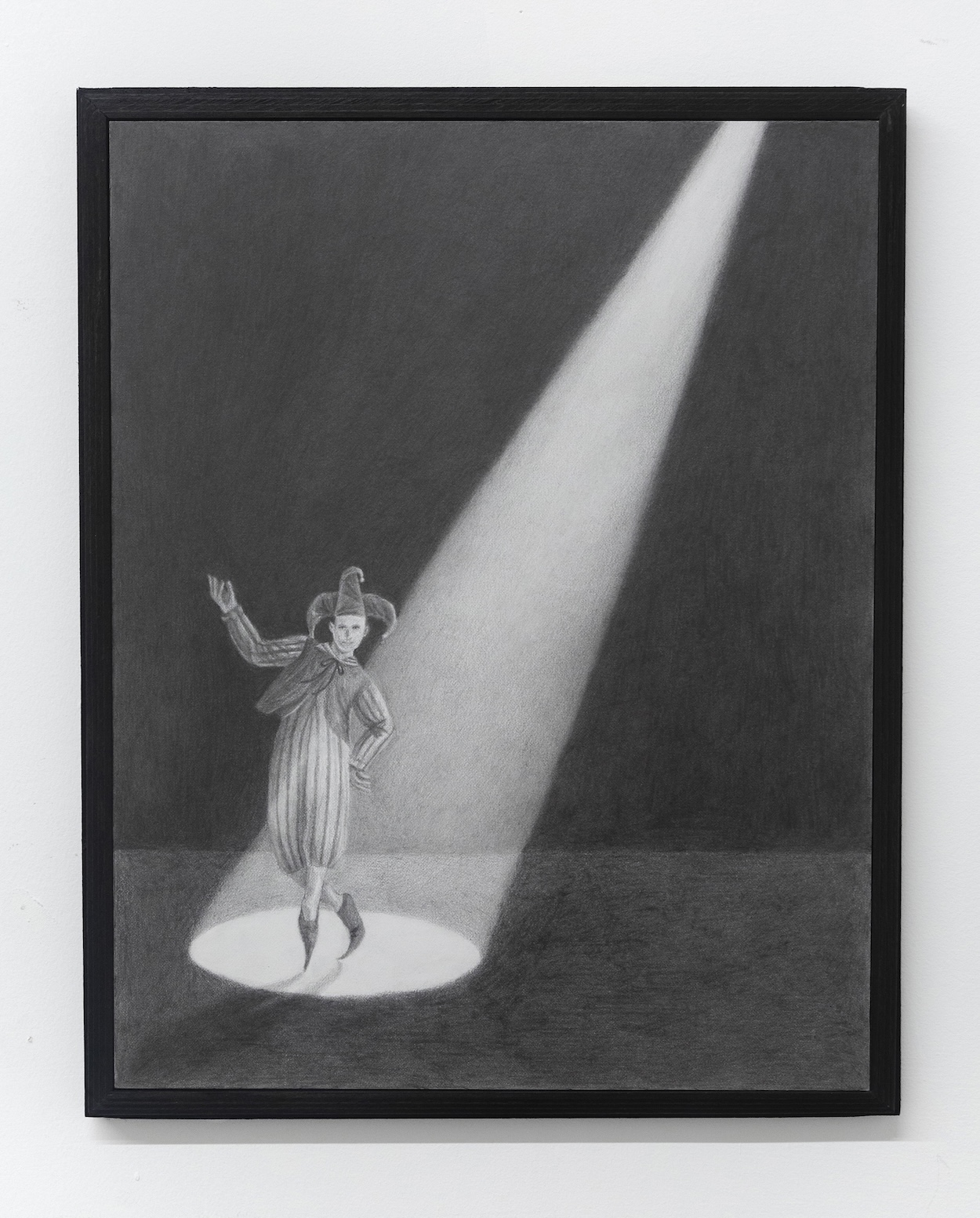
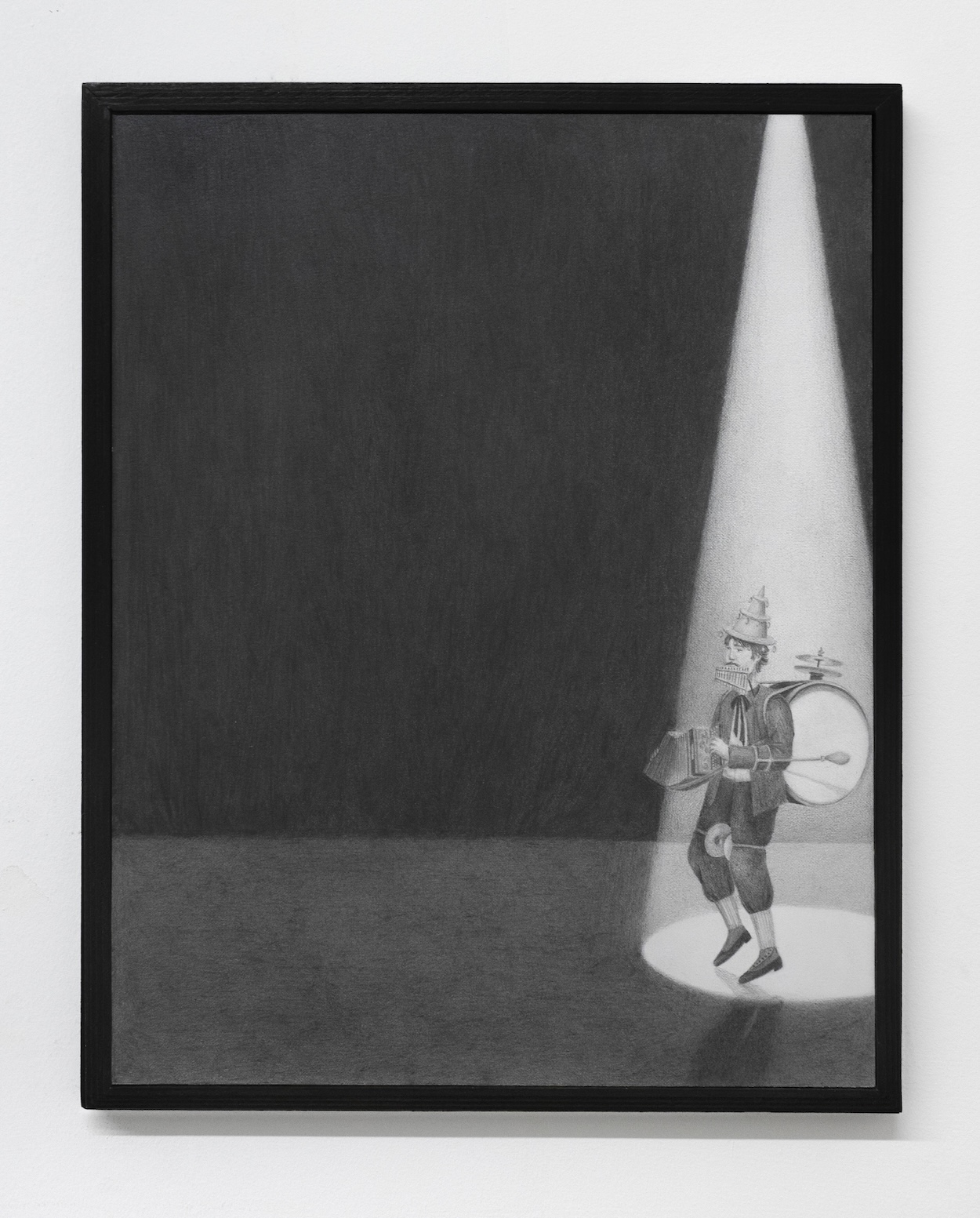
I am also drawn to this anticipated spectacle of a circus and its aesthetics, with the performers’ elaborate garb that indicates their specific roles in a troupe. I think of this as a more fanciful version of how we live and choose to represent ourselves—how society tells us, depending on the job you do and other factors, to dress a certain way that’s limiting. Looking at it through a different lens, my drawings of the solo performers on stage show more possibilities of how one could dress up. I wish we all felt more free to dress like them in our everyday lives.
Though making drawing-sculpture replicas of existing objects is my long-running practice, I like to work in somewhat disparate bodies of work. It is nice to work ideas out in a finite series and have a beginning and end for myself to feel less unmoored. So in that way it didn’t feel so different. The ideas flow from one body of work to another as they do through me.
You’ve woven in a specific cast of idols: Owen Pallett, the drag aerialist Barbette, Gillian Welch and David Rawlings’ case of small tools, Mary Poppins’ carpet bag. What ties these references together for you and how did they shape the “bags of tricks” throughout the show?
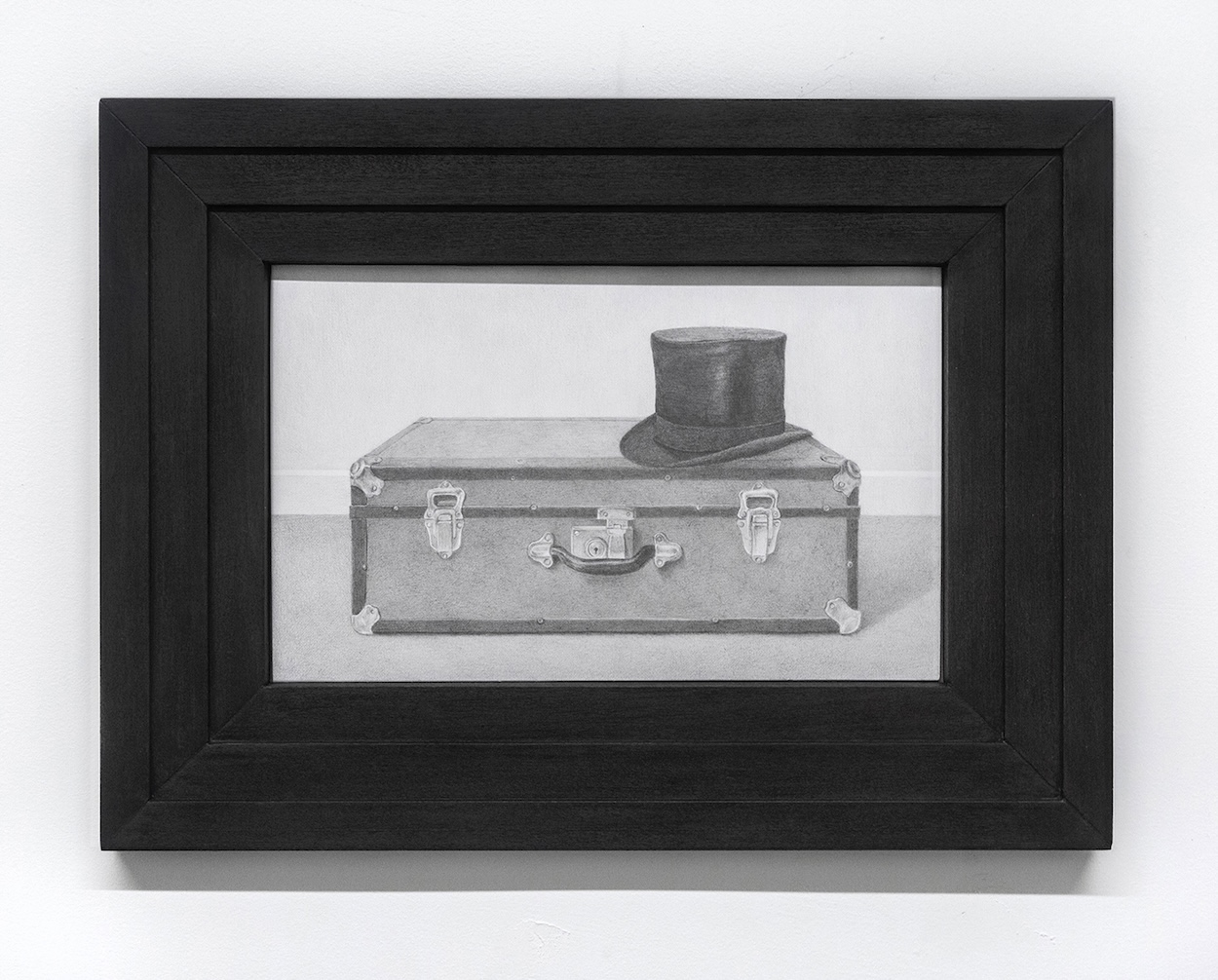
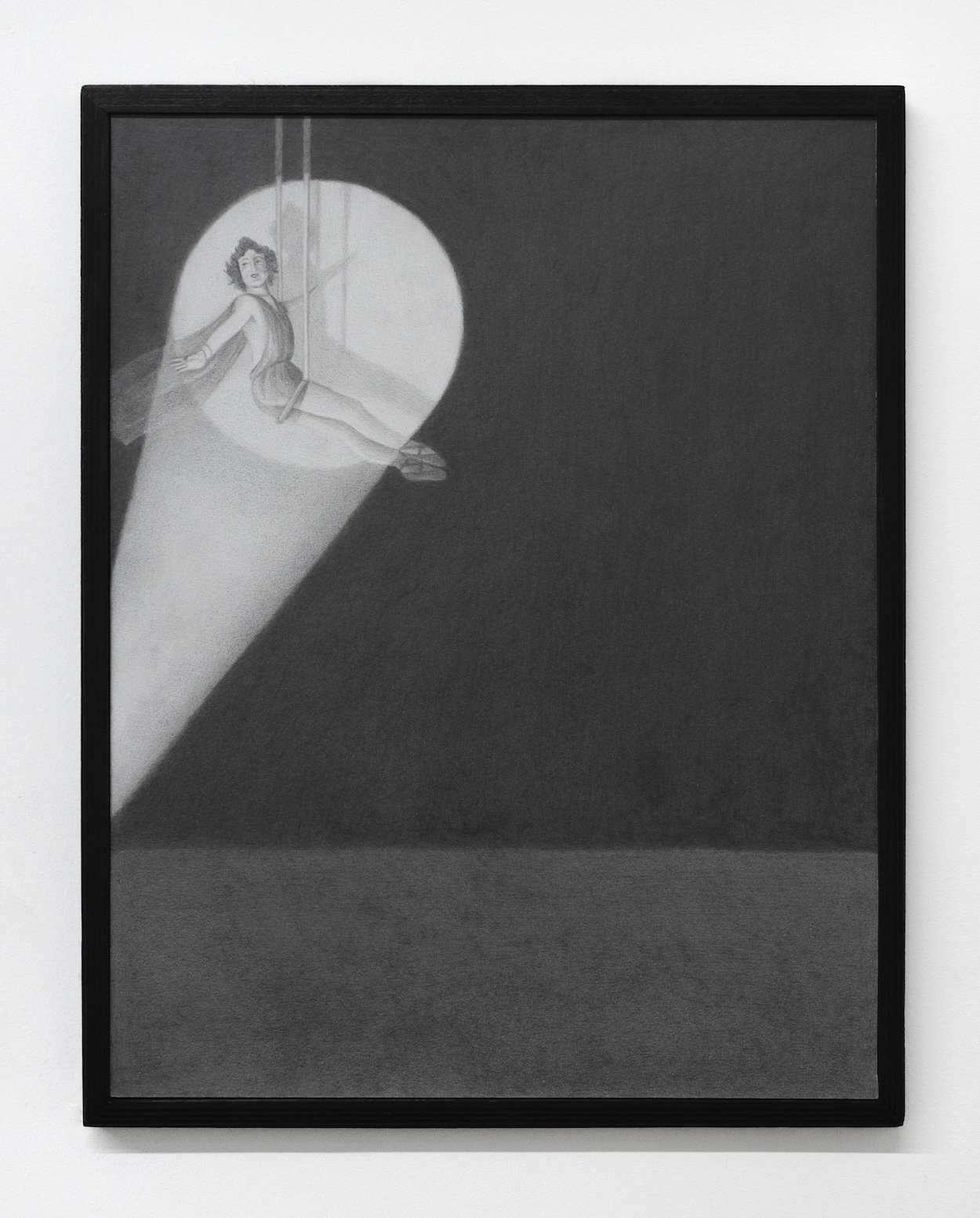
It’s important to me to have varied sources to pull from and present this sort of fragmented narrative. Most of the figures and cases in the drawings don’t have specific references, and the ones that do came to me in a more organic way. Some I just love and knew I wanted to have them be a part of the show. I’ve seen Gillian Welch and David Rawlings perform many a time and noticed that they carry this curious small rectangular box as they go on and off the stage. On my way home from their show, I started looking up photos on the internet and surely the mysterious case showed up in the back. I did some digging on fan blogs and found out that it holds their small tools, guitar picks, capo, and such. Owen Pallett is a brilliant composer, violinist, and performer whom I look up to. Their writing is what I want to somehow model my art practice after. I came across Barbette through researching the history of circus performers. His art of doing trapeze in full drag in the 1920s and 30s is his life’s legacy and has inspired so many others in different mediums. And I’ve loved Mary Poppins since I first saw the movie as a child. Not only is it a superb musical but also an awesome feat in early visual effects. The scene I reference with Mary’s endless carpet bag full of objects of all sizes is this wonderful meta doubled illusion happening, where form and content synchronously meet. The scene shows her amazing the Banks children with this trick, while the filmmakers themselves are doing it to us.
I’m also thinking back to the building of one’s identity, in this case mine as that’s what I can speak to best. Our lives are formed by these different disconnected strands, by the people in our lives, those we’ve been in a room with at a distance, those whose music, art, writing we consume through media, even those that are fictional. We also only get to know each other through fragments that start to build some kind of a picture in our heads with time. With my drawings, I don’t expect viewers to know what each reference point is, but I believe and hope the ideas around them can get through subliminally.
Courtesy of Samuel Alexander Forest.…
The oversized briefcase sits closed for most of the exhibition and only opens during your performances, becoming both instrument case and stage. Can you walk readers through what happens in those moments and why it mattered that the object stay closed until you activate it?
Yeah of course. It’s presented closed, just like the cases in my drawings where there’s intrigue as to what they hold that we don’t have immediate access to. I am drawn to this as with Welch and Rawlings’ small case and ones I see living in the city; I see people transporting their instruments and tools in different colored and shaped cases on the streets or on the train and wonder what they might hold. I like how the containers, designed to safely carry what’s inside, create cool strange forms, and my eyes travel to the hardware that keeps what’s inside locked. Yet these objects receive less attention than what they encase, so I want to turn it back on them. All of this tension and withholding is consistent throughout the show and present in the sculpture. That is until I open it in my performance, when I provide viewers with some resolve.
I open and lay one side of the case down to the floor, an act that reveals multiple things at once. That half is now a stage with steps like the frames to my drawings, that the other half acts as a stand to my keyboard, and that it is vibrant red on the inside. I go up the steps to the top platform and play and sing the first three songs in the set, then come down and open the side compartment that holds my banjo and go back up to play three more songs. There is one more element, a hidden drawer that holds a harmonica, an instrument I have yet to learn, on the side middle step. After the final song, I put everything back in its place and close the case back up.
I think the show can be experienced both ways, it is still complete without seeing my performance. But it rewards those who make the time and catch the right timing with this extra special element.
You describe the performances as covers—renditions of songs that already exist—and connect that to your practice of remaking found objects. What does the act of covering, rather than composing, mean to you as a visual artist?
I like to think of myself as an intermediary or a vessel that passes along what has been made and shares that experience with other people. That’s probably what motivates most artists, but for me it’s also partially a slight rejection of the need for newness all the time. There’s so much out there already, and if I can say what I want to say through them, why should I feel like I have to invent a new thing to say it and to claim as mine? What I do is bring the songs or objects together, filtered through my thoughts and perspective, and bring my time and attention to them.
This relates to the principle of using the humble materials of graphite, colored pencils, and pastels on paper for my work. How do I make something that can be meaningful and move people with the simplest of means? It may not always be successful but I’m compelled to try. It’s nice to think of it also as making fan art, and that that’s what I’ve been doing since high school, even if it may have gotten more sophisticated and complex. It’s not a hard rule I set out for my practice as I sometimes want to switch it up and get the urge to make something more my own, but there are so many songs waiting to be sung again.
Courtesy of Samuel Alexander Forest.…
The show closes on a question: “After the show is over, what is left?” How would you answer that, both for these performers and for yourself?
I’m not sure any of us could definitively answer that question, that is one of the big questions of our lives and one I think so much about. I’ve just made it past 27, the age of which many prodigious celebrities died. Some people try to cement their legacy or write a memoir as they are approaching the end of their life. For these performers, they may have awed the audience with their acts and left lasting impressions. The circus tent then left behind empty and dark, like our skin or our clothes. The bags of tricks all packed-up and closed, like coffins, caskets, urns for what remains of our bodies.
After we die, what do we leave behind? We certainly leave behind our corporeal bodies and all our clothes and belongings. We leave behind the art and the fruits of our life that we worked so hard for. If they withstand time and people care enough about them, they can outlast us for a while. In the end, I think what matters and all we can do is live our lives, make our work, spend time with loved ones, see the sun rise and set. And like Rainer Maria Rilke wisely advised in his Letters to a Young Poet, I want my work and I to live the questions.
Samuel Alexander Forest, A Bag of Tricks, 2026. Courtesy of the artist and Ortega y Gasset Projects. Photo: Chanel Matsunami.…