Designer of the Day: Loney Abrams and Johnny Stanish of Wretched Flowers
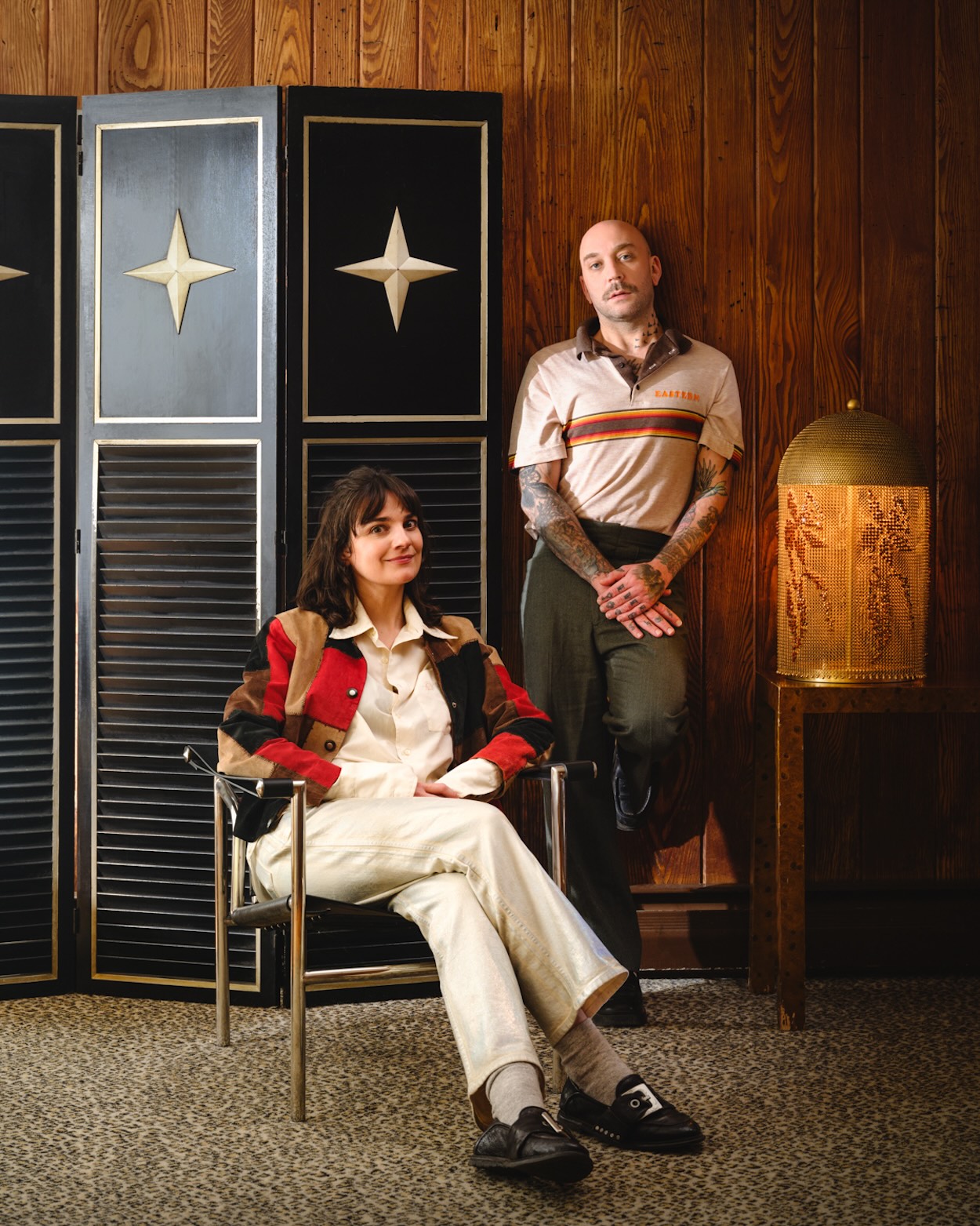
A dance of masculine and feminine, forged in the Connecticut woods. Loney Abrams and Johnny Stanish of Wretched Flowers weave metal and light into poetic forms through their signature chainmail technique. Their work opens a portal—resurrecting ephemera from crusaders to homemakers, from relics to rituals. Each piece challenges, then softens and illuminates, letting time dissolve into a modern gothic reverie.
A dance of masculine and feminine, forged in the Connecticut woods. Loney Abrams and Johnny Stanish of Wretched Flowers weave metal and light into poetic forms through their signature chainmail technique. Their work opens a portal—resurrecting ephemera from crusaders to homemakers, from relics to rituals. Each piece challenges, then softens and illuminates, letting time dissolve into a modern gothic reverie.
Hometown Boston, MA (Loney) and Great Falls, MT (Johnny)
Studio Location: Western Connecticut
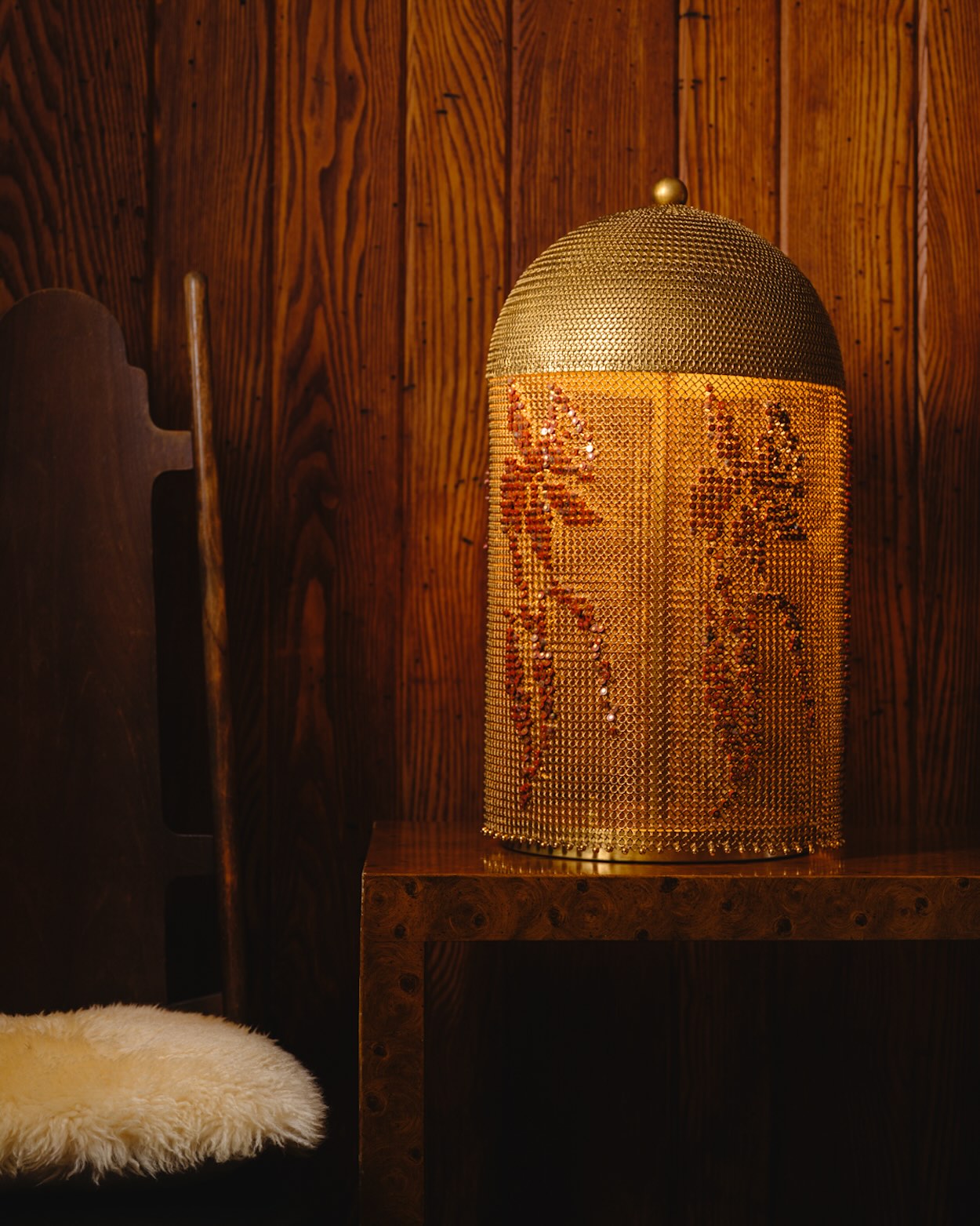
Describe what you make: We’re a collectable design studio that makes bespoke lighting and objects for collectors, interior designers, and their clients. We draw on historical themes and inspiration, like lost craft and the legacy of women homemakers. Our aesthetic is a mix of high contrasts, like the merging of sweet feminine florals with colder, more masculine materials like metal and chainmail.
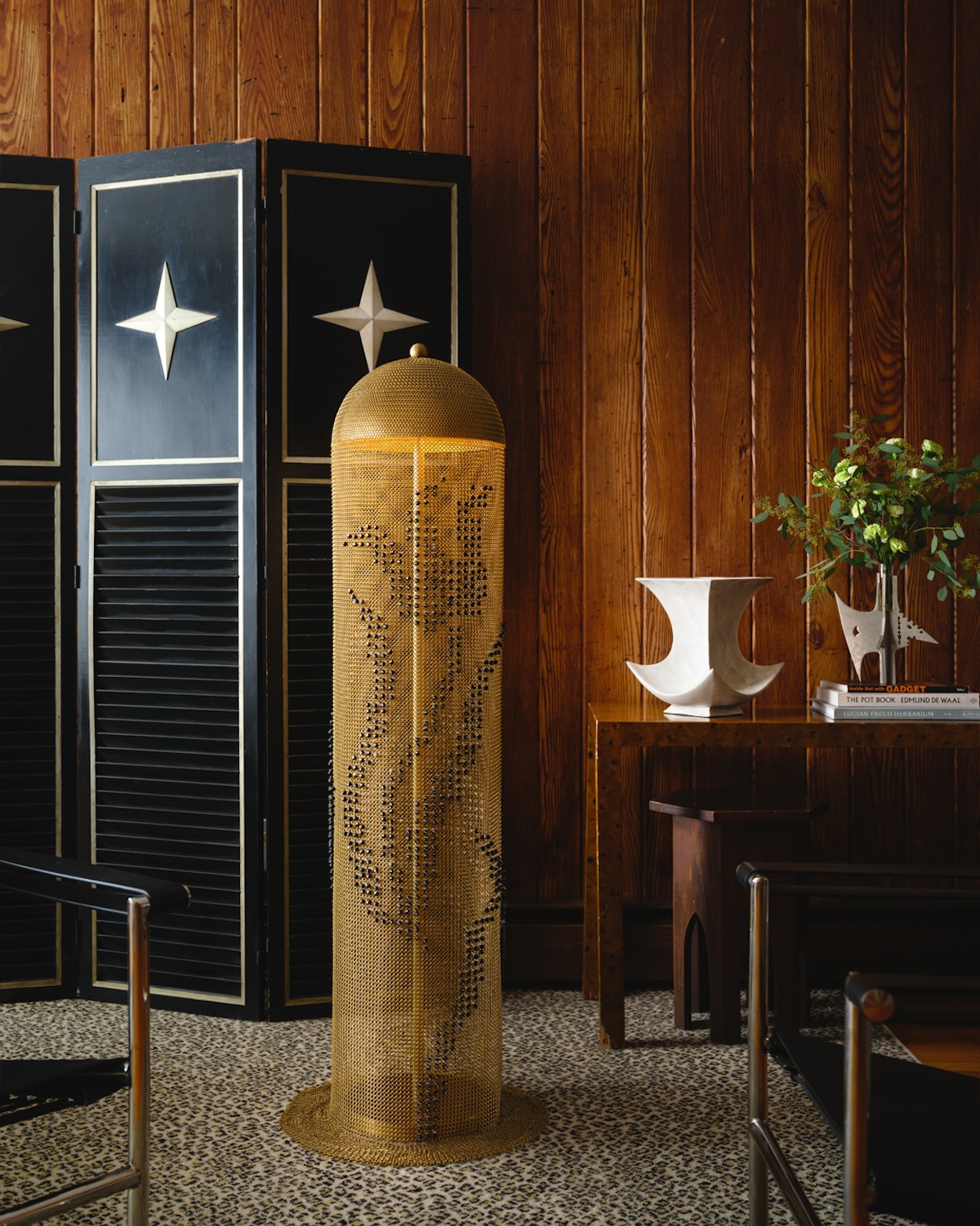
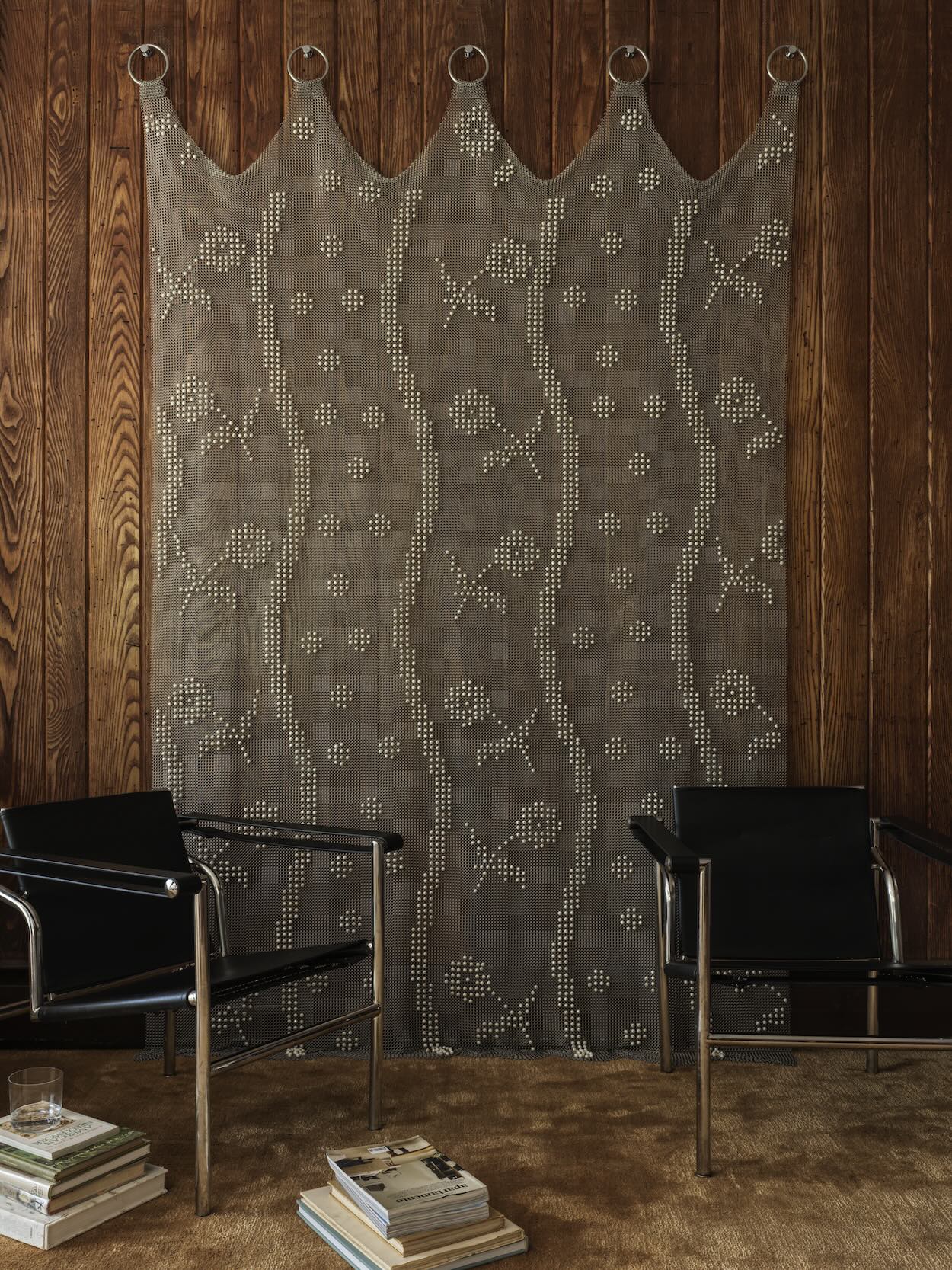
The most important thing you’ve designed to date: We’ve become best known for our beaded chainmail lighting and tapestries. Chainmail has obviously been around for a very long time (historians believe 400 BCE), but our addition of beaded patterns (using a proprietary technique we developed) has become the core of our practice and where we’ve really found our voice.
The pieces merge two opposing visual languages: the toughness of warfare materials and the delicacy of ornamental pattern. This hard/soft dichotomy has really become part of our design DNA. It’s charming and confrontational at the same time. And, the material allows us to get super specific when collaborating with our clients because we can make truly unique pieces, whether it’s a site specific architectural solution like a beaded chainmail screen, or a tapestry with a custom bead pattern tailored to the client in a deeply personal or culturally specific way.
Describe the problem your work solves: We don’t approach our work as problem-solving in a utilitarian sense. We think more about what our work does – both within the history of art and design, and within the context of the home.
Canonical design is beautiful and inspiring, and it’s also deeply tied to patriarchal values. The aesthetic that dominates “intellectual” interiors (think chrome, black leather, Brutalism, Modernism, Breuer, Le Corbusier, etc. etc.) is cold, masculine, and quite dismissive of adornment, decoration, florals, prints… things historically coded as feminine, domestic, and (consequently) lowbrow and less serious.
Our beaded chainmail lamps sit both within and against that tradition. They live comfortably within those highbrow spaces, but they do so with a quiet subversion. The floral patterns come from historic women’s magazines and craft pamphlets, rendered in gemstones on chainmail, and draped over silhouettes borrowed from modernism. In this way, they pay homage to what’s been excluded from the canon of “good design” and to the unrecognized generations of women who have quietly influenced how our everyday homes look and feel.
Share the project you are working on now: We just wrapped an exciting collaboration with Sydney-based designer Christopher Esber for their Spring/Summer 2026 runway show at Paris Fashion Week. We created two looks: an open-back gold chainmail top with sesame jasper gemstones, inspired by one of our table lamps, and a bronze chainmail tunic adorned with horizontal stripes of gemstones.
Back in the studio, we’re working on a diptych curtain (our first figurative image) depicting a woman walking her dogs. Her striped sweater inspired the stripes of the runway tunic, completing a nice circular dialogue between the two projects. Like much of our work, the piece draws from an obscure historical source: an artwork created by a Russian woman in the 1920s using a typewriter.
A new or forthcoming project we should know about: We’re working on a new collection that will debut this May with an exhibition for New York City’s Design Week. It’s inspired by the Spiritualism movement from the turn of the 20th century. Many of the “mediums” of that era were women who staged elaborate illusions in their homes, creating seances (performances) that blurred the line between art, deception, and power. We’re interested in how they used domestic space as a stage and a spectacle, transforming it into a site of agency and authorship at a time when few other avenues existed for women.
Spiritualism emerged alongside the dawn of electricity and telecommunication. When people were suddenly able to speak across oceans, it didn’t seem far-fetched to imagine communicating with the dead. The movement thrived in a moment of uncertainty and cultural upheaval, and not unlike now, people looked for answers in unlikely places. (Today, 80 percent of ChatGPT users say they use the AI for therapy.)
So we’re taking cues from the Spiritualist’s methods of deception (and use of electricity) and we’re thinking about how design also deals with revelation and concealment. We’re also referencing the showmanship of Harry Houdini, who spent his career exposing the Spiritualists’ illusions even as he perfected his own.
Unlike a typical static showroom, our exhibition will operate more like a controlled illusion. Atmosphere, suggestion, and a bit of trickery can make a space feel charged. The collection will animate the space in a way that feels conjured, rather than merely designed, and we hope it proposes an interesting alternative to the traditional design exhibition format.
What you absolutely have to have in your studio: Our studio is in our home, and our home is surrounded by woods. After years of living and working in New York City, moving to the country completely changed how we work. So it’s not so much about what we need in the studio as what we need to surround it: quiet, trees, changing seasons, wildlife, our hounddog Winona. I know it sounds sentimental, but that atmosphere has become essential to how we think and make.
What you do when you’re not working: Like we just mentioned, we live and work in the same place, and I think when you’re an artist, the delineations between work and all the rest aren’t super clear. In some ways, producing in the studio doesn’t feel like work. And in some ways, reading / writing / napping / walking / watching movies / conversations with friends feel like “work” in the sense that they can be as generative and productive as being in the studio. Capitalist conceptions of work time and leisure time don’t really resonate with us or the ways that we think about creation. But, to answer the question in a less pretentious way lol, we go to NYC a lot to see exhibitions, eat food, and spend time with friends. As much as we love it out here in the sticks, we still need our culture fix from the city.
Sources of creative envy (dead or alive)
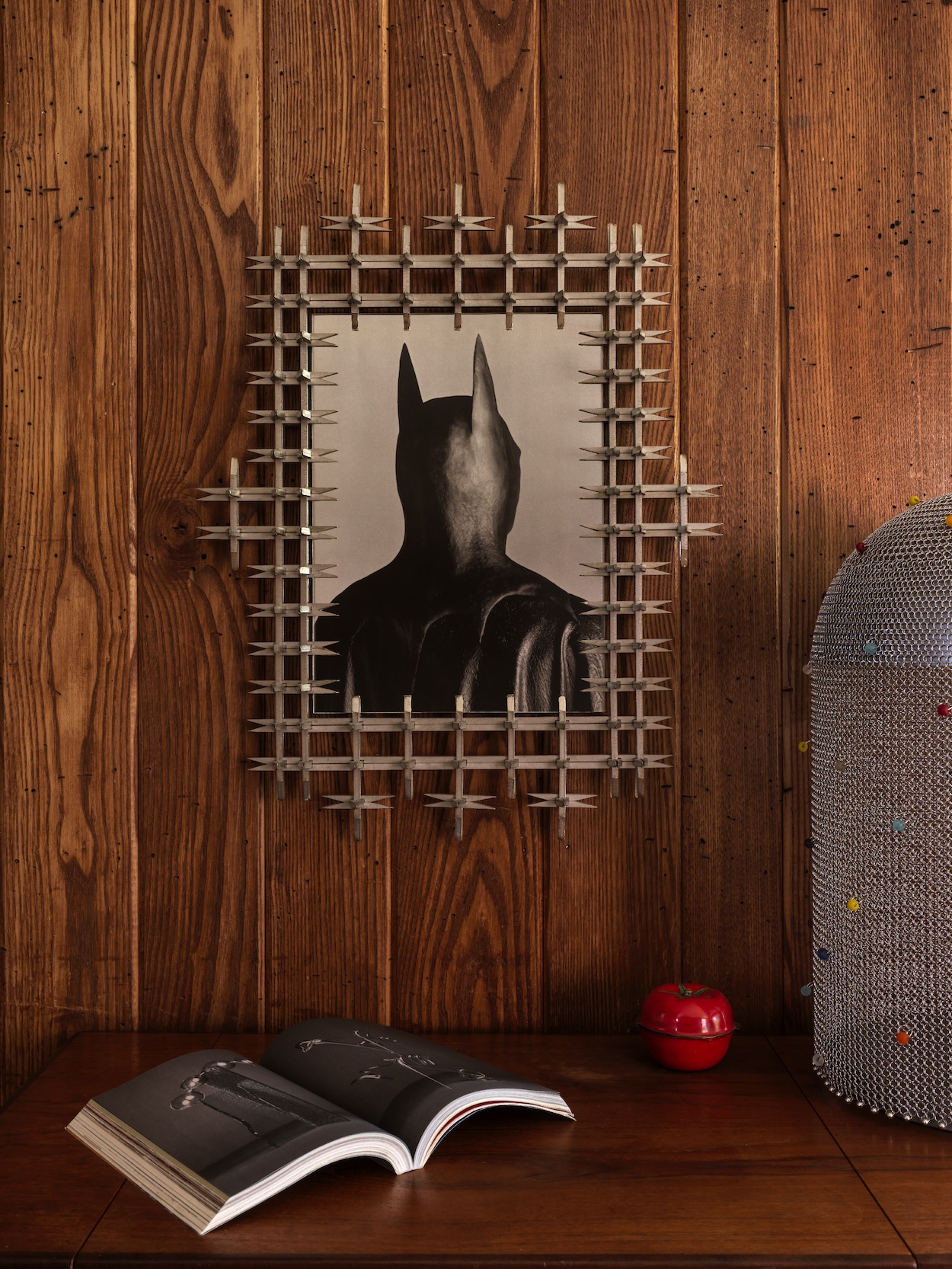
Most of our inspiration is drawn from anonymous craftspeople. Our “Crown of Thorns” series of lamps and mirrors, for instance, uses an intricate joinery technique developed by Tramp Artists in the late 19th century. These itinerant makers were the original upcyclers, carving discarded cigar boxes into ornate frames and keepsakes for their loved ones. They were materially inventive but remain almost entirely anonymous, and their fragile works have mostly deteriorated with time. We wanted to make that craft eternal, so we replicated it in laser-cut steel and brass instead of chipboard.
We’re equally fascinated by historic fabric sample books and old fillet crochet pamphlets – again, mostly the work of unnamed designers. Images from obsolete media like this become fodder for our beaded chainmail.
That said, I won’t totally evade the question and name no names… We’re always watching and listening to ambient content in the studio while we work. This week it’s been back-to-back videos about Martin Margiela and his work. It’s certainly not a new obsession, but the admiration just keeps deepening. He’s the goat.
The distraction you want to eliminate If anyone says anything other than “phones,” I’m not sure I believe them. The Zuckerberg hellscape is hard to resist or ignore. But, we have gotten better lately and our focus on our work is intense, so we’re not scrolling all that often these days, which feels like a meaningful step in the right direction. We do pride ourselves on being extremely responsive to clients, though, which means we’re still tethered to notifications more than we’d like. So it’s a constant battle.
Concrete or marble? Marble
High-Rise or Townhouse? Townhouse
Remember or Forget? Remember
Aliens or Ghosts? Both
Dark or Light? We make light, so let’s go with that.