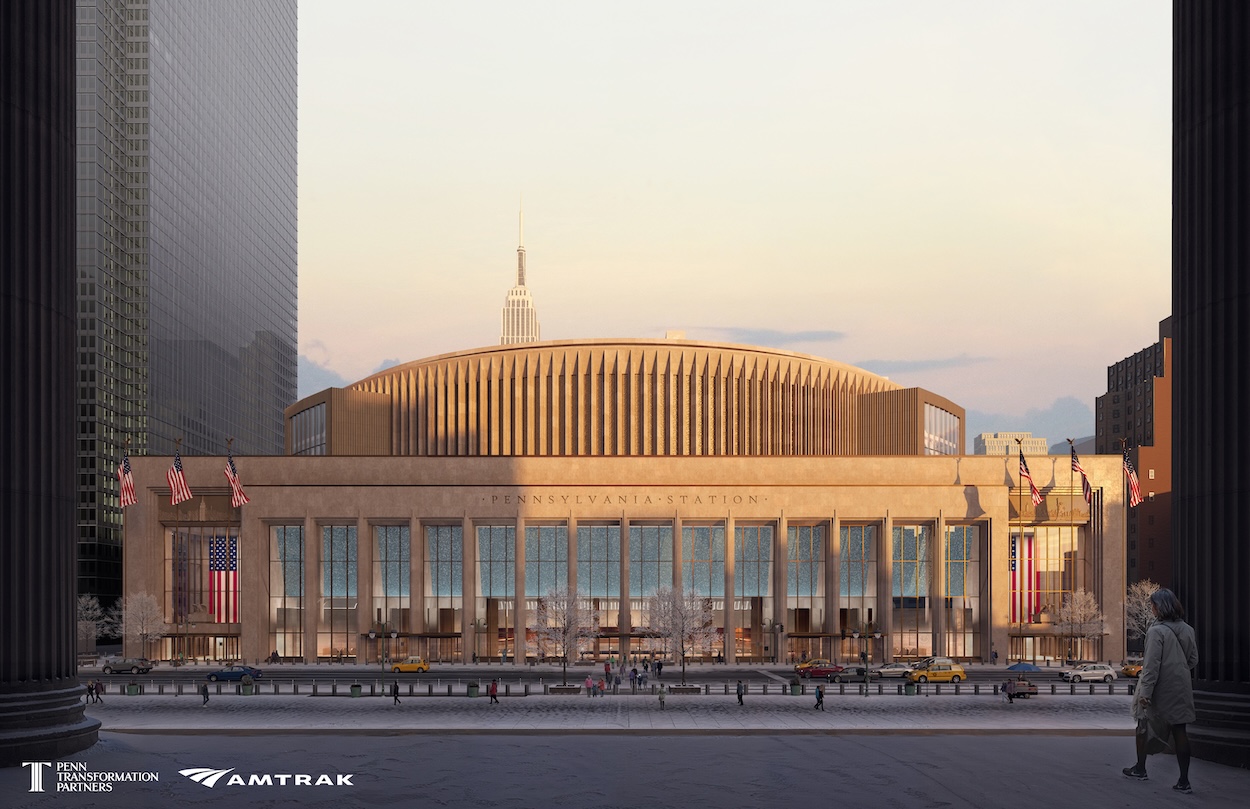
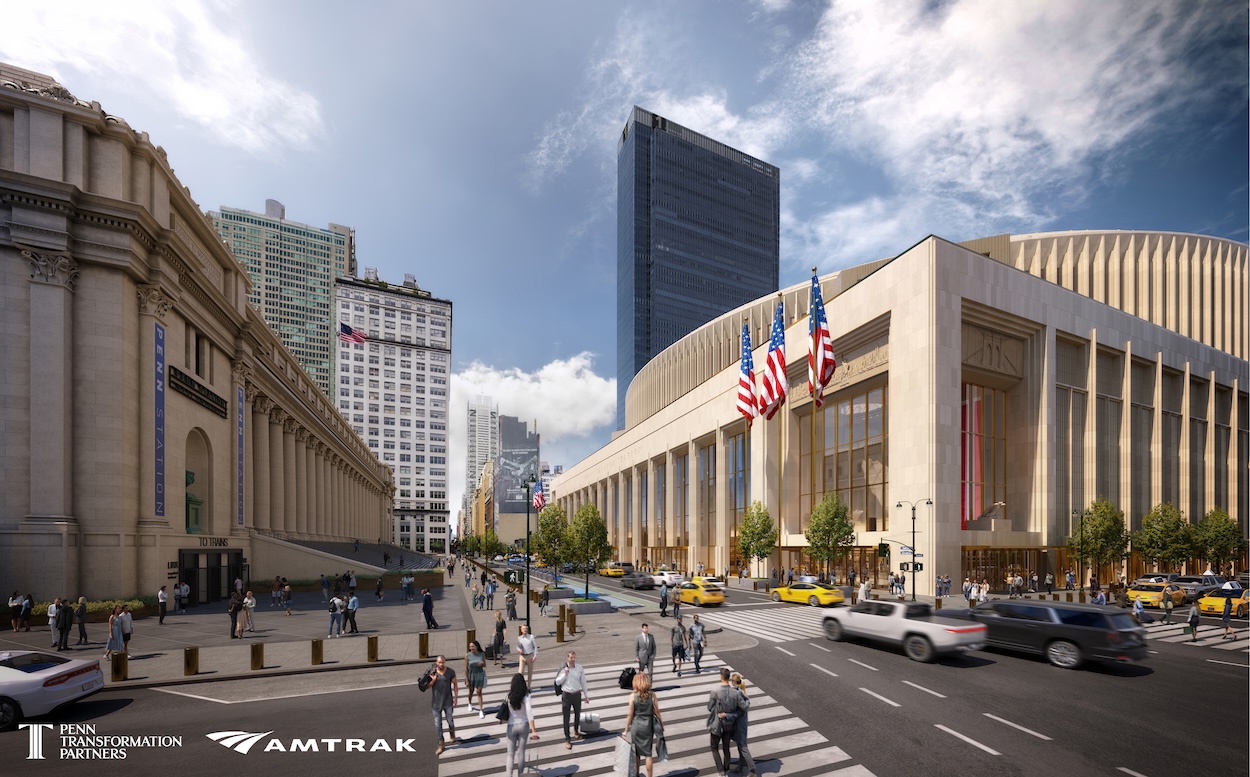
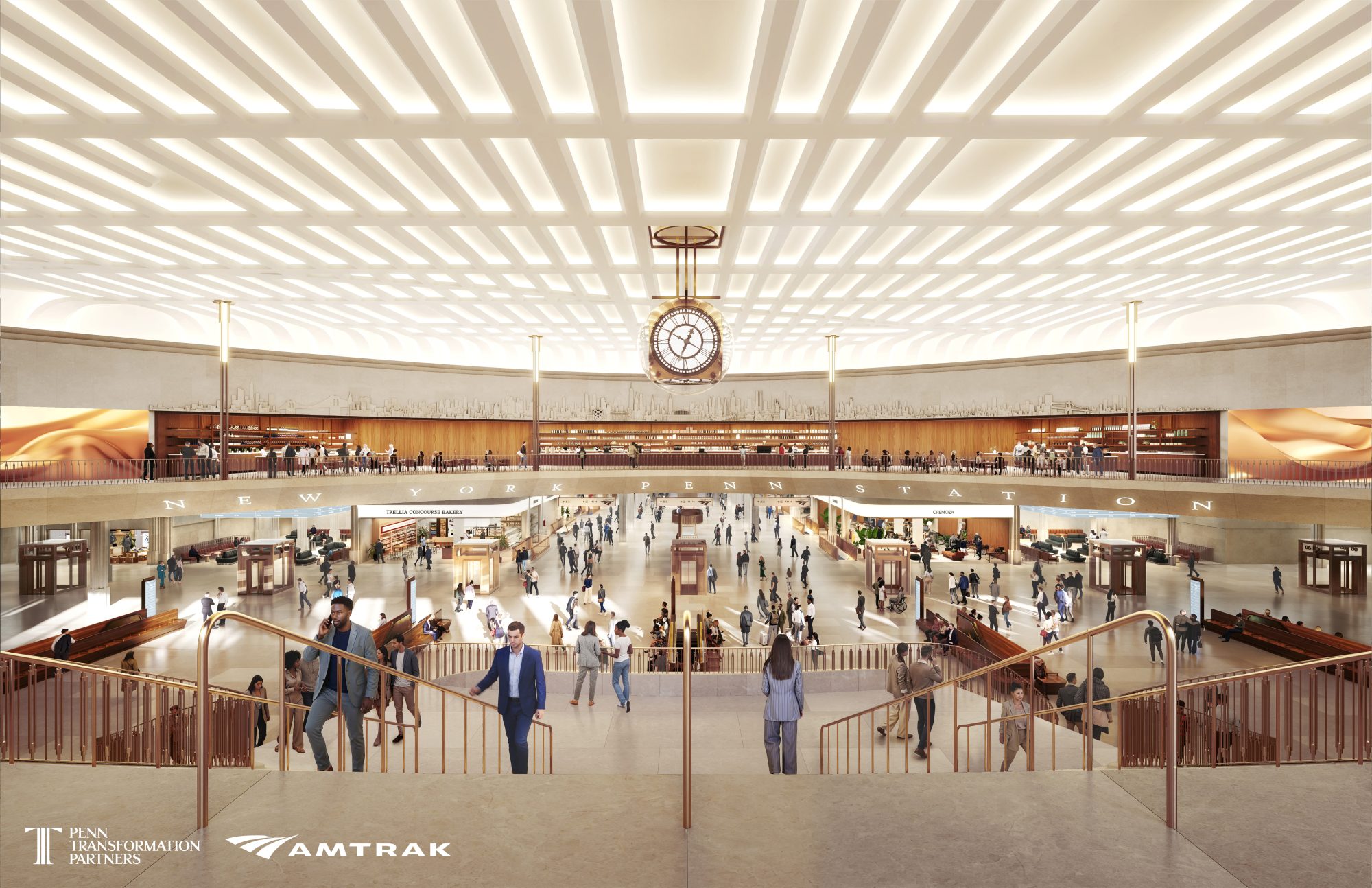
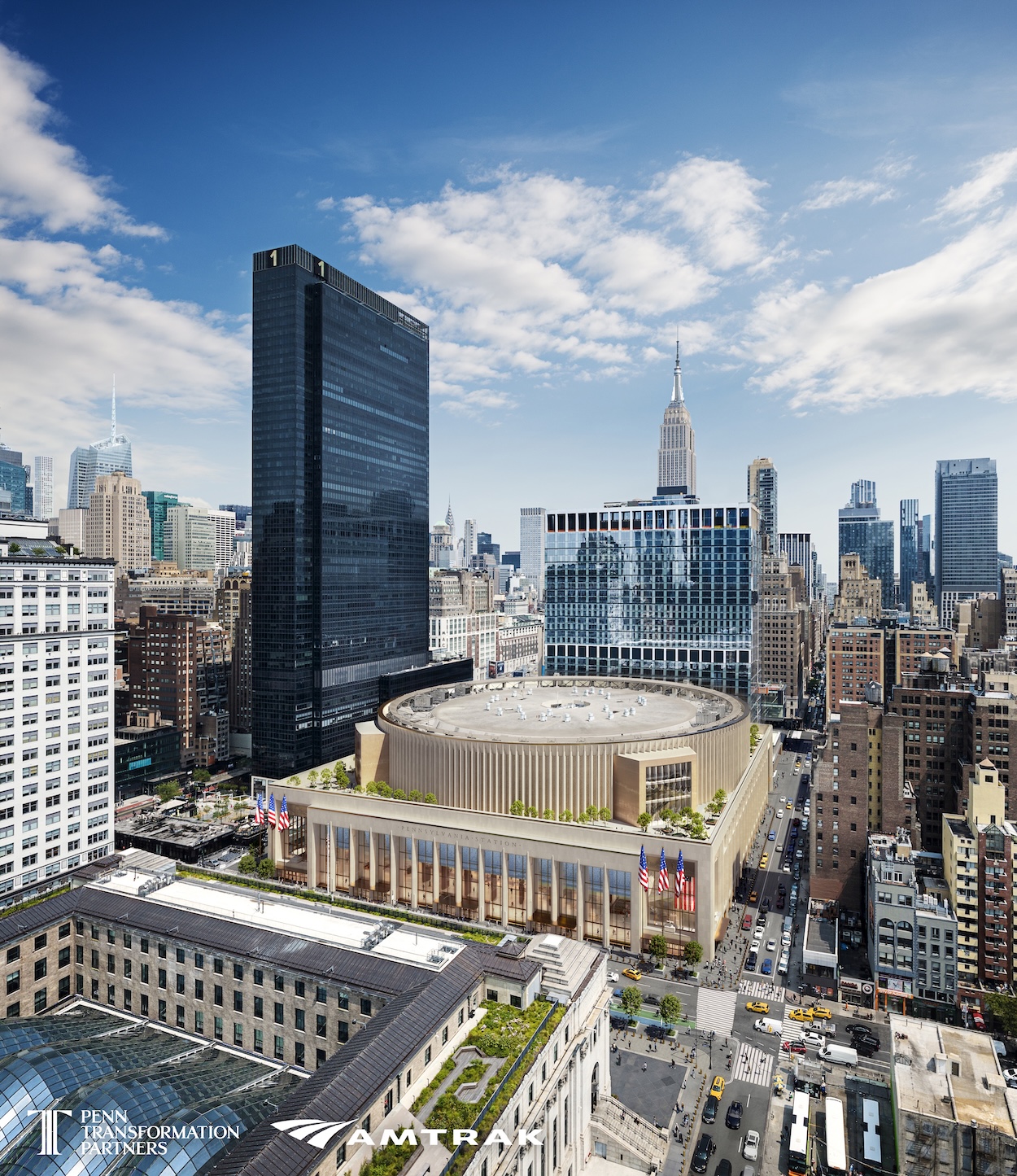
Transportation Secretary Sean Duffy and Amtrak's Andy Byford joined developer Penn Transformation Partners to unveil renderings for the station, designed by Vishaan Chakrabarti and Ruchika Modi's Practice for Architecture and Urbanism.
Courtesy of Practice for Architecture and Urbanism.…
There’s a version of Penn Station known for being monumental, and another that exists in the daily experience of over 600,000 commuters navigating low ceilings, tight corridors, and a terminal that has long felt like an obstacle. For nearly thirty years, Vishaan Chakrabarti, Founder and Creative Director of Practice for Architecture and Urbanism (PAU), has been thinking about the gap between those two versions, and what it would actually take to close it.
Chakrabarti’s thinking on the subject has shifted considerably over time. “Early on, I believed the only solution involved moving Madison Square Garden and designing something new, but as the realities changed, I became more interested in transformation rather than replacement,” he tells Surface. However, that shift wasn’t exactly by choice, it was forced by circumstance. Madison Square Garden was never going anywhere, and neither the arena nor the railroads below it could pause for construction.
For Chakrabarti, that was the insight that shaped the entire design. “The constraint ultimately became the design opportunity,” he says. “Once we accepted that the Garden wasn’t moving, we stopped thinking about demolition and started thinking about transformation.” What emerged, he recalls, is a station that feels entirely new, while making intelligent use of what’s already there. “It’s what I call an architecture of memory, one that acknowledges the past without trying to recreate it.”
Courtesy of Practice for Architecture and Urbanism.…
Among the core issues Chakrabarti grappled with were capacity, safety, wayfinding, and the station’s civic identity. “I think those issues are all connected,” he says. “Better wayfinding improves capacity, more generous public space improves safety, and a strong civic identity helps people intuitively understand where they are and how to move through the building.” The ambition, as he frames it, extends past function. “Our goal was to solve the functional challenges while creating a station that once again feels worthy of New York. Great transportation infrastructure should work exceptionally well, but it should also inspire the people who use it every day.”
That distinction, between something that works and something that has meaning, runs through how Chakrabarti talks about the entire undertaking. “Renovation suggests making something old work a little better,” he says. “A civic icon is something else entirely, a building that embodies a city’s values and aspirations. Penn Station has to function extraordinarily well, but it should also remind us that public infrastructure can be beautiful, generous, and inspiring.”
Courtesy of Practice for Architecture and Urbanism.…
Two other great stations loosely inspired the project, though neither served as a literal template. “We looked at the great stations of the Northeast, including the original Penn Station and Grand Central Terminal, not to imitate them but to understand what makes them so enduring,” Chakrabarti says. “We were equally inspired by Eero Saarinen’s TWA Flight Center, which showed how transportation architecture can be both functional and emotionally resonant.” That same instinct shapes how the design engages with its own Beaux Arts lineage. “Our goal was to recover its ambition and sense of grandeur,” Chakrabarti explains. “We looked to the principles that made the original Beaux Arts station extraordinary: its monumentality, craftsmanship, and material richness. The stone façade, colonnade, bronze elements, and layered interiors are a continuation of New York’s architectural legacy.”
Zoom out far enough, and Chakrabarti sees Penn Station as something larger than a single fix, a possible model for how American cities approach infrastructure more broadly. “Too often, transit has been treated as a purely functional system, rather than as a vital part of our civic realm,” he says. “This project demonstrates that infrastructure can be both practical and inspiring, improving operations while creating a space that reflects the identity and aspirations of a city.” The lesson, he argues, isn’t specific to New York. “Every city has its own history and challenges, but the larger lesson is that we should expect more from the places that connect us.”
Courtesy of Practice for Architecture and Urbanism.…