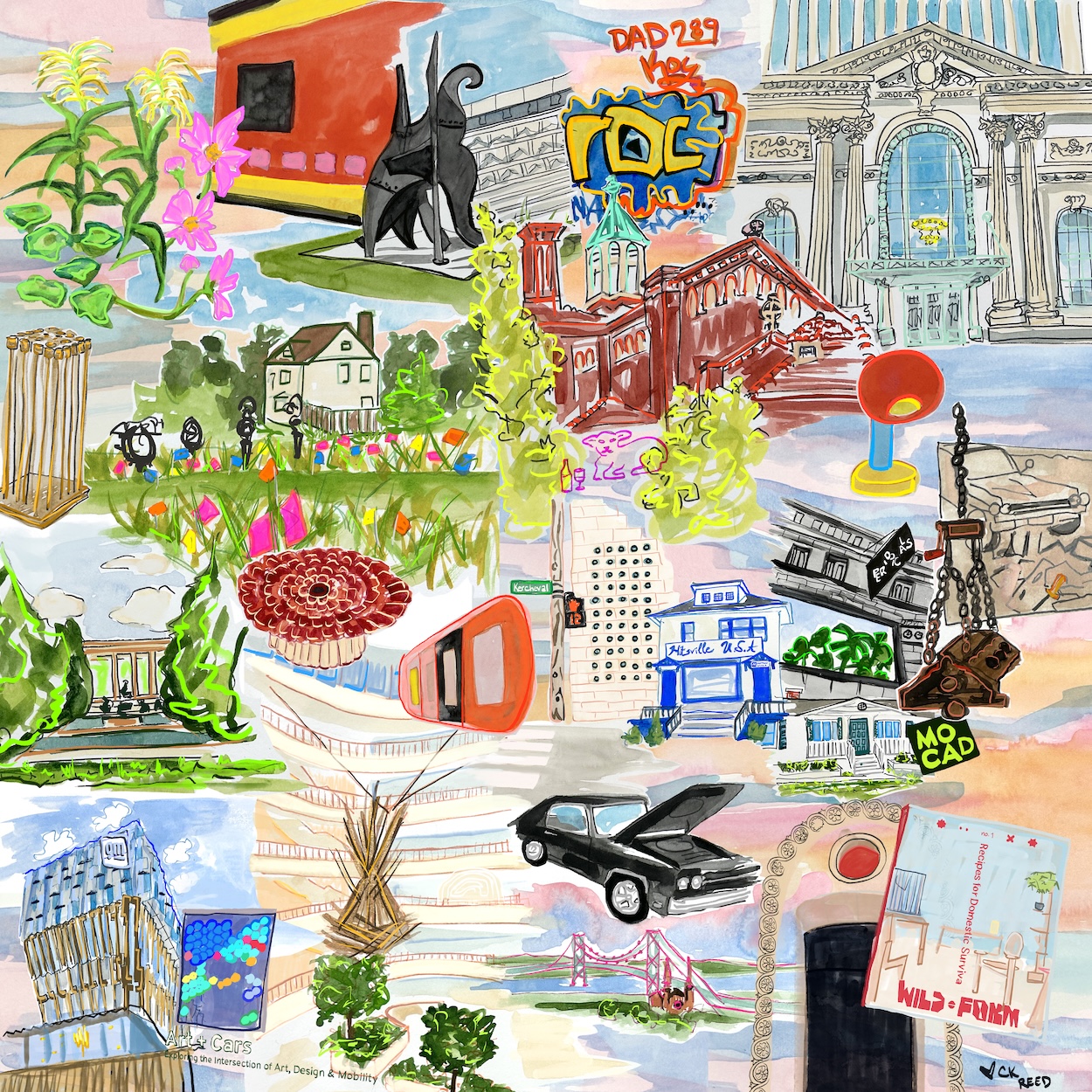
Detroit Month of Design, hosted by Design Core, brings together exhibitions, installations, architecture, interiors, and other creative projects across the city each September. I spent opening weekend moving through Detroit with a packed schedule of art and design stops. Prior to the onset of the itinerary, I checked into the Shinola Hotel and had an hour to spend, so on a gorgeous afternoon I walked around and sketched the exterior of the hotel, which sits next to the impressive Hudson’s Detroit building, now home to GM headquarters.
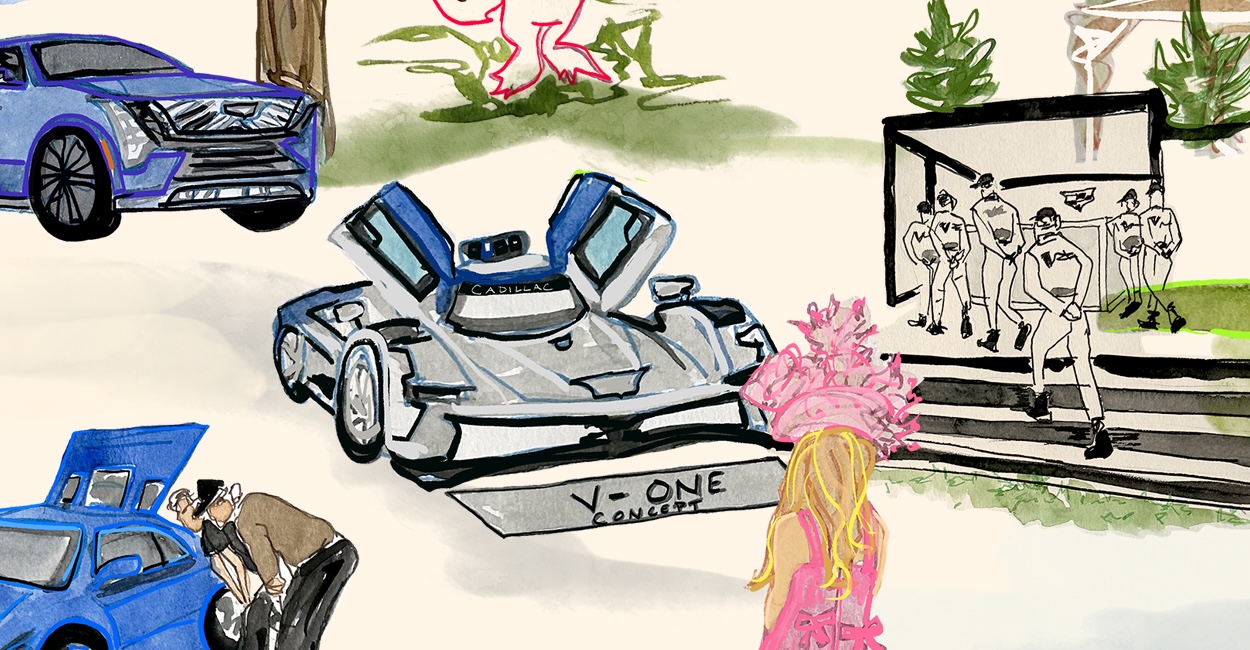
The first exhibition of the trip happened to be next door: “ART + CARS,” an exhibition combining contemporary art with concept cars, presented in collaboration with GM and ArtClvb. I ran into some familiar faces from Cadillac, and there were GM designers live-sculpting a clay car model, which was a nice way to bring the creative process into the exhibition.
From there, we headed to Michigan Central.
I had heard about the history and scale of the building—how the former train station had fallen into disrepair, become covered in graffiti, and even hosted raves. Walking through it now was a completely different story. We had an in-depth tour with Peggy, director of place architecture and planning, who walked us through the extensive restoration and renovation work that has gone into bringing it back to life.
The team from NoMad was also there to show us the active construction site and talk through plans for its forthcoming hotel, which will occupy the top five floors of the building. You will be able to see Canada from your bathtub. Designed by MBDS, the hotel will include a spa and wellness center, as well as a restaurant, bar, and library on the first floor that will be open to the public. I also got to spend time speaking with the GM for the new hotel over margaritas at Vecino about the project and what to expect.
That idea of giving old buildings new lives kept coming up throughout the weekend. At the Detroit Institute of Arts, I remembered the Diego Rivera murals from a visit years ago, but this time I noticed something I hadn’t seen before: behind-the-scenes footage playing in an adjacent room showing Rivera applying wet plaster to the walls, with Frida Kahlo coming in and sitting beside him on the scaffolding. Seeing the process alongside the finished murals made me reflect on the major art history that unfolded in this city.
We also had a private tour of the “Georgia O’Keeffe: Architecture” exhibition with curator Ben Colman, which was a real treat. He went into the kind of detail that isn’t in the history books. The exhibition was years in the making, and apparently some of the works were extremely difficult to get for the show. I was surprised by how many pieces I hadn’t seen before. The Patio Door series particularly captivated me. They were among the more abstract works in the exhibition and felt very different from the O’Keeffe paintings I was most familiar with. Her relationship with well known mid-century designers in the area was also surprising to learn about, another reminder of how often art and design overlap here.
That same relationship between art, industry, and place showed up again at MOCAD. I was delighted and impressed yet again by the combination of exhibitions. I especially loved the paintings by Pat Phillips, whose work brought the automotive theme into the exhibition. His work deals with race, labor, and class. I was drawn to his style and the scale of the paintings, and I liked learning that he made all of the work being shown in this solo exhibition this year.
Then we walked out back to my favorite part of the museum: Mike Kelley’s Mobile Homestead, a permanent public artwork featuring a full-scale replica of the ranch-style home where the artist grew up. The structure hosts rotating exhibitions and a sound residency in the garage. I love seeing art in a nontraditional space. Smaller rooms and different shapes create a much more intimate relationship with the work. There was also a really interesting collection of colorful gospel posters.
The relationship between art, design, and everyday life continued outside the museums. If you visit Detroit, don’t miss Periodicals, a magazine retailer and concept store. The combination of the interior design, magazines, skincare, and writing tools made it the kind of place I could have spent an entire afternoon in. Across the street was Vesper, a wine bar and cookbook store inside a former bank. This was another thing I kept noticing throughout Detroit: so many spaces have been repurposed while still acknowledging the city’s industrial history or connecting back to its automotive past. Periodicals and Vesper made for a perfect afternoon outing.
Back at the Hudson’s building, we toured a space where Pophouse transformed a largely vacant former department-store site into a contemporary workplace and gathering space, incorporating elements of the original building alongside new construction, greenery, art, and amenities. A huge Bertoia sculpture hangs in one space, while Library Street Collective curated artwork throughout another.
The interior designer walked us through the project, pointing out materials and details, including Pewabic tile, which you find throughout Detroit. The space was gorgeous, with an open-air atrium at the center and incredible views of downtown Detroit—you could even see the baseball game happening below.
That evening, we stayed in the same building and had dinner at Pine Hall, the rooftop bar and restaurant. We caught an incredible sunset, and I spent the evening getting to know new friends from Design Core, Cadillac, and Visit Detroit. After dinner, I sat with Kiana from Design Core over a glass of wine overlooking downtown, which was completely lit up and lively below us. These trips are important because I get to see so much art and design, but I also get one-on-one time with the people who actually put things like Detroit Month of Design together. I get to understand who they are, where they came from and why they care about the work they’re doing.
The next day actually blew me away.
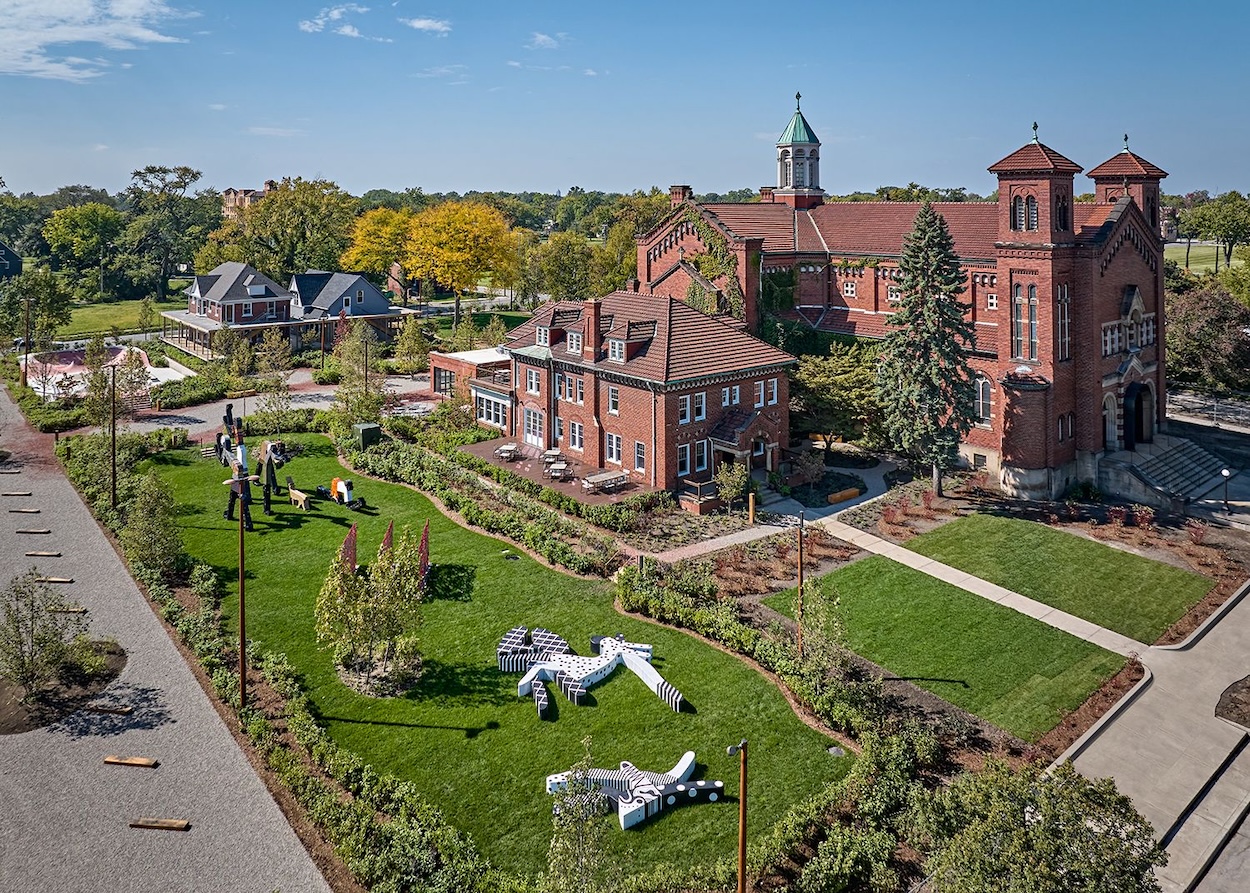
I had heard a lot about Library Street Collective and was told not to miss visiting The Shepherd. The century-old Romanesque-style church has been transformed into a cultural arts center with multifaceted programming. The adaptive reuse, designed by Peterson Rich Office (PRO), includes two exhibition spaces, a public library curated by Asmaa Walton of Black Art Library, a performing arts theater, and workshop space for the community.
The campus grounds, designed by the Office of Strategy + Design (OSD), include a boutique bed and breakfast, ALEO; McArthur Binion’s Modern Ancient Brown Foundation; a public skatepark designed by Tony Hawk; and a sculpture park honoring the late Detroit artist Charles McGee.
There’s also a really great wine and cocktail bar onsite appropriately named Father Forgive Me.
Stefan, the curator of “Between Your Love and Mine,” then walked us down the street to a field that had been transformed into an outdoor art exhibition. He led an elegant and thoughtful tour of each piece—installations set within the River Trail that offer reflections on the Canada-U.S. border. It was a powerful lesson in landscape through very simple interventions.
We walked through the Lantern and Cadillac Art Center, an ambitious adaptive reuse project transforming a vacant 25,000-square-foot building at 1533 Cadillac into a hub for arts, culture, and community activity. I also had some one-on-one time with Anthony, the founder of Library Street Collective who told me about his background, his former career, his love of collecting art, and how he and his wife are building all of this out while continuing to combine art and community.
Detroit’s creative energy isn’t only happening inside traditional museums and galleries. It’s happening in former churches, train stations, banks, department stores, and vacant buildings, often through people who are personally invested in making something new.
That made the next stop, Cranbrook, feel like a natural continuation.
Cranbrook is a place where some of the most influential artists, designers, and architects studied and developed their practices. I had been before, but this time we toured the archives and got to see a number of recognizable chairs. Known as a cradle of mid-century modernism, Cranbrook has alumni including Florence Knoll, Charles and Ray Eames, Harry Bertoia and Mary Chase Perry Stratton, and the campus was designed by Eliel Saarinen.
Two things particularly stood out to me.
The first was the story behind the Zinnia Table, a notable mid-century modern functional art piece designed by Gere Kavanaugh. It connected back to an effort by GM to get women more interested in buying cars. In the mid-1950s, General Motors hired its first all-female design team, publicly dubbed the “Damsels of Design.”
The second was the Anchored Candy Chair by Vivian Beer—heavily incorporating car culture, hot-rod aesthetics, and high-end automotive paint finishes, all of which you can see reflected in the chair itself.
I liked thinking about these two worlds colliding in Detroit. They really aren’t separate here. Automotive design, furniture, architecture, and art have been influencing one another for decades.
Then, the icing on the cake: Saarinen House.
Design history was made here. I loved learning that his wife, Loja, made custom textiles for their home and also started the textiles study division at Cranbrook.
The Motown Museum was next, and once again the history of the building was tied directly to what is happening in Detroit now. The museum is currently undergoing a major expansion designed by Perkins&Will, and we got to do a hard-hat tour of the construction site with Robin, who is a relative of Berry Gordy. Getting that perspective from someone with a direct connection to the beginning of Motown felt like a particularly unique part of the trip.
The museum is scheduled to reopen in 2027. Founded in 1985 by Esther Gordy Edwards, the Motown Museum is the original headquarters of Motown Records, famously known as “Hitsville U.S.A.” It tells the story of how Motown happened and the people behind the music that launched the careers of Stevie Wonder, Marvin Gaye, and Diana Ross.
Even the design of the new space ties back to the music. The ceiling mimics the groove of a record, and Motown blue appears throughout.
The trip concluded with one of my favorite exhibitions of the weekend: “Wild.Form: Domestic Survival.” Two friends, an interior designer and an architect, put the exhibition together and brought in 21 designers. This is the kind of thing that really lights me up. These are people who already have full-time jobs but found the time to collaborate, make something new, and put together an entire exhibition—and even create a publication around it.
The book is essentially a recipe book for making furniture. These are “recipes” built with minimal materials and basic tools, so anyone can pick up a tool—or borrow one—and get started.
“Wild.Form” is a direct response to “fast furniture” and the disposable culture it creates, especially as housing grows more precarious. It felt like a very direct expression of what I had been seeing all weekend: people using their own practices, skills and relationships to make something happen.
What stayed with me most from Detroit was the way the city’s history is impossible to separate from what is happening there now. You see it in the architecture, the industrial details, the automotive influence, and the buildings being given new lives. At the same time, there is this very tangible sense of people supporting one another and investing in what comes next. For me, that made Detroit Month of Design feel like more than a series of exhibitions and tours. It was a look at a city where art, design, architecture, and industry are all very much in conversation with one another.