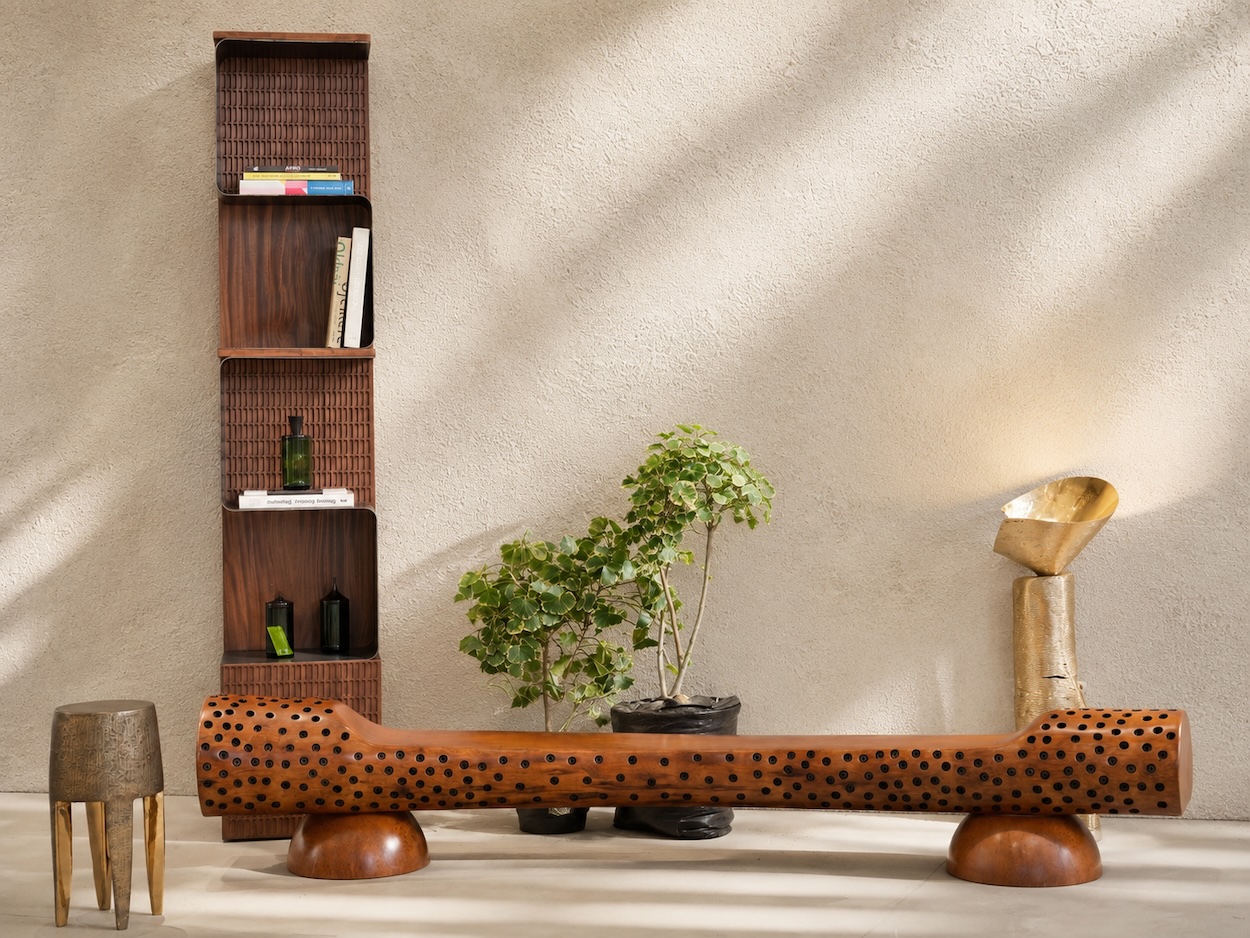
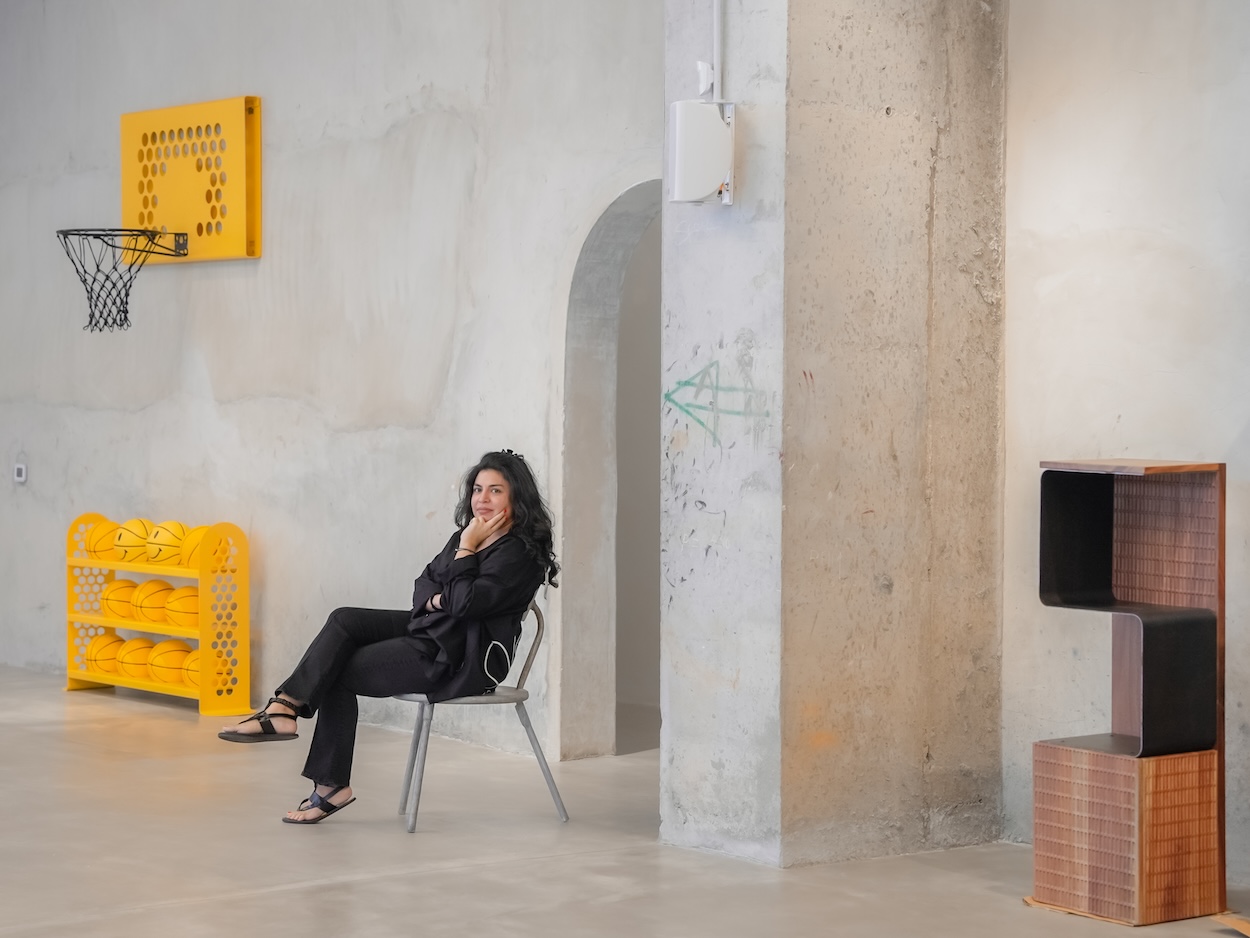
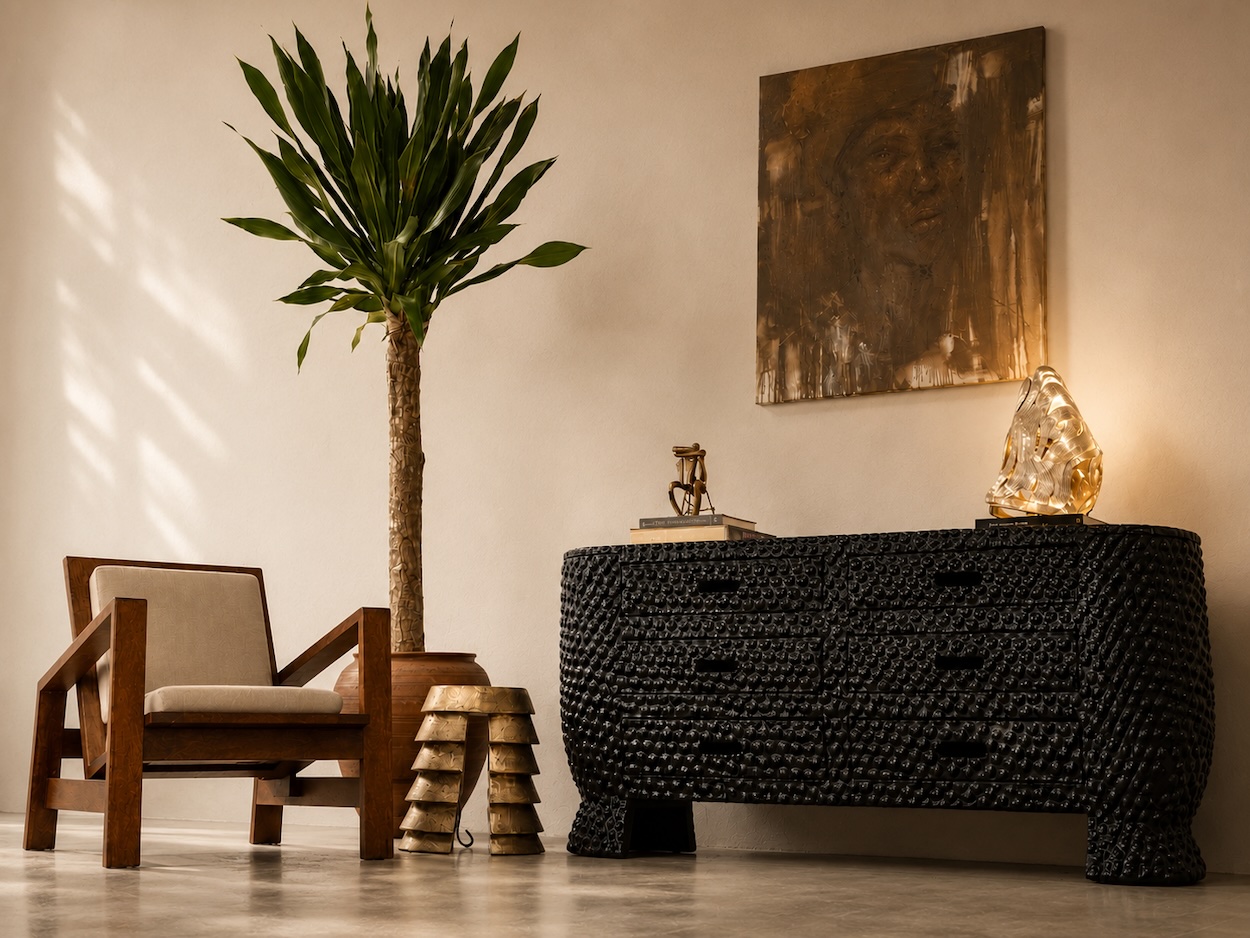
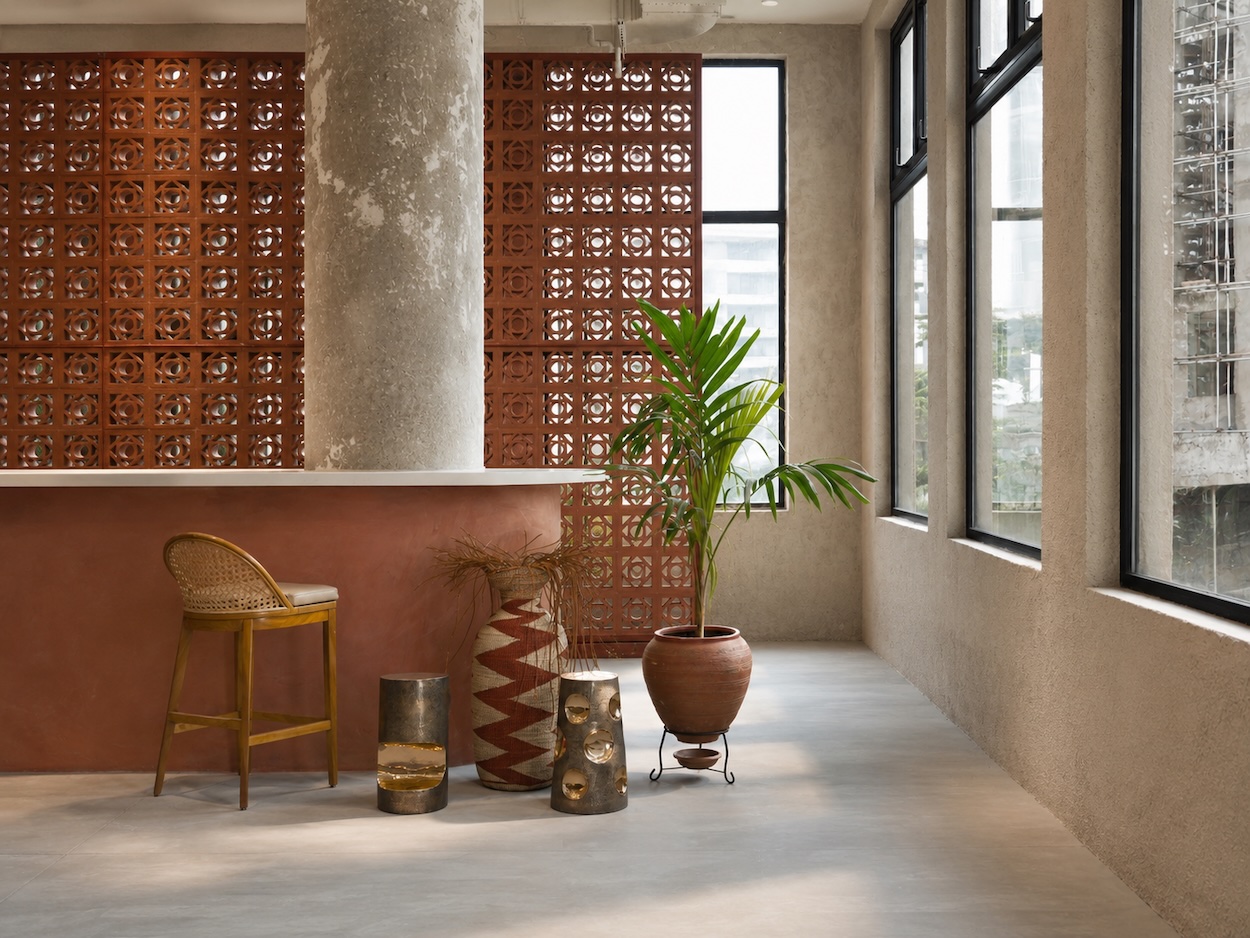
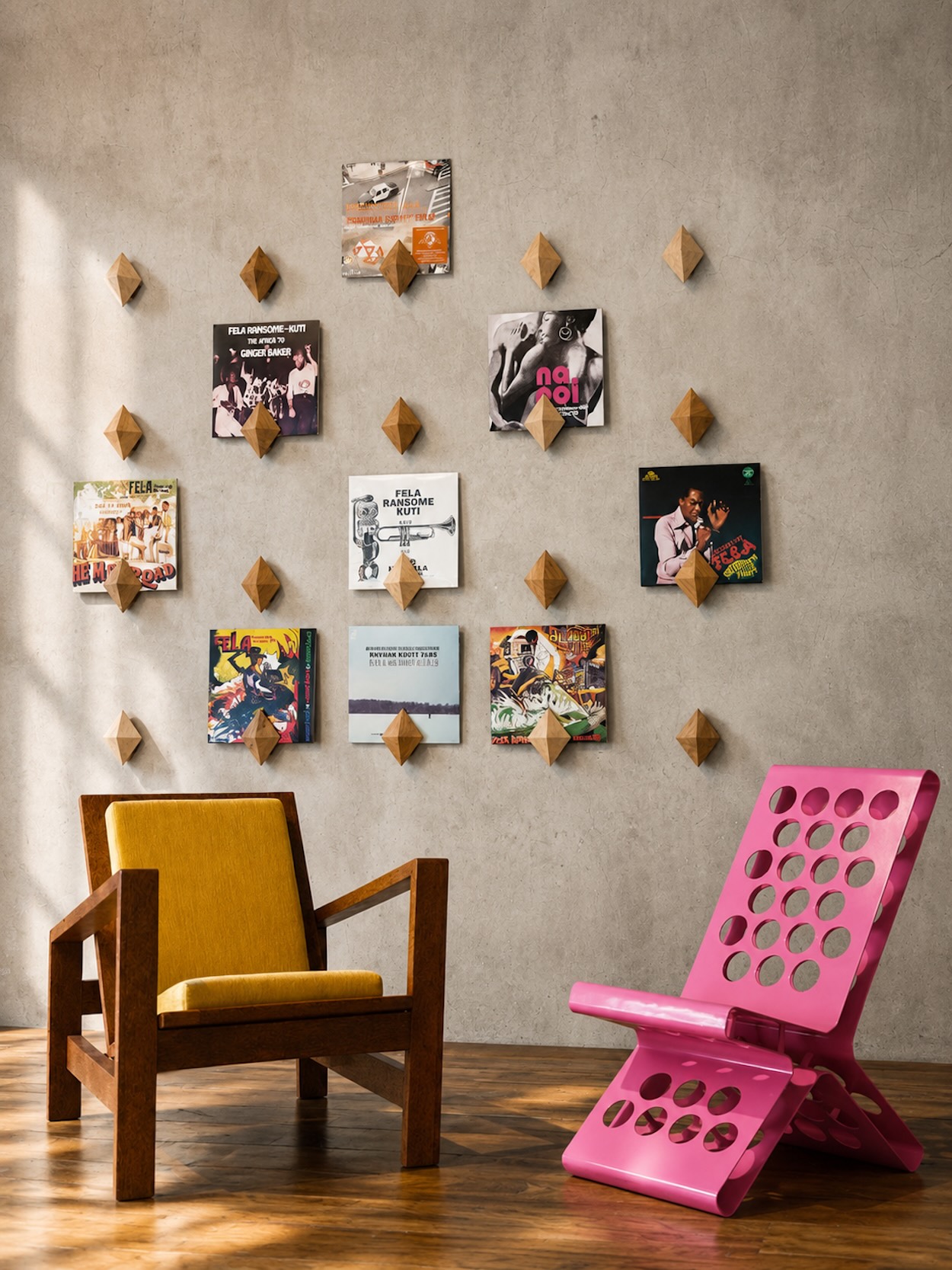
This fall, Casa Mouda—a creative studio dedicated to producing and platforming contemporary African design—will open in Lagos, Nigeria. Founded by art and design entrepreneur Caline Chagoury Moudaber, the studio acts as an evolution of the influential Art Twenty One gallery space, which she established in 2013. Casa Mouda debuts with a collectible design exhibition and experiential activation titled “The Design Institute,” which unfolds across two renovated spaces: aiMe Gallery at Eko Hotel, redesigned in consultation with architect Papa Omotayo of MOE+AA, and aiMe Concept on Eko Atlantic, conceived with Gemma Sfeir and designer Nifemi Marcus-Bello. Together, the venues position Lagos as both the subject of and setting for a dialogue between regional craft traditions, contemporary production, and an increasingly international design community.
For its inaugural, multisensory presentation, Casa Mouda assembles a multigenerational group of designers working across Africa and its diaspora, including Germane Barnes, Hajar Daide, French collective Hall Haus, Nifemi Marcus-Bello, Jean Servais Somian, and Marie-Paule Tano. Objects by African craftspeople and studios broaden the exhibition’s material vocabulary, including handwoven baskets and other pieces from Ghana’s Baba Tree and Malawi-based People of the Sun, while paintings by Midegbeyanevesho Ojisua introduce another layer to the presentation. “Design in West Africa is multifaceted—it ties into so many different areas and ways of engagement,” Chagoury Moudaber tells Surface. “We didn’t want to import a model of viewing art and design that doesn’t reflect how people actually think about it and experience it here. We wanted a full experience of the sights, sounds, smells, and tastes.” To learn more, we spoke with Chagoury Moudaber in advance of the opening.
Photo by Contagious Collective …
Was there a moment that led to the founding of Casa Mouda? How did it emerge from Art Twenty One?
It all started with art. Traveling between Lagos and Paris early in my career, it was jarring that the incredible work I grew up surrounded with and was still seeing at home in Lagos wasn’t represented nearly enough abroad—and in Lagos, we didn’t have the exhibition spaces to show it ourselves. There was so much talent here, so much interest from abroad when people did have the rare opportunity to experience the work, but there just weren’t the spaces in Lagos to exhibit it. That’s what set me on the path to create Art Twenty One: the desire to create an exhibition space for art in this city that was able to present the world-class work being created here, to honor the artists, the public, and the city.
Art Twenty One addressed a need for formal gallery space in the city, at a time when the artistic community was rapidly growing and rising to prominence. Over the past decade, Lagos has become this incredible hub for the arts—there are galleries here now doing great work. By around 2018, I started to feel like the city had enough white-box gallery spaces that I didn’t need to continue in that model. What wasn’t being embraced and celebrated enough in Lagos’ visual culture was the stuff of everyday life that makes this place so special. So I renovated the space to fit a new idea: a design exhibition entirely of work from the continent, Floor One 9, and it opened my eyes—it connected me to designers and started conversation around local production and manufacturing that really energized me to consider how to support this growing and dynamic community of creatives focused on the art of everyday life: design and architecture.
That’s when I realized that my position in Lagos gave me something rare—through the gallery, and through my family’s ties to furniture, construction, and development, I had a unique access to production capacity. That was the bridge: from creating spaces for art, to creating spaces that are art, and showing what’s possible when you produce on the continent—not simply importing international styles and pathways, but building the capacity to retain what makes Lagos’ visual culture so dynamic. That matters especially to me as someone who grew up between Lagos, Paris, L.A., and Beirut—I love what makes Lagos unique, and I want to preserve that: the material, the technique, the aesthetic, the history, and the people.
Photo by Contagious Collective …
How are you tapping into local craftsmanship and local production with Casa Mouda?
In Nigeria, craftsmen are everywhere—that was never the hard part. The real work is finding the ones willing to push, to experiment, to bring what they know and marry it with a contemporary aesthetic. So we’re finding craftsmen and pairing them with designers, and developing that relationship over time—not a one-off commission, but a real collaboration in both directions: one that gives designers access to technique and history, and bridges that into the contemporary landscape.
The designers we work with are a mix. Some are already doing this work in the region—people like Hajar Daide, Nifemi Marcus-Bello, Jean Servais Somian, and Marie-Paule Tano, who’ve done incredible legwork laying the foundation for collaborating with local craftsmen. And we’re also bridging that capacity into a pathway for designers from abroad—people like Germane Barnes—to experiment with working with craftsmen on the continent for the first time. We have factories specializing in wood, in concrete, in metal. At the core of it is respect—respect for the craftsman, for what they already know how to do. When you unite all of that, you’re not just making objects, you’re helping build an ecosystem, one craftsman and one collaboration at a time.
Photo by Contagious Collective …
Can you speak to your relationship with aiMe Gallery at Eko Hotel and aiMe Concept on Eko Atlantic?
aiMe Gallery grew out of Art Twenty One and is in that same physical space, though it’s been completely renovated. It still retains some of that gallery feel, and it’s situated within Eko Hotel—already at the heart of so much of the city’s cultural activity, from major concerts to conferences. aiMe Concept is in a new space, in a new part of Lagos, which gives us a lot more room to experiment. It’s really a flag in the sand for the beginning of a cultural district on Eko Atlantic.
Together, what we’re really doing is infusing the central spaces of the city with culture, art, and beauty. In a small way, we’re building a city—creating hubs where cultural activity actually happens, rather than waiting for it to happen somewhere else.
Photo by Contagious Collective …
Let’s talk about “The Design Institute.” For people who will make it to the exhibition—and for those who won’t—what do you hope they know about the work you’re doing here?
“The Design Institute” has been a major labor of love—an introduction to this whole area of work. Every region of the world has its own traditions of craftsmanship and historic industry, and West Africa has developed these infrastructures, communities, and worlds in a really unique way. The contemporary designers already living and working on the continent have done tremendous, heroic work bridging high and contemporary design with local craftsmanship, aesthetics, and technique—work that goes so under-recognized, given the deep personal investment it takes to make it and to make it turn out beautifully.
We wanted to recognize some of those people—Jean Servais Somian and Nifemi Marcus-Bello among them—who’ve really been on the front lines of building something important. They’re certainly not the only ones, but they’re figures doing exceptional work. This is meant to demonstrate a real foundation for what’s building in West Africa, what can be, and what we want people to see and recognize in this place.
For anyone who can walk through it, I hope they feel the enormity of the work that has been done by some of the early leaders of contemporary design on the continent, and the potential for what can continue to flourish here. When you enter into either space, you have so much to see, but you are also greeted by a custom soundscape by Malloy James, pulling in influences from all the cultures, places, and people that contributed to the space. You are greeted by the scents that have been inspiring to us—coffee brewing at KOFI, our coffee counter across both spaces and the fresh, earthy aroma of iroko wood. Neither aiMe Gallery nor aiMe Concept is built as a space where you view an exhibition and leave—they’re built as spaces we can activate. If you walk in at any point, you’re invited to pause, to get inspired, to enjoy a coffee, to connect, and hopefully to keep coming back for more.
For anyone who can’t be there in person, I hope they understand what this represents: a record of what had been, a demonstration of what’s possible, and a direction for what can happen here. The beginning of a conversation.