I arrived in California already looking at cars a little differently. A few weeks earlier, Cadillac had invited me to Detroit to tour the GM campus and spend time inside its design studio, where I met members of the team behind some of the cars I would eventually see during Monterey Car Week. The visit gave me a glimpse into the thinking and process behind the cars before I encountered them. As an illustrator, I was especially interested in the process of how a drawing becomes a physical object.
At Cadillac House in Pebble Beach, I later spoke with Executive Design Director Dominic Najafi about that process. Dominic described a car as an accumulation of disciplines: product design, architecture, sculpture, graphics, technology, and engineering, all having to resolve into one object. What stayed with me most was his description of the way designers think about reflections—the way a line travels across a body panel and how light moves over a surface. I had always appreciated the shape of a beautiful car, but I hadn’t thought about the reflection itself as something designed.
That detail followed me to Monterey.
I was given a brand-new all electric Escalade for the drive from SFO to Carmel, winding along the California coast with the ocean appearing and disappearing between the curves. As I settled into the drive, Joe Walsh greeted me from the radio. Almost immediately, the highway became its own car show. Old cars appeared in unexpected places, and once I reached Carmel, the streets were lined with vehicles of every size, era, and color. People stood along the highway with cameras waiting for something special to drive past. Meanwhile our group was being chauffeured in a fleet of immaculate Cadillacs. The whole place seemed to reorganize itself around the automobile.
At dinner that first night, I ordered a margarita. The bartender asked if I wanted it “Cadillac style.” Naturally, I said yes.
By the time I arrived at The Quail, A Motorsports Gathering, the line between car show and social spectacle had completely disappeared. People gathered several deep around reveals, margaritas and champagne in hand, while engines revved in the distance and music drifted from the main stage. It was part luxury car show, part fashion show, part country club, part theater. Otherwise, the Quail is your oyster.
At one point, hungry from making my way around the grounds, I found myself standing in line being served Veuve Clicquot by an impossibly attractive waiter. I filled a cocktail napkin with as many blini and as much caviar as I could reasonably carry, then went back out for another lap. The Eagles’ “Hotel California” played somewhere in the background as people circulated between cars, cocktails, champagne, and unveilings. It was all slightly surreal.
Later, I overheard a man explaining that he wasn’t going to mix whiskey and tequila because the last time he did, he ended up spending a weekend in jail. It was the kind of conversation that somehow made perfect sense within the strange ecosystem of Car Week.
The following day, I went to Cadillac House in Pebble Beach, a beautiful home transformed into a clubhouse and showroom for the week. This was where some of the ideas I had been introduced to in Detroit started to come together. I spoke with Dominic and Sean O’Shea, Cadillac’s LMDh Propulsion Manager, and watched a design manager sketch cars in real time. I also met the interiors designer and began to understand how much of the car’s personality is created before it ever reaches the road.
Watching the designer sketch brought that idea back to its most basic form: a line on paper, an idea taking shape. By then, I was thinking about how a simple line eventually has to withstand the realities of aerodynamics, safety, manufacturing, and performance. Meeting the interiors designer added another layer: even the experience inside the car—from materials to the driver’s environment—was being considered as part of the larger design language.
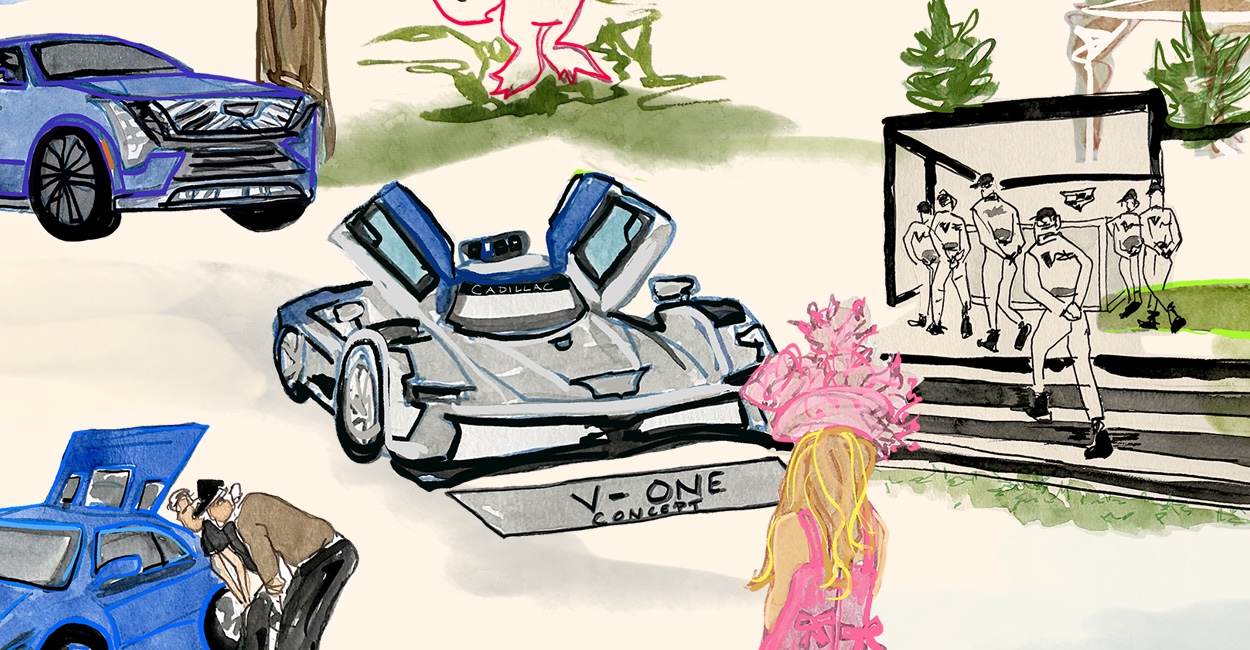
Sean described the V-ONE Concept as something that began almost casually—a conversation at a racetrack that turned into sketches, iterations, engineering, and eventually a physical car. From the engineering side, he wanted to make sure the designers didn’t create a beautiful future vision that couldn’t actually perform on a racetrack. The concept ultimately became a collaboration between imagination and constraint.
Cadillac’s V-ONE Concept was one of the week’s major reveals. Developed by Cadillac Design, Cadillac Racing, and Dallara, the single-seat concept takes its foundation from the V-Series.R race car, pairing race-derived architecture with a bespoke cockpit and an 830-horsepower hybrid V-8. Its hand-sprayed gradient moves from silver into deep navy, a reference to the transition from day to night during an endurance race.
I found myself looking less at the specifications and more at the way its surfaces caught the light.
That idea had become almost impossible for me to ignore.
At Cadillac House, I also got to experience the other side of that design process while test driving the CELESTIQ. The car felt less like a traditional luxury vehicle than a fully realized interior environment: ultra-luxurious materials, carefully considered details, technology integrated almost invisibly into the experience. What fascinated me most was the degree of personalization. CELESTIQ is custom-commissioned and hand-built, with clients working with a personal Cadillac design concierge to develop their own combination of colors, materials and finishes. Cadillac House on the GM campus in Michigan is dedicated to that individualized experience, where clients can explore materials and collaborate with designers on their vehicle.
After spending time looking at cars as objects, I was suddenly experiencing one from the driver’s seat.
Later, back at Carmel Valley Ranch, where I was staying, I sat by the pool with a Cobb salad and a glass of Whispering Angel, looking out over the rolling hills, gnarly oak trees, and vineyards. It was the first sunny day after the marine layer had burned off. Somewhere in the distance, engines were revving. The whole week started to feel slightly dreamlike. You could be sitting completely still while surrounded by some of the fastest cars in the world.
Then came the main event.
The Pebble Beach Concours d’Elegance felt like the moment when everything I had been seeing all week—the design, the engineering, the collecting, the history, the spectacle—converged. Set against the Pebble Beach golf course and Pacific coastline, the Concours brings together some of the world’s most significant automobiles, but what struck me was how much it also felt like a gathering of people who have devoted themselves to looking closely. Cars were being examined for their provenance, their craftsmanship, their originality, their engineering, and, of course, their beauty.
Past, present, and future seemed to occupy the same landscape. Contemporary concept cars appeared alongside some of the most significant automobiles in history, making the event feel less like a straightforward look backward than a conversation between eras.
One of the highlights for me was seeing Alfa Romeo’s BAT 5, BAT 7, and BAT 9 together—the three legendary 1950s aerodynamic concept coupes designed by Franco Scaglione for Carrozzeria Bertone. Decades later, they still looked almost impossibly futuristic. Seeing them together made the passage of time feel strangely compressed. The questions of proportion, aerodynamics, experimentation, and beauty were still there, just expressed through a completely different vocabulary. I spent most of the day wandering, looking closely at details and talking with people about the cars. At one point, I was chatting with a man who asked what I did. When I told him I was an artist, he looked around the scene and said “Well you must be doing something right if you’re here.” There was something fitting about being at the Concours as an artist. So much of what I had been noticing all week—lines, colors, materials, craftsmanship, history, obsessive attention to detail.
At The Quail, Route 66’s centennial celebration had added another layer of American automotive history to the week. Elsewhere, a collection of red Ferrari F40s from different eras created its own kind of spectacle. There were cars that looked like sculpture, cars that looked like machines, and cars that seemed to exist somewhere between the two.
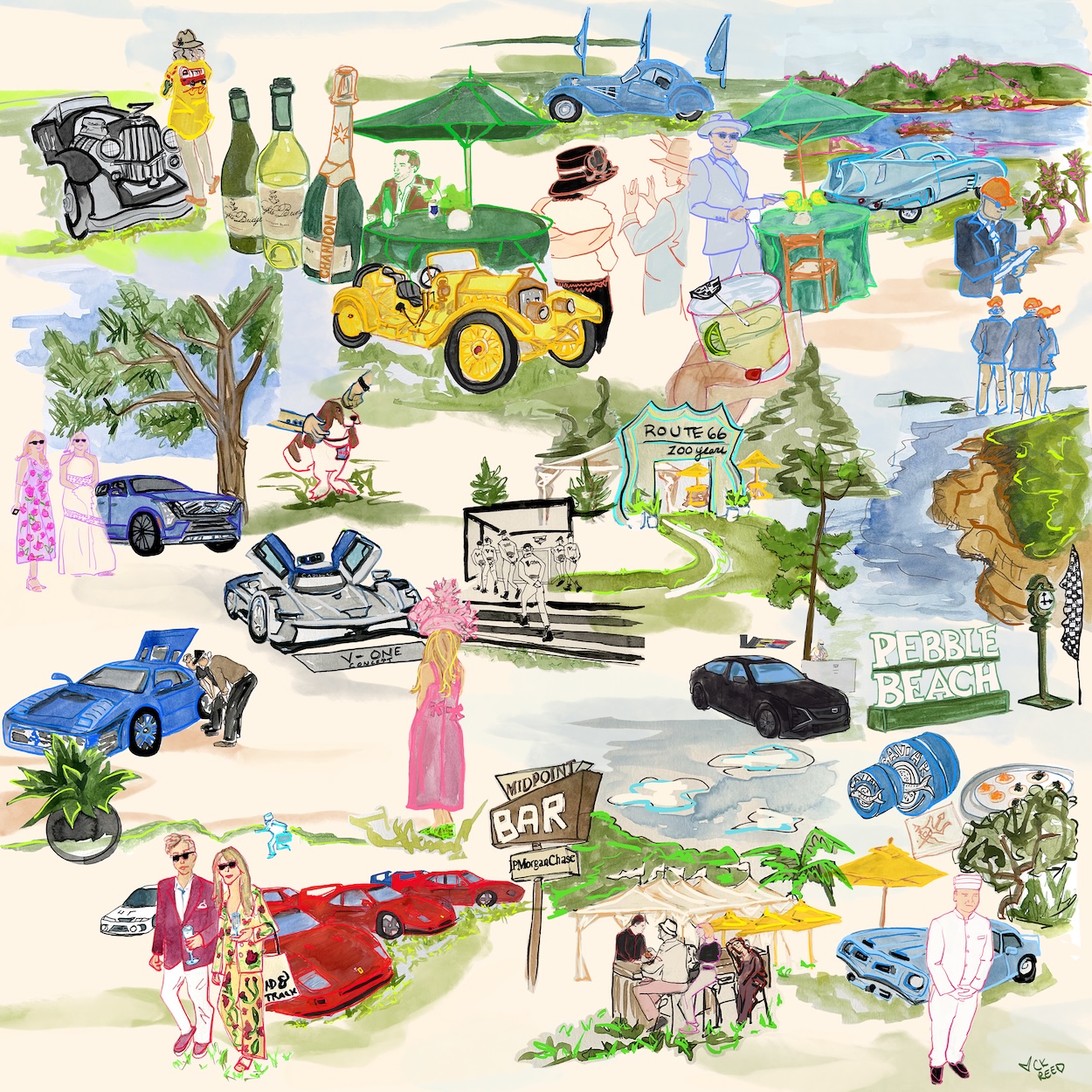
My illustration is a collection of those observations rather than a literal depiction of any one event. The V-ONE sits alongside the history represented by the BAT cars, a collection of red Ferraris, the Route 66 signage, the Midpoint Bar pop-up and fragments of conversations I overheard, Pebble Beach, Cadillac House, a Cadillac margarita, and even Fred the beagle, who I met somewhere along the way. There are people dressed for the occasion, people photographing cars, people drinking champagne, and people simply watching everything unfold.
When I started this experience in Detroit, I was thinking about cars as objects of design. By the time I was drawing Monterey, I was thinking about everything that happens around them. Maybe that is what stayed with me most from Car Week: how many different things a car can be at once. It can be sculpture, engineering, history, fashion, status, nostalgia, competition, and self-expression. For one week in Monterey, all of those things exist together—moving down the highway, parked on the grass, gathered around a bar, being photographed from the side of the road, or catching the last light across a perfectly sculpted surface.