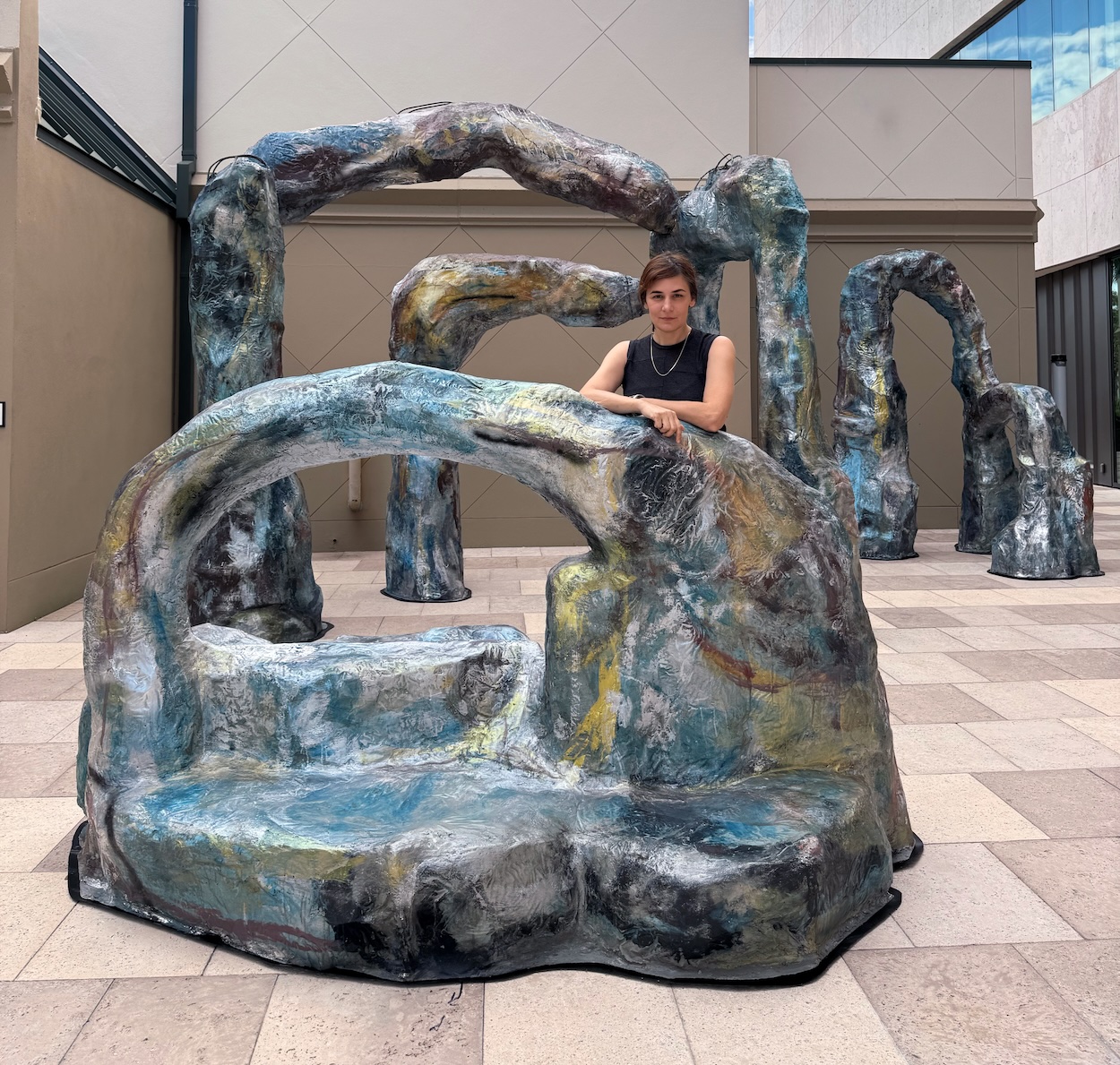
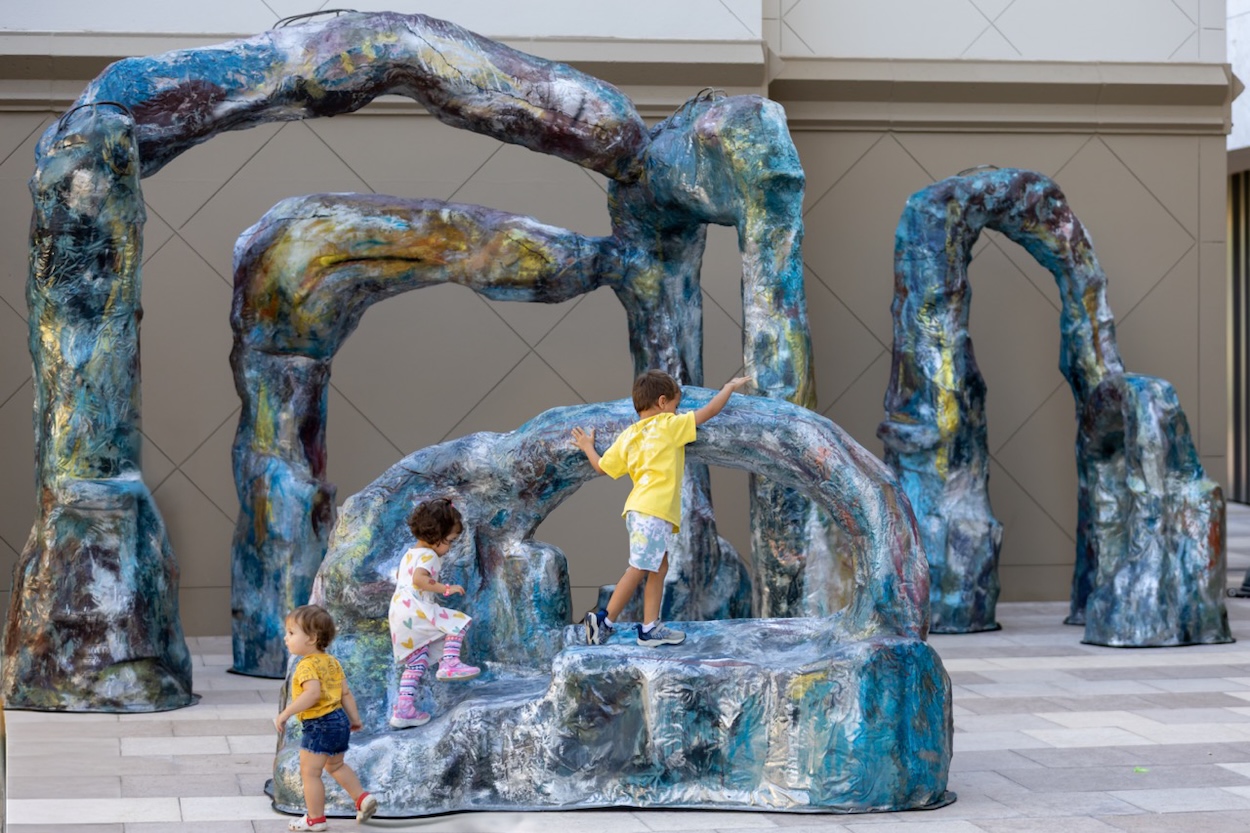
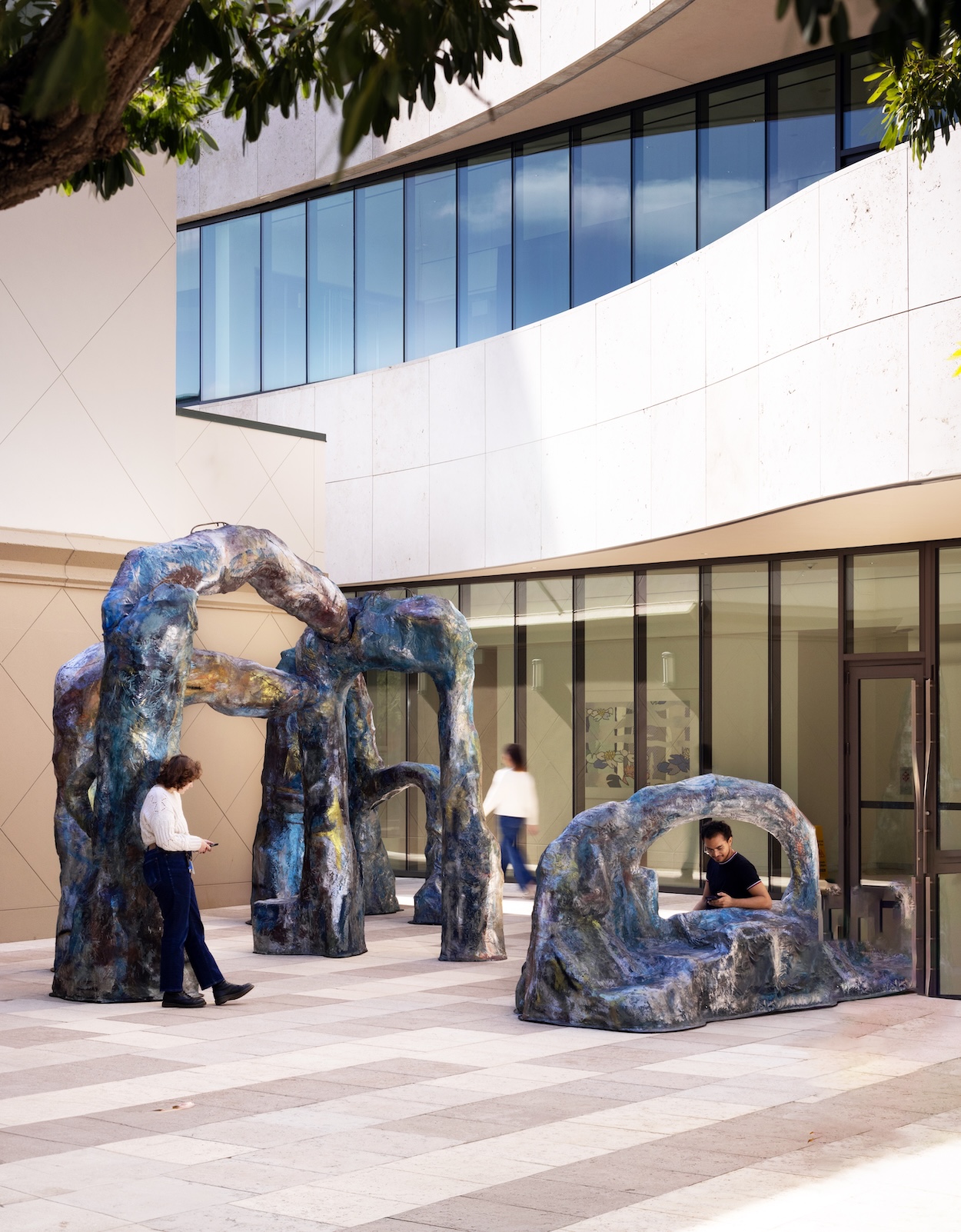
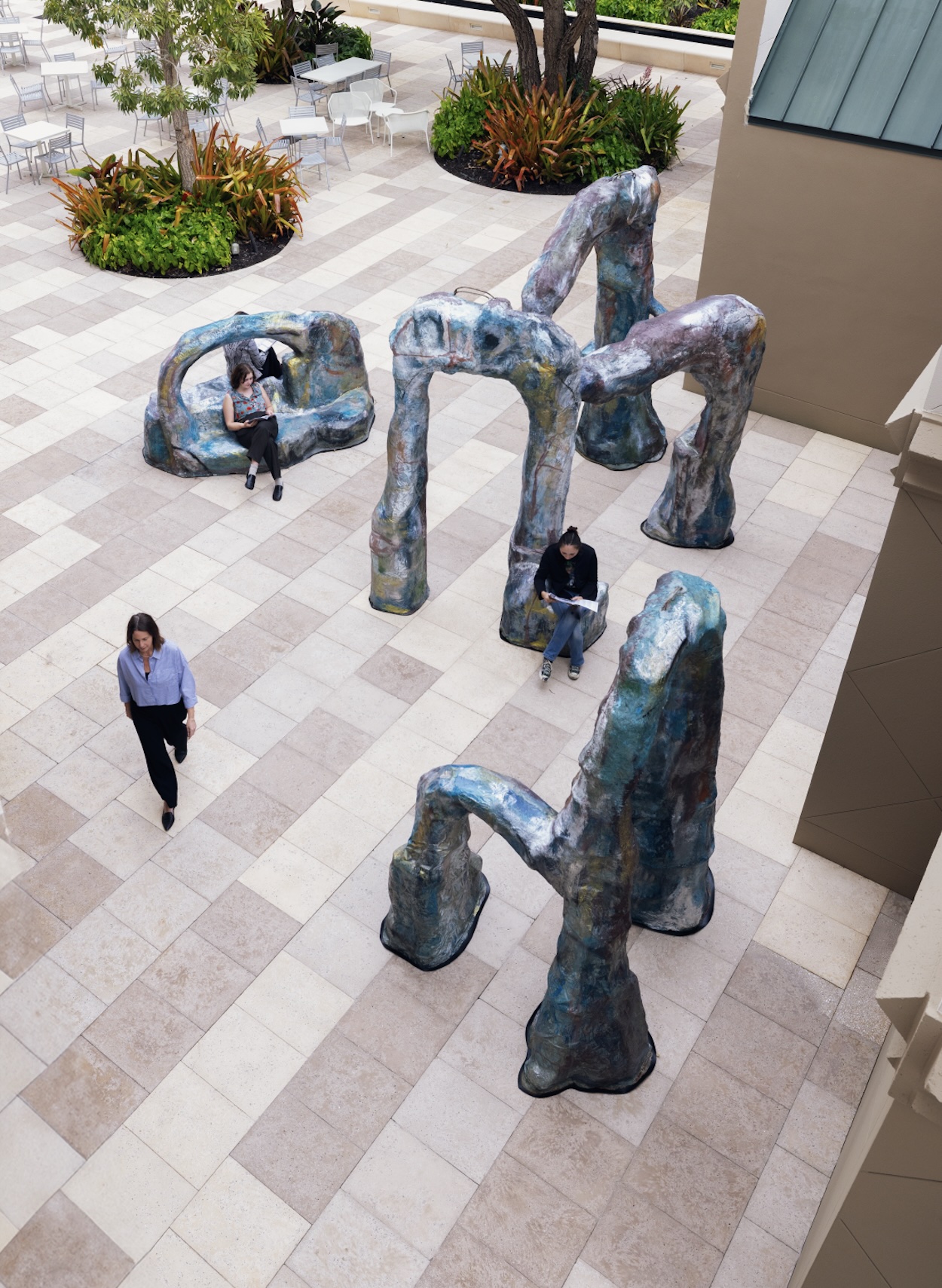
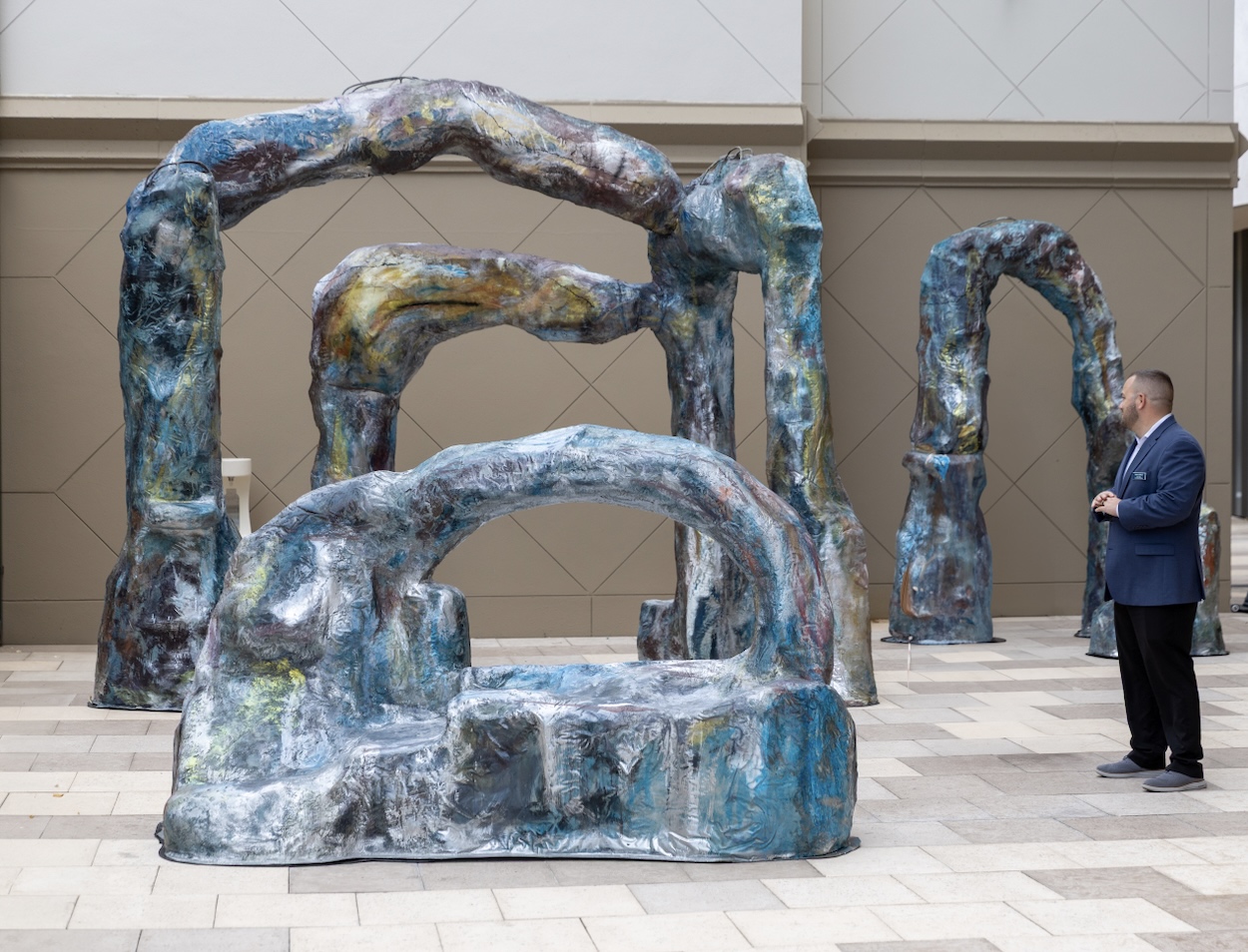
Installation view of Florida Contemporary 2025-26. Courtesy Artis—Naples, The Baker Museum. Photo: RoseBudz Production.…
Positioned within The Baker Museum’s Norris Garden, Miami–based fine artist Jillian Mayer’s largest sculpture yet, Pergola Spolia, provokes engagement and complements human posture through rough-hewn architectural interpretations. With an oil-slick-like iridescence, the piece, commissioned by the Naples, Florida institution and part of the exhibition “Florida Contemporary 2025-26,” is the latest in Mayer’s Slumpies series of functional sculptures. From its enveloping scale to its enticing sheen, the four-part work not only stands as a pinnacle thus far in Mayer’s repertoire, but acts as a haptic invitation to engage with, sit upon, or slump into its concrete, rebar, and metal-mesh form.
Pergola Spolia was introduced to The Baker in October 2025. Though the landmark work will depart this July, Mayer’s year is set to feature a September solo exhibition at Miami’s David Castillo Gallery, where she’s exhibited since 2011, and inclusion in a group show dedicated to glass at The Future Perfect’s New York City location also this fall. To learn more, we spoke with Mayer as “Florida Contemporary 2025-26” draws to a close.
Installation view of Florida Contemporary 2025-26. Courtesy Artis—Naples, The Baker Museum. Photo: RoseBudz Production.…
This is your largest piece yet. Can you walk us through the way you imagine, design, and fabricate?
I tend to go about most things backwards, perhaps because I have learned most things in this manner. When you make a large-scale, outdoor work out of concrete and other robust industrial materials, it’s expected that multiple drawings of the plans are configured before you start, but with Pergola Spolia, I let the way the materials landed guide the shape of the sculpture, creating a dialogue of chance. It’s familiar for me to work in this way because of my many lives as a breakdancer, aerialist, filmmaker, and now sculptor––all of which use chance as a generative tool of creation. I wanted to keep a bit of the Flintstone-esque style I’ve developed in my body of work visible in Pergola Spolia, regardless of the shift in materials.
Conceptually, Pergola Spolia extends my long-term exploration of posture, built form, and planned obsolescence found in my Slumpies. It’s scaled up into a modular architectural system that never settles into a single, finished state. I thought about a world full of surplus with issues of excess and turned to reclaimed materials. Pergola Spolia’s interior is foam plucked from a movie prop fabrication site and much of the rebar which gives the sculpture structure, was gathered from abandoned build sites.
For inspiration, I looked to the root systems of mangrove trees, the rejection of renders and straight lines, and two architectural ghosts: Louise Nevelson’s Dawn’s Forest (which is on site at The Baker) and Florida’s iconic Cape Romano Dome House, a futuristic concrete dwelling that slowly surrendered to the Gulf before finally disappearing.
…
Can you touch upon its color and materiality?
Have you ever seen oil floating in a puddle of water, in a hole on the street? I know it’s bad for our environment, but at least there is a beautiful moment present in the way humans mess up earth. Ok, I would not like to see oil dumped on the street, but if I have to, I can’t help being mesmerized by it. I love the way the oil and water fight each other and create iridescent hints of rejection.
The color world was achieved by mixing pigments and stains directly into the concrete.
The last few years of sculptures are majorly influenced by metals and patinas because I’ve started casting in bronze and aluminum.
How has the Slumpies series developed over the years?
This piece is an evolution of the SLUMPIES series, interactive sculptures which offer slouching, body-responsive sculptures designed for the “post-internet body”, often providing wifi or charge portals for users to feel at home.
All of the Slumpies are actually prototypes. They are simply suggestions. I make small models of them as well, bronze, aluminum, ceramic, and sometimes 3D prints. This helps me visualize and explain to assistants when necessary. For scale, I tend to say things like “this one is iguana size, or lizard size.”
With this work, I have leveled up and explored more permanent materials. When I say permanent, I don’t mean forever-ever. I mean, likely till when I am old enough for the institution to have to call in someone younger to repair it, which I guess means twenty to forty years from now.
Do you still approach it the same way?
Yes and no. Later this year, one of my larger Slumpies will be on view at MASS MoCA. That one is the first large scale aluminum one. For that one, I created a ceramic model that was about the size of a large watermelon and then it was scanned and created at a foundry. It was weird not to touch it as it was built. It feels like a friend I know from another part of my life rather than a baby I had (assuming that feeling—can’t really speak to that exactly).
How did the commission process with The Baker Museum come together?
The curators reached out after a studio visit during Art Basel, inviting me to create a new work for their “Florida Contemporary” exhibition. During the site visit, I became fascinated by Louise Nevelson’s Dawn’s Forest because it had been salvaged from a demolished building (rescued through a last-minute phone call, basically) and I loved that precariousness.
Even though Pergola Spolia is massive and heavy, I built it with the assumption that it might move because permanence is never guaranteed. Whoever shows up next with a bigger plan or budget rewrites the landscape. Florida is literally sinking. So why build as though anything will last forever? Instead, I wanted to design with transience in mind, embracing the idea that nothing, including the land beneath us, is promised.
Installation view of Florida Contemporary 2025-26. Courtesy Artis—Naples, The Baker Museum. Photo: RoseBudz Production.…
You founded an art studio space and mini-gallery in Miami, CITY-STATE. Can you tell us a little bit more about this—what motivated it, why now in your career?
CITY-STATE came from noticing a lack of artist-run enclaves in Miami, spaces that genuinely foster creative community rather than just output. After doing residencies at places like Bemis, Headlands, and Art Omi, and speaking at schools like CalArts, RISD, and Ringling, I realized how much young artists flourish in proximity, conversation, and support.
At CITY-STATE, we widen the circle beyond fine art. There’s an architect, a historian, a landscape designer, it’s a cross-pollinated ecosystem.
How does it reflect what’s occurring in the Miami art scene right now?
Miami feels both electric and unstable, like we’re bracing for a storm that’s both metaphorical and literal. Organizations are trying to scale up and plan for a future as our politicians continually try to degrade funding allocated for arts and culture. The scene remains scrappy and inventive, though. There’s beauty in the tension; it’s survival as creative rebellion. Miami will never be NY or LA, but rather a secret third thing.
Installation view of Florida Contemporary 2025-26. Courtesy Artis—Naples, The Baker Museum. Photo: RoseBudz Production.…
You’re no longer an emerging artist. You’ve emerged. People care deeply about your work. Is there something you wish people knew about your practice that hasn’t been written about yet? Or something about you?
I started out making a ton of video work and built a community around that time, mostly online. Eventually, I needed to make tangible things again. I needed to hold stuff, not look at files on a hard drive.
I was exhausted from digital projects where most of my time was spent answering questions on set just to keep things moving so everyone else could do their job. I worked in a very indie micro budget space and ultimately, as you scale up, it just becomes so expensive and you need to worry about so many things all at once. I wanted space to think, to touch, to stumble.
What other things have you been working on?
I’ve been developing MAYER OBJECTS, a design-forward branch of my practice that focuses on furniture, lighting, and small sculptural vessels. I’m also working on a project for Serpentine LA that focuses on plant and vessel design.
A couple of years ago, I made a bracelet designed specifically for sitting in a chair. I liked that because it inverted the idea of utility and permanence. The person is interchangeable, but the object might outlast us all. That sense of longevity, of art persisting beyond the human, is something I keep returning to.